A high-end drape shows in how it hangs: folds that fall straight, fabric with real weight, a heading that holds its shape year after year. I sew custom drapes in Sherbrooke for lakeside chalets and for homes in town alike, and the choices that matter are made before the first cut.
What makes a drape high-end
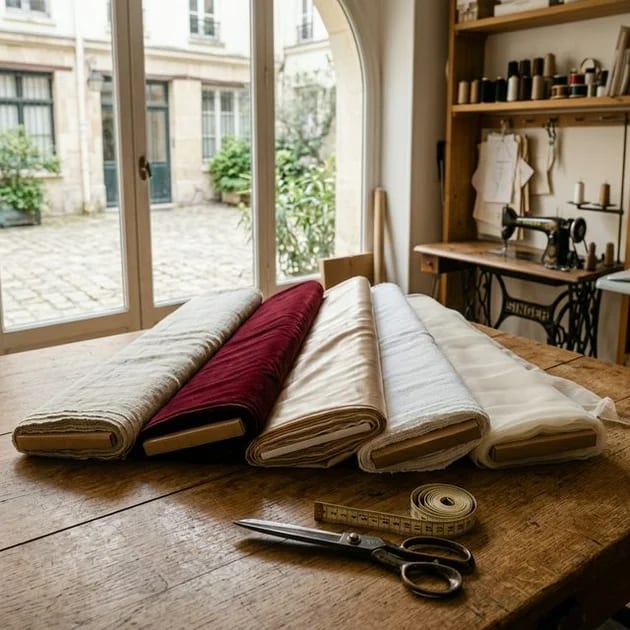
Fabric weight. On a spec sheet, I look first at weight per square metre, in g/m². It tells me how the drape will hang before the fibre name does. Between 250 and 350 g/m², a mid-weight linen or an upholstery velvet breaks into crisp folds. From 400 to 500 g/m² and up, a heavy velvet falls with a gravity nothing lighter can fake.
Lining. It is sewn behind the face fabric, on the glass side. It takes the UV in place of the fabric you chose, adds the weight a light fabric lacks and, depending on the type, softens the light or blocks it. Face fabric and lining never shrink at the same rate, so I mount them with some slack instead of flat against each other.
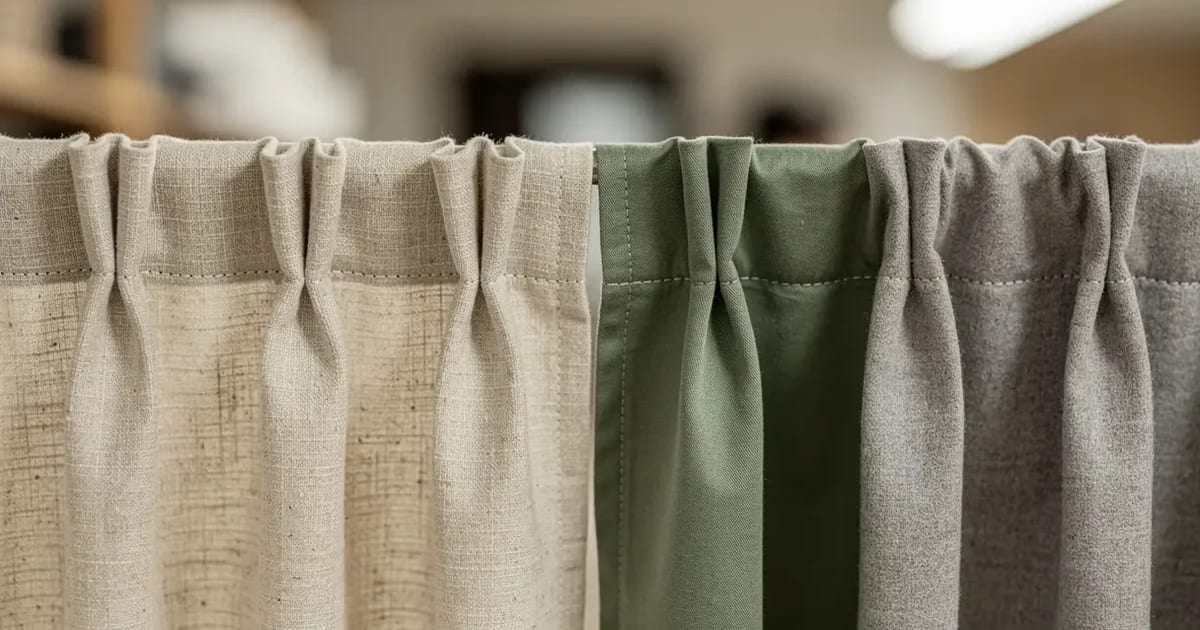
Heading stiffening. The stiffening sewn inside the heading, not across the whole panel, gives structured pleats such as pinch and goblet their body. It helps them keep their shape after years of opening and closing.
Handwork. Every panel is cut, sewn and finished by hand in my atelier, never in a production run. A well-made drape also keeps spare fabric in the hem, often 15 to 20 centimetres, so it can be lengthened later.
Fabric prepared before the cut. Unwashed cotton can lose 5 to 10 percent of its size the first time it meets hot water, so I pre-wash it before cutting. Linen is washed before construction to settle its size, and I allow for its seasonal movement when I set the cut length.
The fabrics that carry the work
Heavy linen. It is the fabric I recommend most often to anyone who wants something natural. It filters light in a way few fibres can and it ages well. It wrinkles a little, which is what gives it a lived-in look. It makes good flat and pinch pleats. For a wave heading, I lean toward a linen-cotton blend instead.
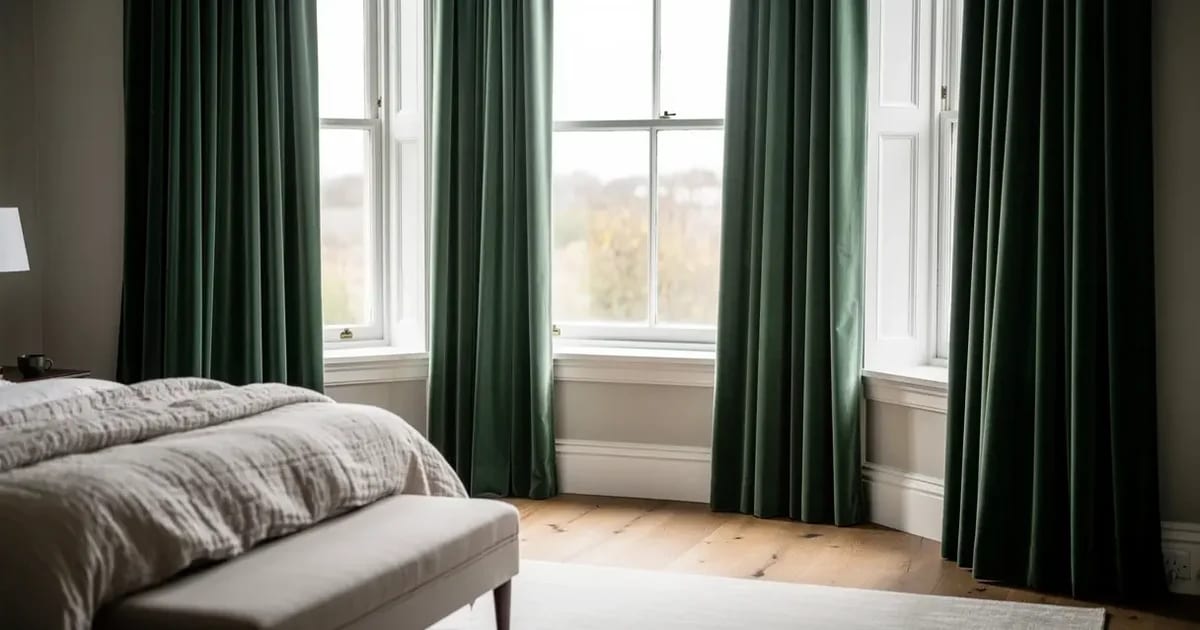
Velvet. Its thickness and density form a barrier against the cold that creeps through the glass, which matters in our winters. A good upholstery velvet runs between 250 and 500 g/m². It is brushed in the direction of the pile and dry cleaned. What wears first is the pile at points of repeated contact, where a tieback pinches the fabric every day. I write about its mood in my January velvet post.
Sheer. It is almost always the first layer. I often make it twice the width of the window for the cloud effect: flat against the light it is almost ordinary, but gathered it becomes a play of shadow and transparency. Many of my clients in the Eastern Townships layer a sheer for the day and a heavy curtain for the evening.
The full rundown of each fabric family, including what I steer people away from and why, is in my custom curtain fabric guide.
Pleats for tall windows and high ceilings
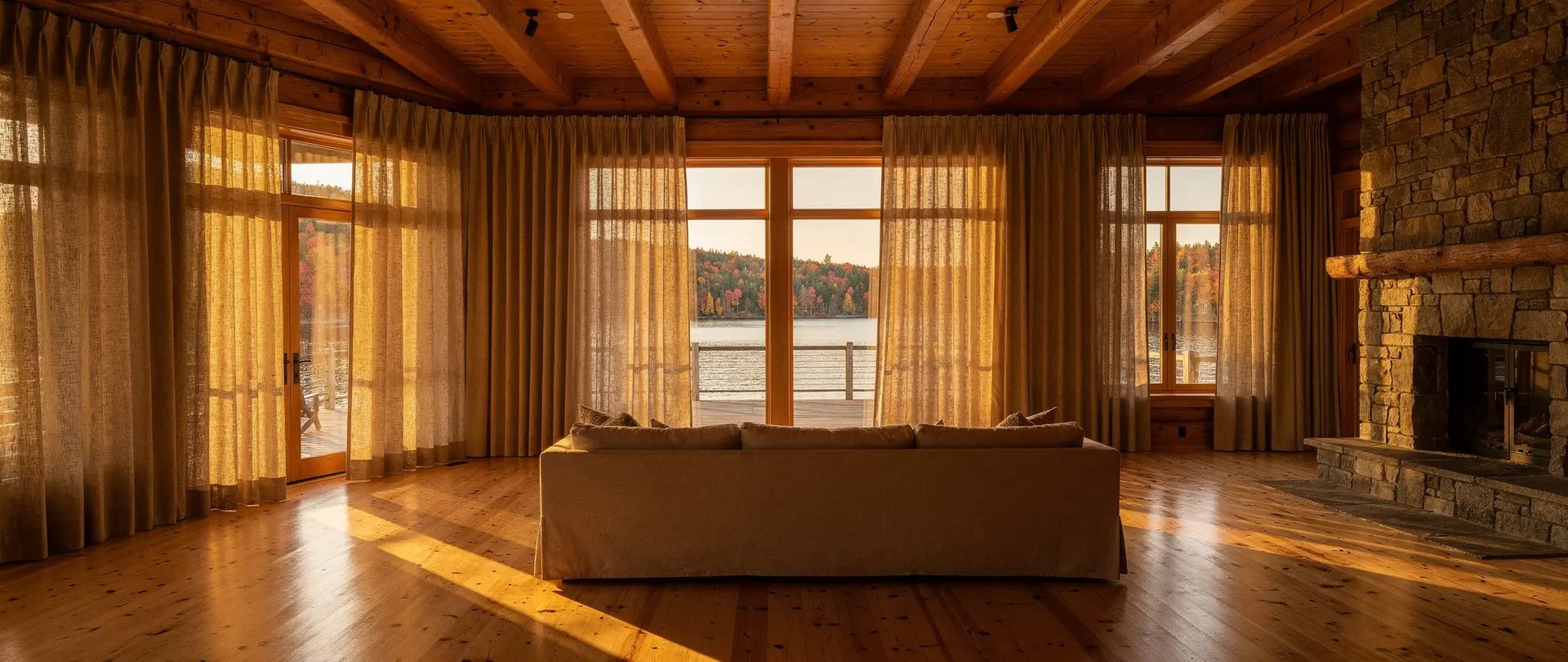
On a large window, the rod goes as high as it can, ideally 5 to 10 centimetres from the ceiling, and the drape falls to the floor. The room looks taller and the window bigger. The pleat then sets the look.
Pinch pleat drapes (pli flamand in French) like height: the clusters need room to open out. They take 2 to 2.5 times the window width in fabric.
Goblet pleat is the most dramatic and the hungriest, at 2.5 to 3 times the width. Its cylinders are reinforced inside to stay hollow, and under an eight-foot ceiling they look cramped. It is a pleat for show, and I advise against it in a room where the drapes are opened and closed every day. I tell you so before I sew.
Wave gains the most from height: a wave that unrolls over two and a half metres reads very differently from one squeezed under a low ceiling. It needs a specific track and a fabric that holds the undulation without sagging. My guide to rods, tracks and wave rails explains what the track has to allow.
I compare the six pleats I sew most often in my curtain pleat types guide, and the pleat types page lines them up side by side. For what is current, see the wave pleat in 2026 and the window treatment trends for 2026.
A bay window or an arched window needs its own templates, taken directly on the window, and a custom curved track. Each has its own guide: the bay and the arch.
How long should linen curtains be?
Ceiling to floor, on a large window. What remains is how the drape ends at the floor. Linen is hygroscopic: it takes up moisture from the air and gives it back, so on a 2.6 metre panel the difference between January and July can reach one to two centimetres. Three finishes account for that movement:
- Kissing the floor: the drape touches the floor in the humid season, with a slight gap in winter.
- The break: two to three centimetres of fabric rest on the floor, and the seasonal movement disappears into the fold.
- Floating: one centimetre above the floor all year, cut for the dry season.
I ask about it at the consultation, because it is a question of look and the cut depends on it.
A project of several rooms
My specialty is chalets and large homes in the Eastern Townships: high ceilings, wide picture windows, natural fabrics, and a curtain built to hold the heat as well as the view. Every panel is sewn for one particular window, in a room I have seen with my own eyes. One curtain to redo or a whole house to dress, the work starts the same way.
I sew long, wide drapes for big window walls and high ceilings without any trouble. For a large project, a chalet or a full residence, I travel past my usual radius of about 100 km when needed.
This is how I work:
- Home consultation. I take the measurements myself, in front of your windows and in the real light of each room, with fabric samples.
- Fabric and pleat. We look at the fabrics in your light, then I give you a detailed quote within 48 hours of the fabric choice.
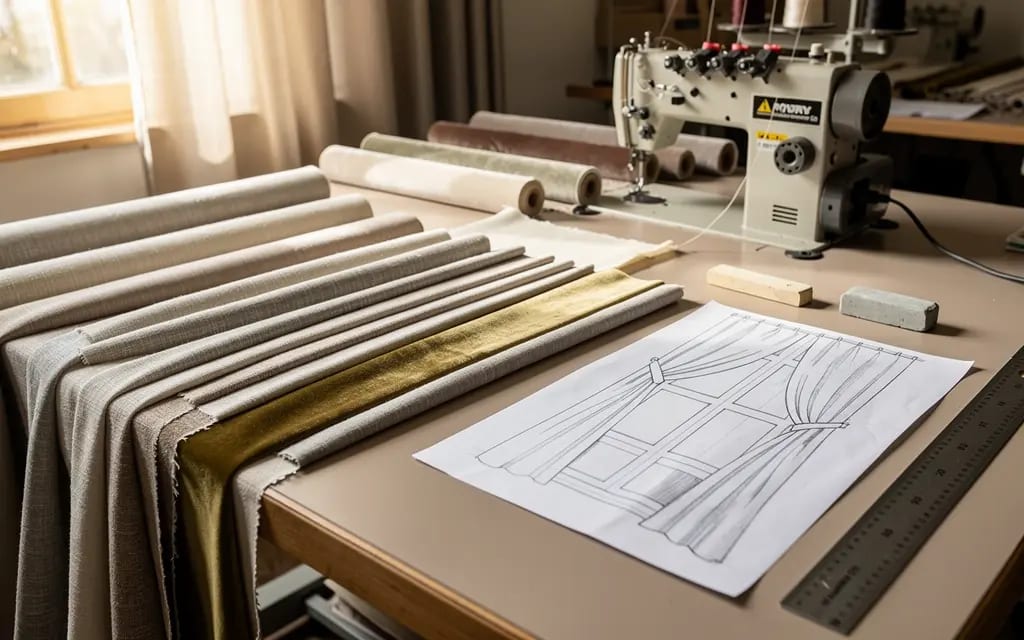
- Hand sketch. You see the result before the first cut.
- Making in my Sherbrooke atelier.
- Installation support. I give you complete directions, my hardware recommendations and detailed instructions.
My guide to recognizing a real workroom covers what a serious quote spells out. The comparison with store-bought curtains lives in this post.
What I don't do
I make the textile. Rods, tracks and suspension systems are yours or your installer's to supply: I tell you what to buy and make sure my drape fits it, but I neither supply nor install that hardware. I don't sell ready-made curtains either.
My machines will not sew industrial machine-room fabric, or stage curtains. Even the heaviest upholstery velvet on the market is nowhere near that limit.
Frequently asked questions
Which pleat suits a high ceiling?
Pinch pleat and wave gain the most from height. Goblet carries the most presence, as long as it is opened rarely. Under an eight-foot ceiling, pinch pleat and goblet look cramped, and flat pleat is the most forgiving.
How much fabric do goblet-pleat drapes need?
From 2.5 to 3 times the window width. Each cylinder needs spare fabric to stay hollow.
Do you supply the rod or track?
No. I make the textile. I tell you what to buy and make sure my drape fits it.
See the work
Finished projects are on my residential page. I have sewn in Sherbrooke since 1997, and you can read how I work on the about page. Answers to common questions are in the FAQ.
Where to start
For a larger project, call me at 873 200-4056. We talk about your windows, your rooms and what you have in mind. You can also book a consultation.