Bay Window Treatments: A Quebec Custom-Curtain Guide
Dressing a bay window right: bent rods, per-facet panels, wave pleats. Five design approaches and five challenges that justify custom work. By Nalia, Sherbrooke.
A client from the Rock Forest area wrote to me in February. Her 1980s home had a classic three-facet bay window in the living room, and for fifteen years her curtains had never closed properly: three off-the-shelf panels that overlapped awkwardly, a straight rod that cut through the volume of the bay rather than following it, and pleats that never lined up across the three sections. She had just repainted the room and wanted, finally, a window treatment made for her window. This is the kind of project only custom work can solve, and it's one of the most rewarding projects I do in Quebec.

A note on the term
Quebec clients naturally say "baie window" even in French, which is why I use that phrasing on my French pages and why the term shows up bilingually across the market. In English, "bay window" refers specifically to the three-or-five-facet projecting window that creates an alcove in the room, distinct from a flat picture window.
The bay window is one of the hardest windows to dress well. Angles, variable dimensions, return walls, stack-back of open curtains, the bench seat that often occupies the base: each element demands decisions that off-the-shelf panels simply can't anticipate. Custom work isn't a luxury here; it's close to a requirement.
Five approaches to dressing a bay window
There are five main ways to treat a bay window, and the right choice depends on style, desired function, and budget. I work with all five, depending on the project.
A continuous bent rod follows the shape of the bay from end to end. A single curtain travels the rod and hugs all three facets. This is the most elegant, most formal solution, but it requires a custom-made rod and a single curtain large enough to cover the entire bay. Ideal for traditional living rooms and homes where you want a curtain that fully closes at night.
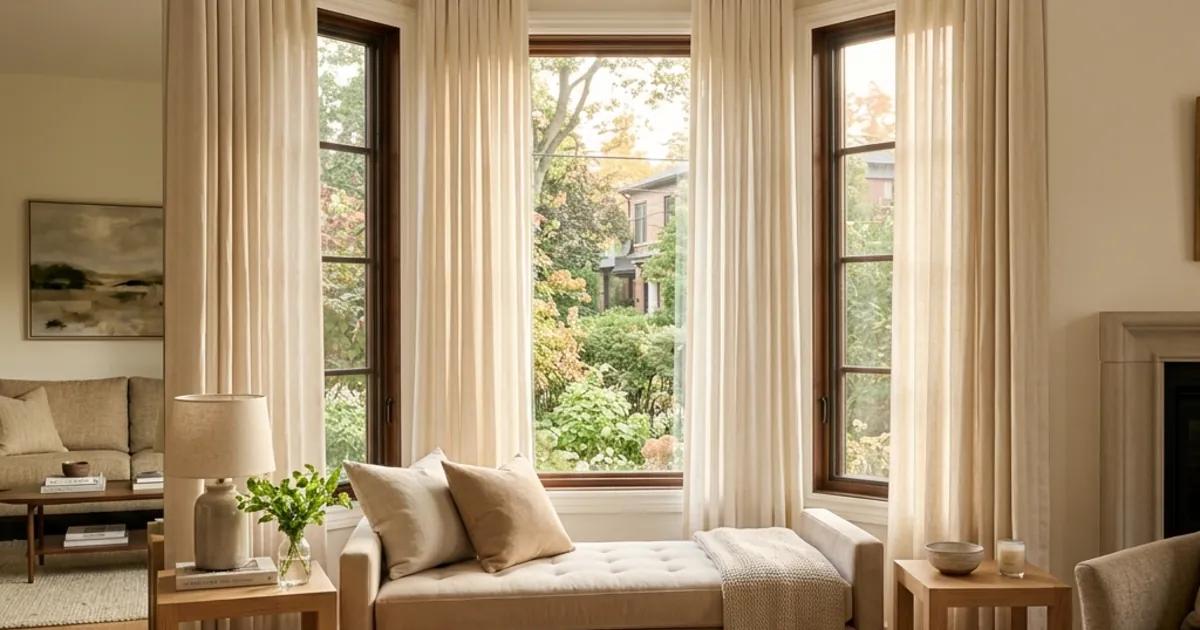
Three separate panels, one per facet, offer maximum flexibility. Each panel opens and closes independently, which means you can leave the central facet open while the two sides are drawn, for example. This is the most practical solution for everyday use and probably the most requested in contemporary renovations.
Cellular or honeycomb shades per window are the most minimalist and most thermally efficient option. One shade per window, custom-sized, and the bay keeps its architecture without a curtain covering the structure. An excellent choice in modern homes or for clients prioritizing insulation.
A layered treatment with a sheer and a lined outer curtain combines daytime filtration with full evening closure. A fine inner rod carries a continuous sheer, and a second outer rod carries heavier panels drawn for the night. This is the most refined approach and the one that gives the most range throughout the day.
Roman shades per facet, finally, offer a more tailored finish. Each shade folds neatly at the top of the window when raised, the stack stays discreet, and the fabric becomes an architectural element. Very appropriate for transitional interiors and for bay windows where a bench seat limits the lateral space for curtains.
Five challenges that justify custom work
Quebec residential bay windows almost always present the same technical challenges, and those challenges are precisely what justify artisan work over big-box panels.
The angles between facets are never perfectly symmetrical. A bay nominally at 45 degrees may have one facet at 43 and another at 47, simply because the original construction wasn't built dead-plumb. Each facet has to be measured individually, not inferred from the others.
Bent rods require custom fabrication. Standard straight rods can't follow the bay. A rod has to be ordered with specific angles, calculated from actual measurements, and the lead time is three to four weeks — something off-the-shelf panels can't accommodate.
Out-of-square framing is the rule in Quebec construction before 2000. A window with a one-centimetre difference between the top and the bottom, or that tilts slightly inward, needs a fabrication adjustment that can't be made from a prefabricated curtain. I always measure four heights per window for this reason.
Stack-back in the open position is the most commonly underestimated challenge. When curtains are fully drawn, they need to gather into a space that doesn't block light or the view. A poorly calculated rod leaves the stacked curtain covering 30 centimetres of the window when open. The "width plus stack-back" calculation is one of the reasons I always ask for extra side allowance when planning the rod.
Radiators, bench seats, and sill projections change what's possible. A bay with a built-in wood bench can't take curtains that reach the floor. A radiator under the window limits the length. These constraints must be documented during measurement and built into the fabrication plan.
2026 trends for bay windows
2026 marks a real shift in how bay windows are being dressed, and I see it concretely in the orders arriving at the workshop.
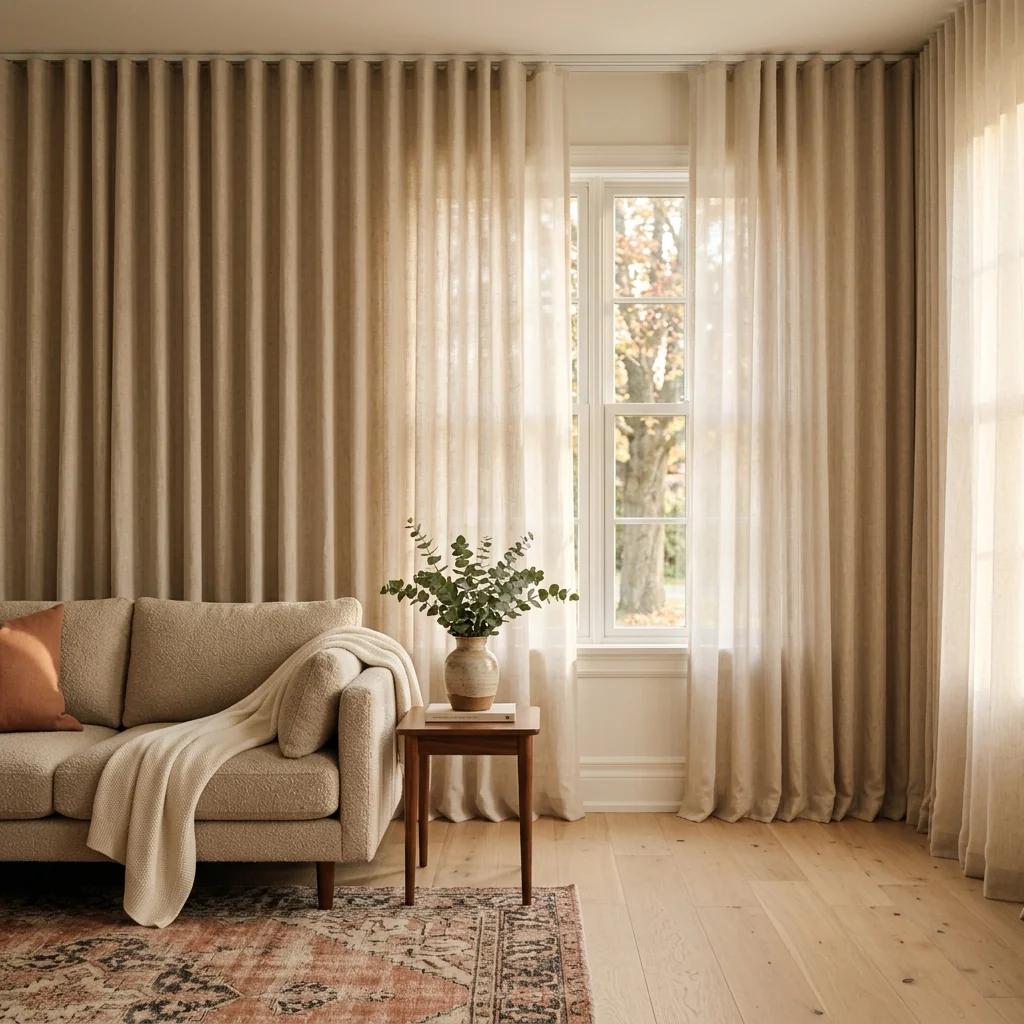
Wave pleats on a continuous bent rod dominate the high-end requests. The regular ripple of the curtain, running along a bent rod that follows the bay, produces a very contemporary and very sophisticated result. The stack is compact, the drape is fluid, and the look ages well because it doesn't depend on a passing trend.
A minimalist single panel per facet, without marked pleats, is taking over in more modern homes. A single wide curtain per window, framing the view without dramatizing it, lets the bay's architecture speak. Often in natural linen, in very neutral tones.
Mixed combinations — Roman or cellular shade inside, drapery outside — answer the need for flexibility. The shade handles daytime light; the drapery frames and softens visually. This is a very practical approach that is returning to favour after being less popular from 2015 to 2020.
Real wood blinds paired with linen drapery remain a signature of renovated classic living rooms. This combination is returning in the heritage homes of the Vieux-Sherbrooke area and in transitional-style renovations. The natural wood brings warmth; the linen drapery softens.
The bay window is probably the window where I see the most big-box errors corrected by custom work. A client once told me she had lived for fifteen years with a badly dressed bay because she thought it was impossible otherwise. It's never impossible. It's just a little longer, a little more precise, and it requires on-site measurement.
Five common mistakes
After years of measuring residential bay windows, I keep seeing the same installation mistakes made before I arrive.
Insufficient stack-back is the first. Curtains, when drawn, block part of the window because there isn't enough lateral space to gather them. The solution is a rod that extends past the bay on each side, not a rod aligned flush with the walls.
Curtains that are too short, floating 10 or 20 centimetres above the floor, shrink the bay visually and make the room feel lower. The right length, in 90% of cases, reaches the floor or stops one centimetre above it.
A rod hung too low, just above the window frame, visually compresses the space. A rod mounted halfway between the top of the frame and the ceiling — or just under the ceiling — creates a sense of height that changes the perception of the room entirely.
Mismatched fabrics between the three facets are a fabrication error. When panels come from different fabric lots, tones can vary subtly. A workshop fabricating for a single bay uses one bolt of fabric for all three facets.
Approximate dimensions on an out-of-square bay produce curtains that open badly or don't fully cover the window. This is the most expensive error because it can only be corrected by remaking the curtain.
Serving the Eastern Townships from Sherbrooke
My workshop is on the Plateau St-Joseph in Sherbrooke, and bay window projects take me into residential homes throughout Sherbrooke, Magog, Coaticook, Lac-Mégantic, and across the Eastern Townships. I travel for every measurement. Bay windows can't be measured from photos or remotely, and a measurement error on this kind of window can't be easily recovered.
The process I offer for a bay window follows my standard residential approach: an initial conversation about the style you're looking for, an on-site measurement visit with fabric samples shown in the light of your own room, a detailed quote, full fabrication at the workshop, and installation. For the bent rod, I work with Quebec manufacturers who produce custom hardware according to the actual angles of the bay.
If your bay window has been bothering you for years because your curtains have never really done the job, request a quote and we'll start with a conversation about what you want to see when you walk into the room.