Arch Window Treatments: The Sunburst Pleat and Alternatives
Arched and half-moon windows: six artisan ways to dress a curve, from the sunburst pleat to cellular shades. Oval windows too. By Nalia, Sherbrooke.
A couple from Lennoxville called me in March about the half-moon transom above their front door. For ten years they had lived with that arched window left bare, and the morning sun was literally blinding the adjacent dining room. They had checked three big-box retailers; none offered a solution for a window of that shape. That's what led them to my workshop. Arched, half-moon, and oval windows are one of the rare window-treatment niches where custom work isn't a luxury: it's almost the only option that actually works.

Six ways to dress an arch window
An arch window is simply defined: a window whose upper section is curved, whether a full half-circle above a rectangular lower window (the true half-moon), a flat eyebrow arch, or a complete circular oval. Each form can be dressed, and there are six main approaches.
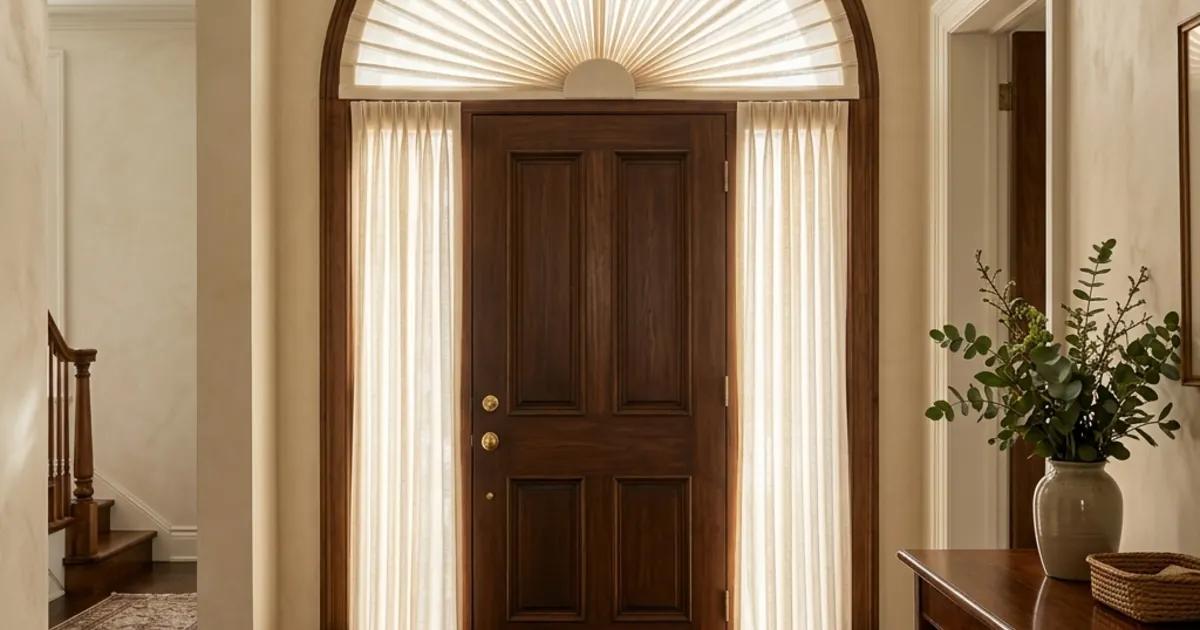
The sunburst pleat, also called a fan pleat or sunburst curtain, is the classic, most strictly artisan technique. The fabric is hand-pleated from a single point at the top of the window, and the pleats radiate in a fan shape down to the base. The curtain is fixed, purely decorative, and the base follows the straight line of the window sill. This is the most elegant finish for traditional and transitional interiors.
A custom cellular shade cut to the exact shape of the arch is the modern, functional solution. The honeycomb fabric adapts to the curve and can, in certain configurations, even open and close. This is the best option for thermal insulation and for clients looking for a utilitarian solution.
A custom bent track following the curve allows a curtain to run along the actual arc. The hardware is complex and the cost is higher, but the result is striking in large arched windows of cathedral-ceiling living rooms.
Curtains on a straight rod that ignores the arch entirely, covering only the rectangular portion below the curve, is a compromise solution. The arch stays bare, treated as an architectural element, and the curtain handles the lower section. This approach is increasingly popular in modern homes wanting to highlight the architecture.
A Roman shade on the lower section combined with a separate treatment for the arch lets the two functions be handled independently. A classic Roman shade on the rectangular part, and an independent treatment (sunburst pleat, stretched sheer, cellular shade) for the arch itself.
Custom interior shutters cut to the shape offer a very classic, substantial look. This is a millwork solution rather than a textile one, but it remains a valid option for arched windows in heritage homes.
The sunburst pleat technique
The sunburst pleat deserves its own section because it's a pure artisan technique that can't be industrialized or automated. No machine can produce a sunburst pleat on a production line. Each pleat is set by hand, pinned individually, and adjusted in position until the fan is regular.
The technique consists of attaching the fabric to a single central point at the top of the window, then pleating the fabric radiating downward, keeping a regular spacing between each pleat. The fabric opens like a fan, the pleats descend in parallel lines to the sill, and the base is finished with a straight hem or sometimes a scalloped edge.
Fabric choice is critical for this technique. A fabric that's too stiff doesn't pleat well and gives a brittle result. A fabric that's too fluid collapses and loses the fan shape. I generally work with washed linens, lightweight cottons, or silky polyester sheers that hold their structure while accepting the pleat. Sheer fabric is particularly popular for this technique because it lets light through while still filtering it, preserving the sense of openness the arch window brings to the room.
The sunburst pleat is almost always installed as a fixed treatment. It doesn't open or close. It's a permanent architectural decoration that filters light and dresses the window without moving. Clients who want a mobile option should look at the cellular shade or the bent track instead.
Measuring an arch window: the real challenges
Measuring a curved window has nothing to do with measuring a rectangular one. This is where experience matters.
Templating the arch is the first step. I cut a template in heavy paper or thin cardboard, pressed directly against the window, to capture the exact curve. Factory-built arches are never perfect: there's often a subtle asymmetry, one side slightly higher than the other, a radius that changes mid-curve. Without a template, those discrepancies end up in the finished curtain.
The depth of the wall and the embrasure determines the mounting type. A window with a deep embrasure can take an inside-mount treatment, fitted into the recess of the frame. A window with a frame flush to the wall needs an outside mount, extending onto the plaster.
The choice between inside and outside mount changes the dimensions of the treatment. An inside mount demands perfectly calibrated measurements, to the millimetre, so the fabric doesn't rub against the sides. An outside mount tolerates more generous tolerances but requires careful handling of the return to keep the installation clean.
The height of the treatment relative to the floor must be documented, especially when the half-moon is a transom above a door. A treatment mounted too low blocks the door's swing. A treatment mounted too high loses visual integration with the rest of the room.
2026 trend: bare or dressed
Two schools are visible in 2026 for arched windows, and they are almost opposites.
The modern approach favours leaving the arch bare as an architectural element. The window becomes a building detail that highlights the ceiling height, and only the rectangular section below the arch is dressed when necessary. This approach works well in contemporary homes with high ceilings, in minimalist builds, and in projects where the arched window is genuinely the architectural focal point of the room.
The traditional and transitional approach continues to dress the arch, almost always with a sunburst pleat or a custom cellular shade. In those interiors, the arched window is part of a more classical architectural language, and leaving it bare would create a visual rupture. A sunburst pleat in ecru linen or washed cotton gives these rooms a tailored finish you won't find anywhere else.
My observation is that the choice rarely comes down to pure personal taste. It comes down to the architectural language of the house. A cathedral ceiling in a new build with black aluminum windows calls for the modern approach. A 1940s living room with plaster mouldings calls for the sunburst pleat.
The sunburst pleat is the technique clients specifically seek me out for. There aren't many workshops in Quebec that still do it really well. It's slow work, done almost standing against the window to adjust each pleat. I always budget a half-day per window just for the final fitting, after the fabrication is done at the workshop. — Nalia
Cost: understanding the artisan premium
Arched windows cost more to dress than an equivalent rectangular window, and that's a structural reality, not an artificial premium.
The markup comes from three sources. First, the template and custom cutting demand measurement time and workshop preparation that a rectangular window doesn't require. Second, fabricating the sunburst pleat or adapting a cellular shade to the curve takes slower, more precise handwork. Third, the hardware (bent track, custom rod, supports) costs more than standardized equivalents.
As a rule, a treatment for an arched window will cost between 25% and 100% more than a treatment for an equivalent rectangular window. The range is wide because complexity varies enormously depending on the arch type, the treatment chosen, and the window's size.
This is one area where I prefer to be very transparent in the quote. I always break down the estimated workshop time, fabric cost, hardware cost, and installation time, so the client understands exactly where each dollar is going.
Serving the Eastern Townships from Sherbrooke
Arched windows appear throughout the Eastern Townships: in the heritage homes of the Vieux-Sherbrooke area, in 1980-to-2010 builds in Rock Forest and Deauville, in renovated cottages around Magog and Orford, in newer residences in Lennoxville and Ayer's Cliff. I travel for every measurement visit.
Templating cannot be done remotely. It requires being physically in front of the window, with template material in hand, to capture the actual curve. This is a service I offer throughout the Eastern Townships as part of my standard residential process.
If you have a half-moon window, an oval, or an arched window you've never been able to dress properly, whether you're looking for an authentic artisan sunburst pleat or a more modern solution like a custom cellular shade, request a quote and we'll start with a conversation about the exact shape of your window and the effect you want to create.