Bathroom Window Treatments: When Fabric Actually Works
The whole first page of results is written by blind and shutter sellers. Here is the fabric-side answer, including the Quebec winter problem nobody mentions.
Search for bathroom window treatments and you will find the same verdict on every result: do not use fabric. It will grow mould, it will hold moisture, it is hard to clean. One national retailer states it flatly: "we do not recommend curtains or drapes in the bathroom."
Look at who wrote those pages. Every one of them manufactures or sells blinds, shutters, or vinyl roller shades. That is not dishonesty. It is a conclusion drawn from an inventory, and when your inventory has no fabric in it, "no fabric" is a reasonable place to land.
I make fabric, in Sherbrooke, so here is the other half of the answer.
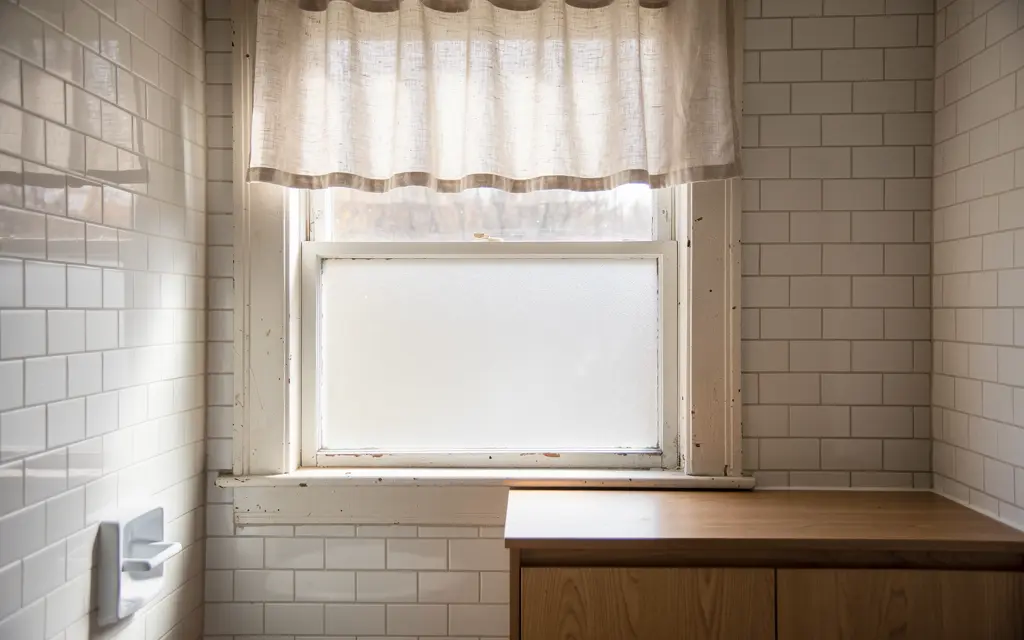
The splash zone is not the room
A bathroom is not uniformly wet. There is a zone of direct water contact, and there is everything else.
Direct contact means a window inside a tub surround, a window in a shower enclosure, or a window close enough to the sink that it catches spray. In that zone, do not hang fabric. Not linen, not treated polyester, not a waterproof panel. Water that sits in a hem does not dry, and a hem that does not dry will smell before it stains.
Everything else in the room is a humidity problem, not a water problem, and humidity is a manageable condition rather than a disqualifying one. Most bathrooms I measure in the Townships have exactly one window, and it is usually above or beside the toilet or the vanity, well outside the splash zone.
The advice you find online collapses those two situations into one. That is why it reads as absolute.
The Quebec problem nobody writes about
Every guide discusses shower steam. Almost none discusses what actually happens to a bathroom window here between December and March.
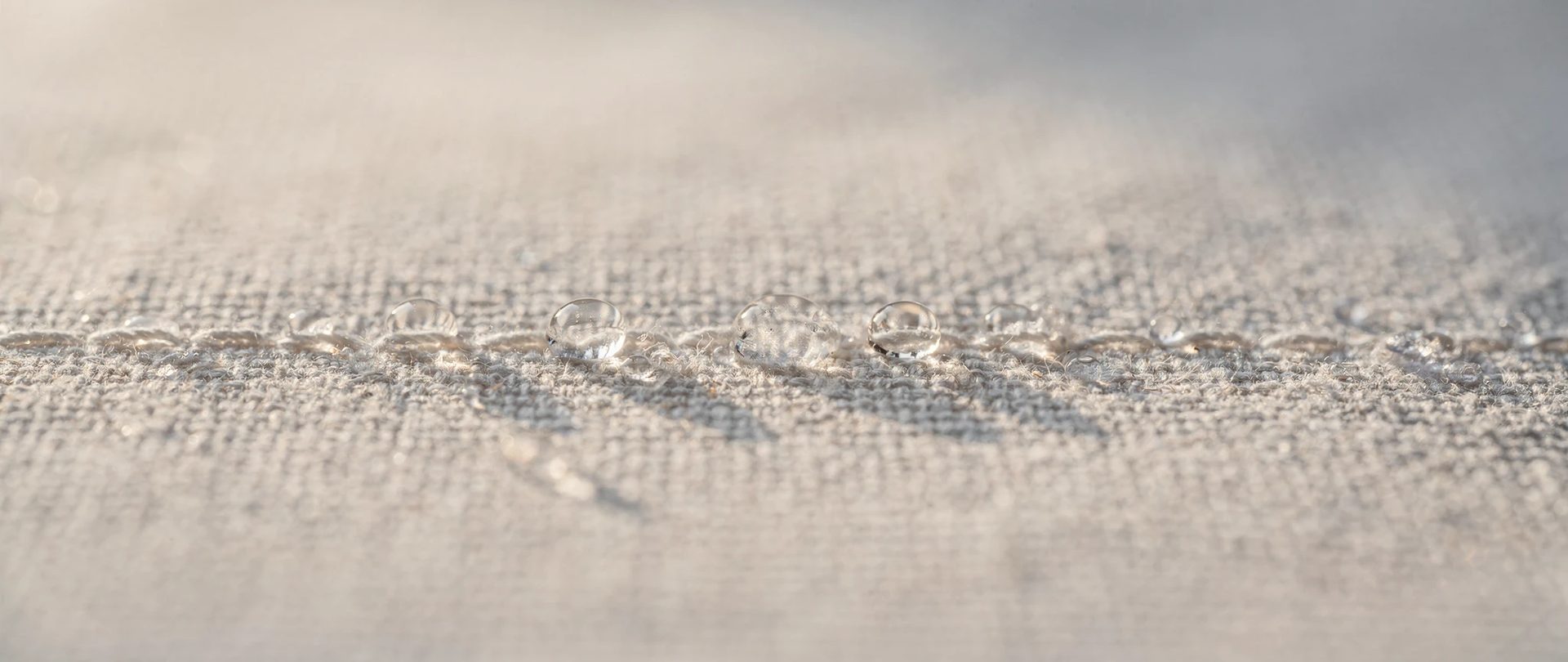
Warm humid indoor air meets a cold pane and condenses. In an older Sherbrooke home with a single window in the bathroom, that window weeps every morning all winter. Water collects on the sill. It is not spray from the shower, it is the glass itself producing liquid water, several months in a row.
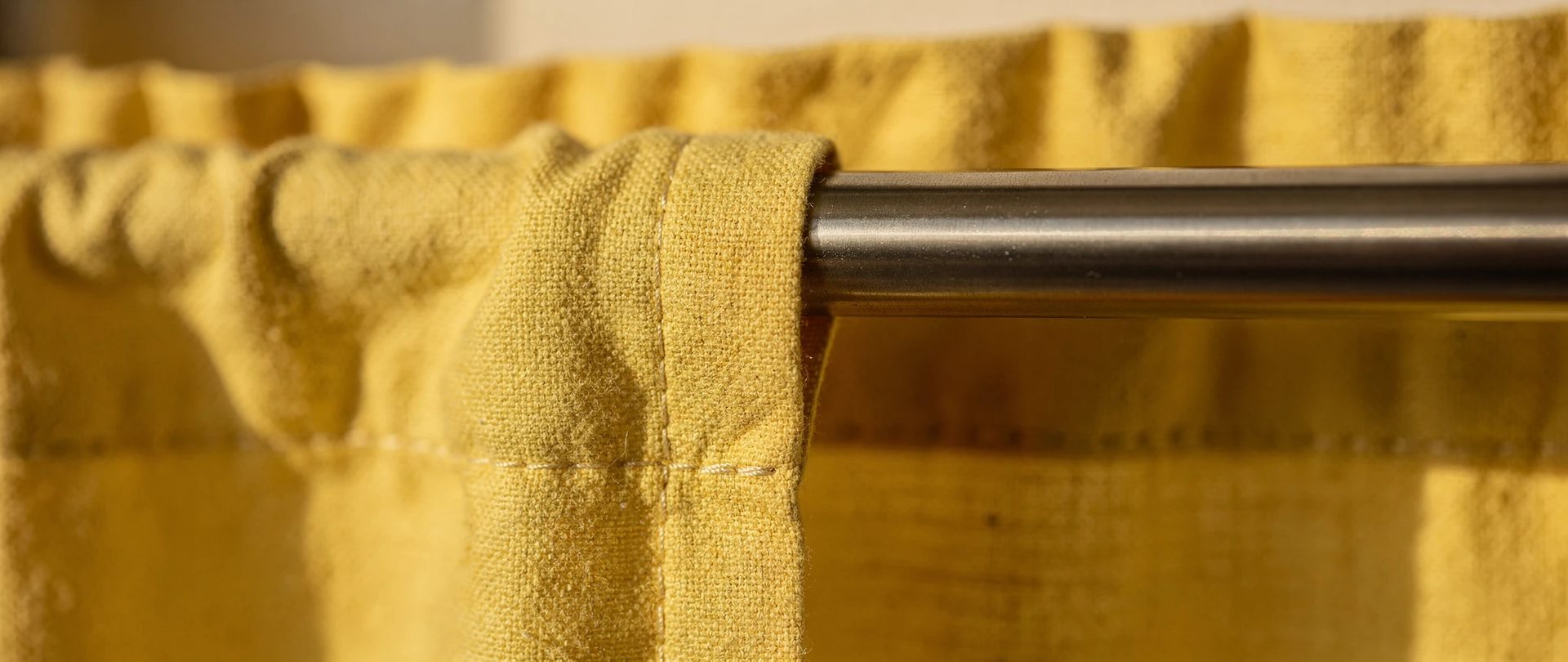
This changes the recommendation in a specific way. Fabric hanging against a weeping pane wicks that water up into the hem and stays damp for months. Fabric mounted clear of the glass, on an outside mount with a few centimetres of air behind it, is not touching the water at all.
So the rule for a Quebec bathroom is not about the fabric. It is about the mount:
- Mount outside the frame, not inside the reveal.
- Leave the panel clear of the glass so air moves behind it.
- Keep the hem above the sill, never resting on it.
- End the curtain at the sill on a short window, not below it.
Get that right and the winter condensation never reaches the textile. Get it wrong and even a vinyl roller will show a waterline.
The first thing I look at in a bathroom is not the window. It is whether there is a working exhaust fan. Without one, nothing I hang will be the reason the room has a problem.
Which fabrics survive, and which do not
Washed linen and cotton are the practical choices. They wash at home, they dry fast because they are unlined, and they tolerate repeated cycles. Unlined is the operative word: in a bathroom I make the panel single-layer on purpose, because a lining traps humidity between two layers and dries far more slowly than either would alone.
Treated polyester and poly blends resist mildew well and hold their shape. They are a good answer for a family bathroom that runs humid all the time.
What I will not put in a bathroom: velvet, silk, anything with a thermal or blackout lining bonded to the face, and anything requiring dry cleaning. A bathroom curtain has to go in a household machine several times a year or it is not the right product.
Privacy without darkness
The real design problem in a bathroom is that you need privacy at all hours, but these rooms are usually small and often have exactly one source of daylight. Solve it with the wrong product and you have a dark room you keep the light on in.
Three approaches that work:
The cafe curtain. Covers the lower half only, mounted at mid-window. Privacy where eye level actually is, daylight through the top. It is the oldest solution and still the best for a window facing a neighbour.
Sheer over frosted glass. If the pane is already frosted or filmed, privacy is handled and the textile is purely for warmth and softness. This is where a light linen sheer does its best work, and it can be short.
A blackout panel on a night-facing window. A bathroom that looks onto a street is fully lit from outside after dark. A blackout panel mounted outside the frame handles that, and in a bathroom it stays unlined and single-layer for the reasons above.
When a hard product genuinely wins
I would rather say this plainly than have you find out afterwards. If your window is inside the tub surround, or in the shower itself, buy a vinyl roller shade or a composite shutter. I do not make those and I am not going to pretend fabric belongs there.
The same goes for a bathroom with no exhaust fan and a window that runs with condensation from November onward. Fix the ventilation first. Anything I hang in that room is going to be blamed for a problem it did not cause.
For every other bathroom window, which is most of them, fabric is a normal option that the search results have quietly written off.
Where to start
Measure nothing yet. Stand in the room and answer three questions: does this window get hit by water, does it fog up all winter, and who can see in.
Those three answers determine the product. I go through them during the consultation, and I bring samples so you can see them in the light the room actually has, which in a bathroom is usually one small window and a fixture.
If you would rather start remotely, call me at 873 200-4056 and tell me where the window sits relative to the tub and the sink. That tells me most of what I need.