Kitchen Curtains: 'Avoid Them' Is Half an Answer
The advice to skip kitchen curtains is written by people who sell blinds. What it misses: the splash zone is about sixty centimetres wide, not the whole room.
Search for kitchen curtains and you will land on the same conclusion, repeated across a dozen sites: do not put fabric in a kitchen. It gets dirty, it holds odours, you have to wash it, you have to iron it, why complicate your life.
The advice is not absurd. It is simply written by people who sell blinds. When your inventory is slats, vinyl and roller shades, "no fabric" is a practical conclusion to reach.
I make fabric. So here is the other half of the answer, the half that is missing.

The real constraint is the splash zone, not the room
A kitchen is not one uniform environment. The window above the sink and the window in the eating corner do not live the same life, even three metres apart in the same room.
The zone genuinely at risk is small: roughly sixty centimetres around the tap and the hob. That is where soapy water flicks and where airborne grease settles. Past that boundary, a kitchen behaves like any other room in the house.
"No curtains in a kitchen" takes the sixty-centimetre constraint and applies it to the entire room. It is like banning rugs from a house because the entry is wet in winter.
The question worth asking is per window, not per room: will fabric hung here actually receive water or grease? If yes, move the textile out of the zone or use a blind. If no, a curtain behaves normally.
Fabrics that wash and go straight back up
The second objection is laundering. It is fair, but only for certain fabrics and certain construction.
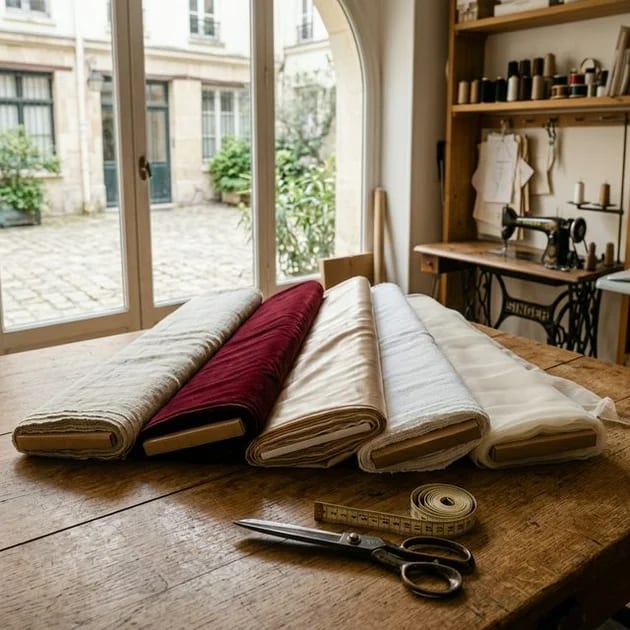
Washed cotton and linen are a kitchen's allies. They go in the machine on warm, they go back up while still slightly damp, and their faintly rumpled look is part of the style rather than a defect to press out. That is why I recommend them first here: they are the only fabrics where "you will have to iron it" simply does not apply.
Polyester-cotton blends also wash and dry faster, but they hold frying odours more stubbornly, because the synthetic fibre retains the greasy compounds.
What I avoid in a kitchen: silk, velvet, anything with a fused lining, and anything that demands professional cleaning. A kitchen curtain you cannot wash yourself three times a year is a kitchen curtain doing nobody any good.
One construction detail matters as much as the cloth. A kitchen curtain is sewn without heavy lining and with a simple hem. Face fabric and lining shrink at different rates, and it is that mismatch, not the washing itself, that twists a panel out of true after three trips through the machine. The same mechanism is worth understanding before you wash any lined curtain.
I make a kitchen curtain so that it goes back in the machine without the client phoning me first. Otherwise she will not wash it, and that is the moment the blind sites become right.
Cafe length gets the fabric out of the risk zone
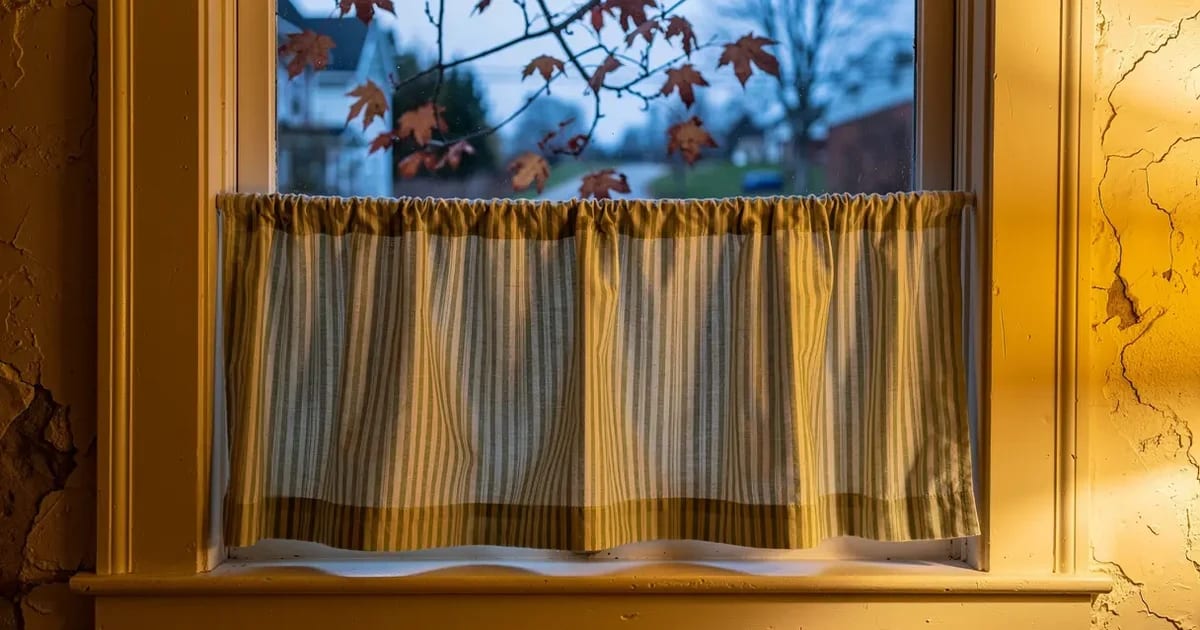
This is the oldest solution above a sink and still the best. A cafe curtain covers only the lower half of the window, mounted at mid-height on a slim rod.
It does two things at once. Useful privacy first: what you want to hide from the neighbour across the street is eye level, not the sky. Then light: the top half stays clear, so the kitchen does not go dim, which is the main complaint against blinds pulled down in the middle of the day.
Most of all, the fabric sits beside the splash zone rather than inside it, provided two rules hold:
- The rod goes at least fifteen centimetres above the counter, so the bottom of the curtain never dips into the working surface.
- The curtain stops at the window sill, never below it.
On a tall window well away from the sink, a short sill-length panel does the same job with more cloth and a more generous fall.
Above the sink, when a blind beats a curtain
I am not going to pretend fabric wins everywhere. If your window sits directly behind the tap, within flicking distance, and you cook every day, an opaque roller or a solar shade is the right call. It wipes down with a damp cloth, it holds nothing, and it rolls fully out of the way when you want the light.
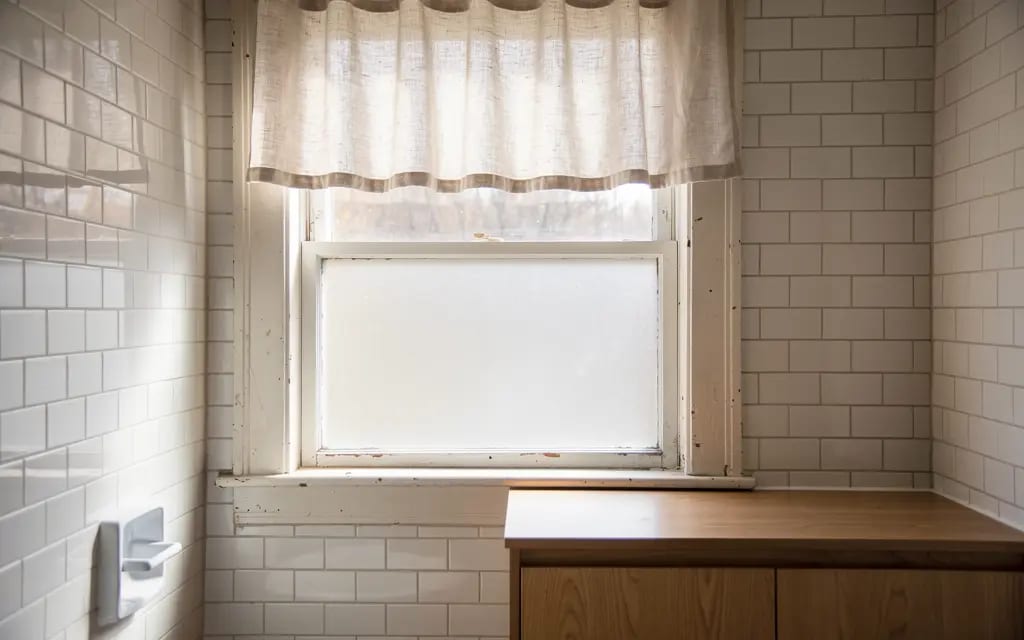
The question is never fabric versus blind in the abstract. It is: which window, and how far from the water. In most Townships kitchens I visit there are two or three windows, and only one is genuinely in the risk zone. The same reasoning governs a bathroom window, where people make the identical mistake in the other direction and rule out fabric for the whole room.
The construction numbers nobody gives you
Here is what separates a kitchen curtain that looks made to measure from a panel bought in the right width.
Fullness. You want two and a half to three times the window width in cloth. Two panels on a ninety-centimetre window means roughly one hundred and fifteen to one hundred and thirty-five centimetres of fabric per panel. Below that the curtain looks skimpy, and it will look skimpy even if the fabric is beautiful.
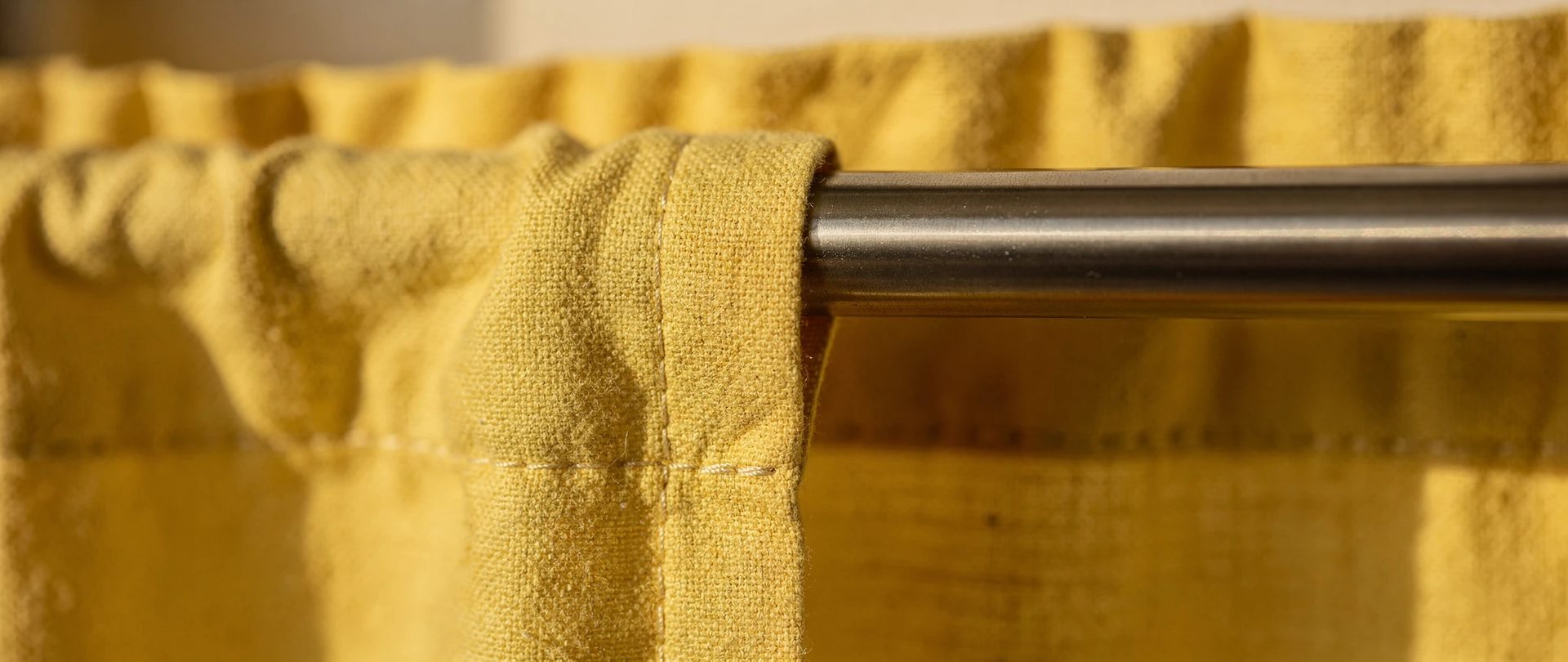
The hem. A double hem of fifteen to twenty centimetres at the bottom. That sounds like a lot on a short curtain. It is that weight which gives the fall and stops the bottom edge flapping every time the window opens.
Weighting. Lead weights sewn into the hem corners on a curtain, lead cord on a sheer. It is invisible, it costs little, and without it a light kitchen curtain never hangs straight.
Clearance. On a window that opens inward or has a crank handle, the rod goes wide enough that the open panels clear the glass completely. Otherwise you will live with a darker kitchen all year for the sake of a curtain you never fully open.
Where to start
If your kitchen has been bothering you for a while, the decision to make first is not the fabric. It is the map of the windows: which one sits in the wet zone, which one does not, and which one faces the neighbour.
I do that reading during the consultation, with samples laid out in the real light of your room, because a kitchen beige facing north and the same beige facing south are not the same colour. The rest, the fullness, the hem, the weighting, is my work. If you want the room-by-room version first, the kitchen window treatment page covers what I make for this room.
You can also call me at 873 200-4056 and describe each window. I will tell you what is realistic before either of us goes anywhere.