Cafe Curtains: The Fix for a Street-Facing Window
A sheer reverses after dark and shows more than it hides. A cafe curtain does not. Why the cropped panel works on a ground-floor window, and how to make it.
There is a particular kind of window I see over and over in older Sherbrooke streets and in every village centre in the Townships. Ground floor, tall, and about three metres from a sidewalk people actually walk on.
The usual solution is a sheer, and the usual complaint arrives about four months later: it works beautifully all day and fails completely at night.
That complaint is correct, and the physics behind it explains why the fix is not a better sheer.
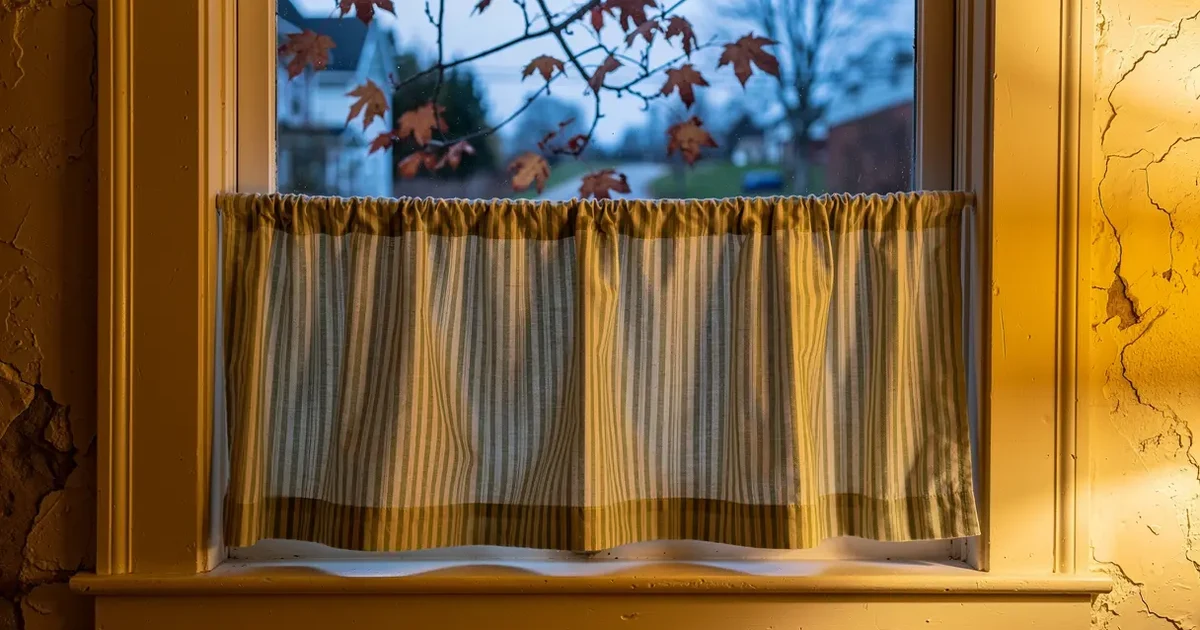
What a sheer does after dark
A sheer works by being brighter on one side than the other.
During the day the outside is far brighter than your living room, so light scatters off the fabric back toward the street and someone walking past sees a pale surface. You, in the darker room, see straight through. That is the whole trick, and it is a good one.
At sunset the brightness flips. Now the lamp beside your chair is the brightest thing in the equation, and the scattering runs the other way. The person on the sidewalk sees a lit interior through a faint haze, and you, looking out, see almost nothing but your own reflection. The sheer has not stopped working. It is working exactly as designed, in the direction you did not want.
No weave fixes this. A denser sheer buys you a little, at the cost of the daylight you bought a sheer to keep.
A sheer trades privacy for light and rebalances that trade every time the sun goes down. A cafe curtain does not trade at all. It just puts the opaque part where the sightline is.
Opaque where the sightline is, clear where the light is
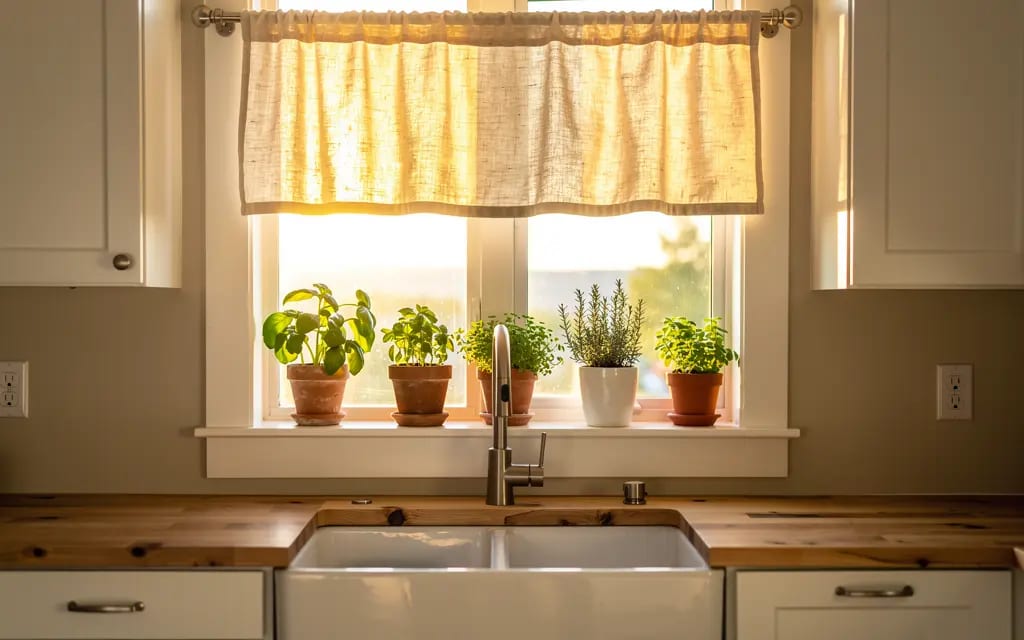
A cafe curtain covers roughly the lower half of the window and leaves the top open.
That sounds like a compromise and it is not, because the two halves of a ground-floor window do completely different jobs. The bottom half is where a person standing on the sidewalk can see into the room, because it faces them at eye level. The top half is where nearly all your usable daylight comes from, because light entering high in a window travels further into the room and bounces off the ceiling.
So the cropped panel blocks the half that costs you privacy and leaves the half that pays you in light. It does that at noon and it does it at ten at night, without depending on which side is brighter.
This is why the treatment came from cafes in the first place. A cafe wants passers-by to see a warm glow and not to study the person eating alone by the window. Same problem, same answer.
Where the rod sits, and what that does to the room
The mounting height is the whole design decision, and it is worth thinking about before fabric.
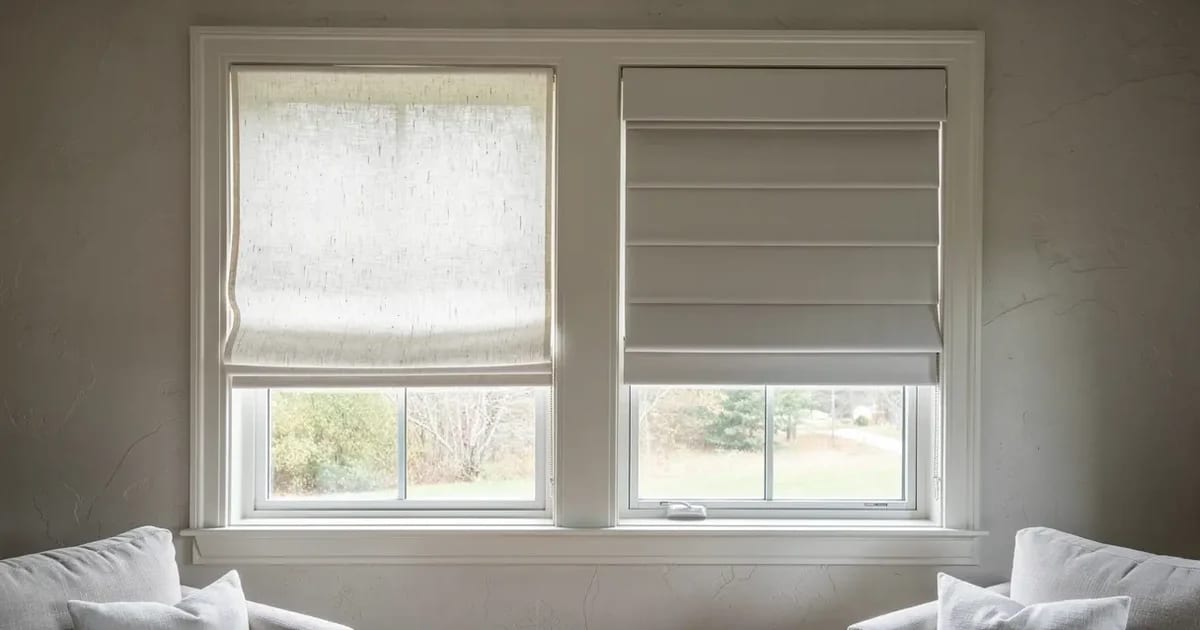
On the meeting rail of a double-hung sash is the traditional position and usually the right one. The line of the curtain lands on a line the window already has, so it reads as intentional architecture rather than a curtain that stopped early.
Slightly above the meeting rail buys more coverage for a window very close to the sidewalk, or for a room where people sit low. It costs a little of the visual logic, so it wants a plainer fabric to compensate.
Below the meeting rail almost never works. The curtain looks short rather than cropped, and it is the single most common reason a cafe curtain reads as makeshift.
I do not supply or install rods, so this is a conversation to have with whoever is mounting it. What I need from you is the finished measurement from the rod to where you want the hem, because that number is the pattern.
Hem weight on a cropped panel
Here is the construction detail that decides whether the thing looks made or looks improvised.
A cropped curtain is short and light, and short light panels flap. Every time the window is opened, every time someone walks past quickly, the bottom lifts. It also never hangs quite straight, because there is not enough fabric weight above the hem to pull it down.
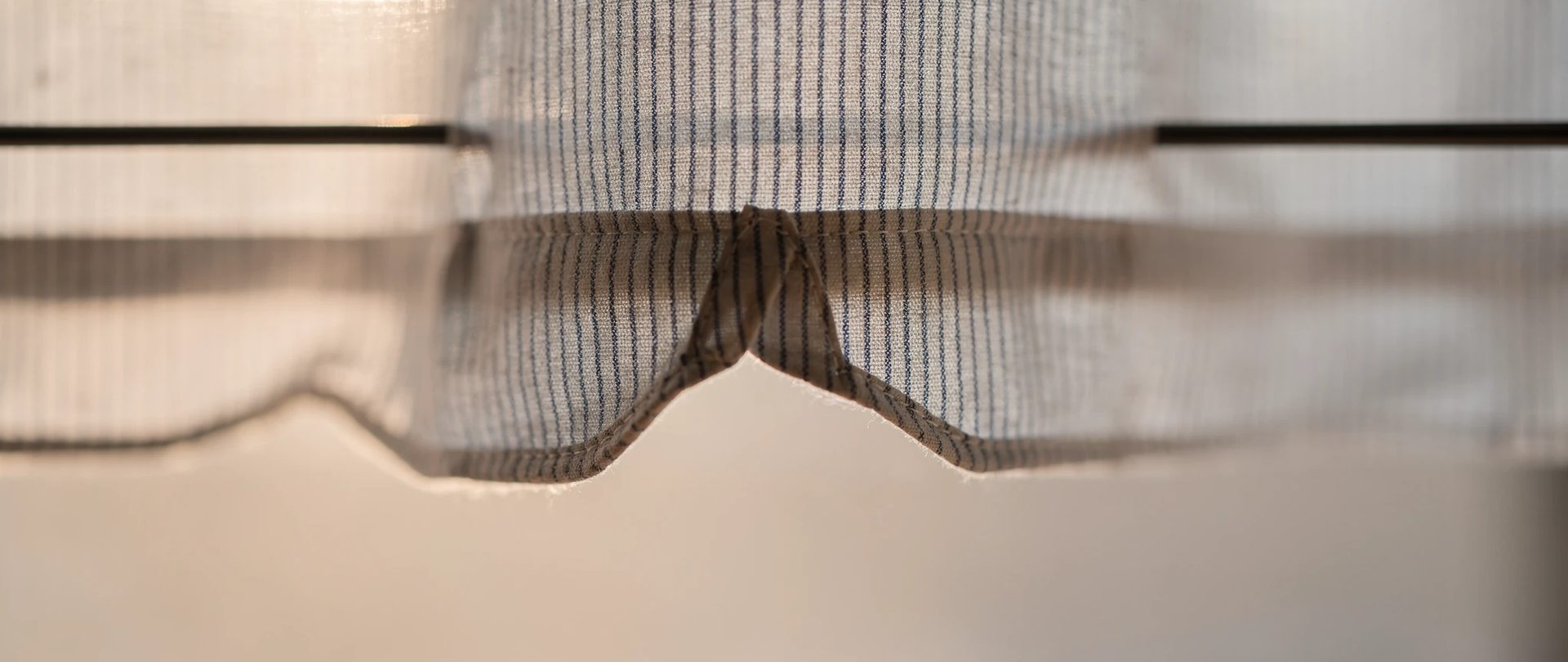
The fix is a hem far deeper than the panel's size suggests: fifteen to twenty centimetres, doubled. On a curtain that might only be sixty centimetres tall, that feels absurd until you see the two versions side by side. The deep hem is what makes a short curtain hang like a heavy one.
On very light cottons I add weights in the hem corners, or a fine chain across the whole width for anything approaching sheer. It costs almost nothing and it is invisible, and without it a light cafe curtain never sits still.
Unlined by default, lined by exception
Cafe curtains want to be unlined, and there are two good reasons.
The first is visual. A cropped panel is small, and a lining makes it stiff and thick. On a short curtain that thickness reads as heaviness, and the charm of the treatment is that it is light.
The second is practical. These panels live in kitchens, bathrooms and street-facing living rooms, which are the three places where things get splashed, steamed and dusty. Unlined means you can wash it without the differential shrinkage problem that makes a lined panel twist.
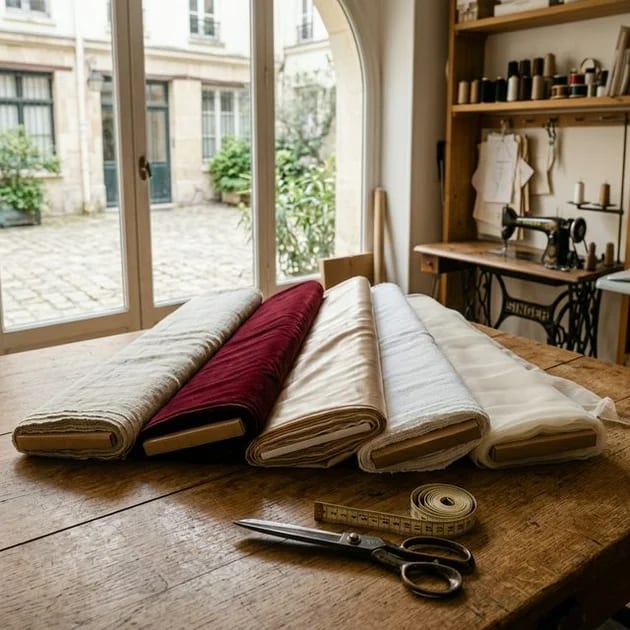
The exception is a window where you want genuine darkness in the covered half — a bedroom on a lit street, most often. There, a light lining is worth the stiffness, and the panel becomes a dry-clean item rather than a wash-at-home one. Decide that before choosing the fabric, not after.
The mistake that makes it look like a tea towel
Not enough fabric across.
A cafe curtain is small, so people order it flat or nearly flat, and a flat panel across a window is a piece of cloth on a wire. The gathering is the entire look. I cut these at two and a half to three times the width of the opening, which on a ninety-centimetre window is around two and a half metres of fabric total, and that fullness costs very little because the panel is short.
This is the one place where being generous with fabric is cheap, and it is the difference between a treatment that looks chosen and one that looks temporary.
Where it works, and where I will point you elsewhere
Ground-floor rooms facing a sidewalk, kitchens over a sink, breakfast nooks, and bathrooms: yes, and it is usually my first suggestion. Over a sink the reasoning shifts from privacy to splash, which is a different calculation and one I set out separately in the guide to kitchen curtains.
Where I will redirect you: a window where you need full darkness, since covering half a window cannot do that no matter the fabric, and a window whose lower half holds the view you actually want. On a window looking at a garden rather than a street, cropping the bottom removes the reason you have the window.
For those, the layered approach in the room-by-room guide is the better starting point.