
Window Treatments by Room: How to Choose the Right One
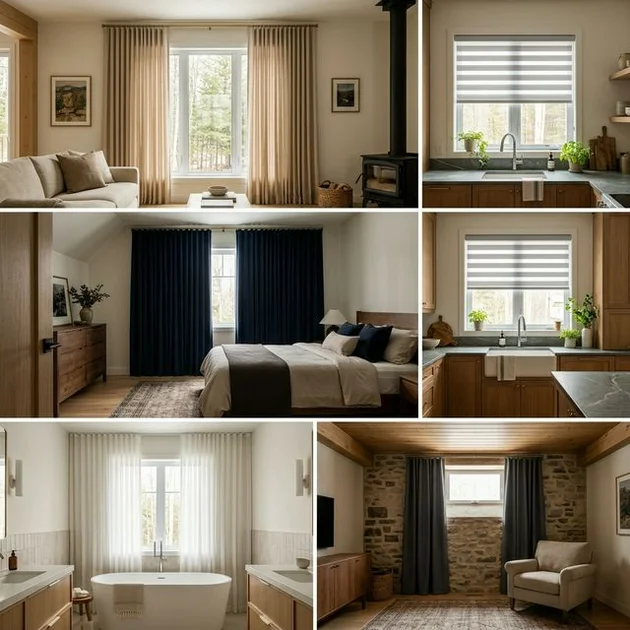
Each room has different light, privacy, and humidity demands, the right window treatment starts with the room. Room guide by Nalia, Sherbrooke.
The most common mistake people make when choosing window treatments is starting with a fabric or a style they like and then trying to make it work in every room. The better approach, the one I always take with clients here in Sherbrooke, is to start with the room. Each space in your home has its own requirements: different light needs, different privacy demands, different practical constraints. A treatment that's perfect in your living room may be completely wrong for your kitchen. Here's how I think through each space.
Living Room: Focal Point, Layering, and Entertaining
The living room is where window treatments do the most visual work. It's often the first space guests see, and it tends to have the largest, most prominent windows in the house. This is also where investing in something well-made pays off most visibly.
In a living room, curtains serve two roles at once: they dress the window and they frame the entire room. Panels that run ceiling to floor transform a good window into an architectural feature: they add perceived height, make the space read as larger, and create a coherent backdrop for all the furniture in front of them. I lean toward wave pleat in living rooms because its continuous, even ripple brings a quiet movement to the space without competing with anything in it.
For living rooms that see a lot of company, I almost always recommend layering: a semi-sheer in front for daytime light and visual connection with the outdoors, a heavier opaque panel behind that closes for evening privacy or when you want to shut out the afternoon sun. The result is more versatile than any single treatment, and it reads as considered rather than just functional.
See all living room window treatment options
Bedroom: Privacy, Light Control, and Sleep Quality
The bedroom operates on fundamentally different priorities than the living room. Darkness comes first. Quebec summers bring light early in the morning and late into the evening: without proper blackout coverage, sleep suffers, particularly for children and anyone who works overnight shifts.
I always steer bedroom clients toward a lined blackout or a properly opaque fabric. This doesn't mean sacrificing aesthetics: a deep velvet or a weighty lined linen can be genuinely beautiful while doing its job completely. The mistake is compromising on performance in the name of a lighter, airier look that ends up waking you at five in the morning in June.
Privacy is the second major consideration. Bedrooms often face the street or a neighbouring property, and the level of coverage the window needs is often higher than people initially account for. For windows that face directly into another living space, I recommend a treatment that provides complete privacy even when the sash is cracked open for air, which means thinking about how the fabric sits in relation to the window frame, not just whether it covers the glass.
Explore bedroom window treatment options
Kitchen: Humidity, Grease, and Washable Fabrics
The kitchen places practical constraints on window treatments that no other room in the house does. Cooking steam, grease vapour, condensation on cold mornings: these all work on fabrics in ways that your living room curtains never experience. A beautiful linen panel I'd happily hang in a salon is not the right choice in front of the kitchen sink.
In kitchens, I prioritize two things: washable fabrics and appropriate length. A Roman shade or a short café curtain above the sink is far more practical than a floor-length panel that collects humidity from the floor and catches every cooking splatter within range. Cotton-polyester blends treated for stain resistance exist specifically for this context, and they're worth using.
The kitchen is not the place to compromise on washability. A treatment you can't put in the machine won't get washed often enough. And one that yellows with steam loses its appeal after one Quebec winter of serious cooking.
If your kitchen is already bright and privacy isn't a concern, a simple sheer or a light roller shade may be all you need: something that can come down easily, go into the wash, and go back up without drama. The point is to choose something you can actually maintain without thinking twice about it.
See kitchen window treatment options
Bathroom: Moisture, Privacy, and Mildew Resistance
The bathroom is technically the most demanding room for window treatments. Humidity is constant, temperature swings are significant, and the risk of mildew is real if you choose a fabric that holds moisture and dries slowly.
I generally steer clients away from heavy natural fibres in the bathroom. Linen, which I love in almost every other context, absorbs moisture and takes its time drying. Over time, that creates the conditions for mildew and accelerates fabric deterioration. For this space, I work with quality synthetic fabrics treated for moisture resistance, lightweight polyester voiles, or aluminium slat blinds that simply don't react to humidity at all.
Privacy is the other key consideration. Bathroom windows tend to be smaller and positioned higher on the wall, which simplifies things: a modest opaque roller shade or a light sheer that obscures sight lines without blocking daylight entirely is usually sufficient. You rarely need the kind of dramatic treatment that a living room window calls for. Precision and practicality matter more here than visual presence.
Browse bathroom window treatment solutions
Basement: Maximizing Light and Improving Insulation
Basement windows are usually small and positioned near the ceiling, which means the two challenges are almost opposite to what you face in the rest of the house. You want to preserve every bit of natural light that comes in, and you want to improve insulation along windows that are often poorly performing.
In finished basements used as offices, playrooms, or lounge spaces, I avoid heavy treatments that cut off what little daylight is available. A light roller shade in a translucent fabric, or a simple sheer panel on a short rod, keeps the window dressed without swallowing the light. If insulation is the priority (and in Quebec, it often is), a thermal curtain mounted close to the wall provides meaningful resistance to cold-air infiltration without making the space feel darker than it already is.
For basement windows that face the street or a walkway, privacy still matters even if the space is used less often. A top-down roller shade (one that opens from the top rather than the bottom) is an elegant solution: it admits light from the upper portion of the window while keeping the lower portion covered against passing eyes.
See basement window treatment options
Patio Door: Large Format and Easy Access
The patio door is its own category. It's the largest opening in most homes, often more than two metres wide, and it needs a treatment that doesn't interfere with daily use. Curtains that snag, bunch, or resist movement quickly become frustrating, which means glide matters as much as appearance.
I almost exclusively use a glider track for patio doors: the panels stack smoothly to one side with minimal effort, even in a heavier fabric. The right length is at or just above the floor: low enough to read as intentional, high enough that the fabric isn't being walked on every time someone steps outside. For patio doors that face south or west, a fabric that filters the light without fully blocking the view of the garden is usually the best balance between solar control and connection with the outdoors.
Where space allows, two panels that open to opposite sides of the door frame give a more balanced look than a single panel pulled to one side. And if you're drawn to layering, the patio door is one of the best places to use it: a permanent sheer that stays put and maintains the view, with a heavier panel that closes only in the evenings when the garden lights come on and you want the room to feel contained.
For projects that span multiple rooms, the residential services page explains how I approach whole-home window treatment planning: creating coherence across spaces without making everything look the same.
Every Room Deserves Its Own Answer
There is no single window treatment that works well across an entire home. What's right for your living room is often wrong for your kitchen, and what performs in your bedroom may be unnecessary in your bathroom. This is why I always begin with a conversation about each room before making any recommendations.
In my Sherbrooke workroom, every project is a response to a specific home: its orientation, its light, and how the people living in it actually use the space. If you have multiple rooms to dress, we can plan them together so the result feels considered from room to room without feeling uniform.
Book a free consultation and let's talk through what works for your home.