Custom Blackout Curtains: Guide to Total Darkness
Custom blackout curtains reach total darkness with ceiling tracks, side overlaps and triple-weave fabric. Where store-bought panels fail, and why. By Nalia, Sherbrooke.
In Quebec, we live with two extremes: January mornings where the sun doesn't rise until 7:30 a.m., and summer nights where it's still bright at 9 p.m. If you work night shifts, have a baby napping during the day, or your bedroom faces east, you know exactly what I mean. Light comes in when you don't want it. Store-bought blackout curtains promise a lot. In practice, they rarely deliver.
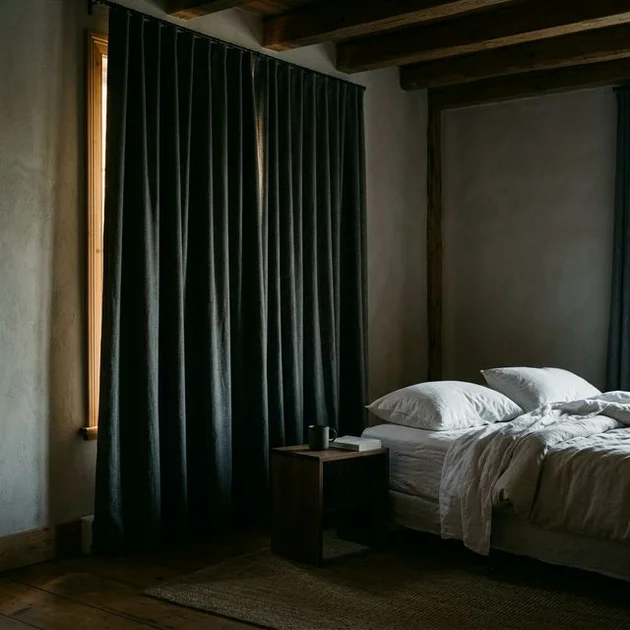
Why total darkness genuinely changes sleep quality
This isn't about preference. It's about physiology. The human body produces melatonin in response to darkness. Even low ambient light, perceived through closed eyelids, can suppress that production and disrupt deep sleep cycles.
For night-shift workers sleeping during the day, this is a serious issue. For infants whose circadian rhythm is still forming, total darkness during naps supports longer, more restorative sleep cycles. For home theater enthusiasts, a truly dark room is the baseline condition for correct image rendering.
What I hear regularly from clients who contact me through the residential page: they already had "blackout" curtains from a big box store, but light still came through. Not through the fabric itself, but along the sides, the bottom, sometimes the top. The fabric might have been opaque. The installation was not.
What "blackout fabric" actually means: triple-weave, lining, coating
There's a meaningful difference between what's commonly sold as "blackout" and what actually produces total darkness.
Dim-out fabric blocks between 85 and 95% of light. It reduces glare, creates a softened atmosphere, but still lets enough light through to see objects clearly during the day. Fine for an office or a living room, but not adequate for a nursery or a recovery room.
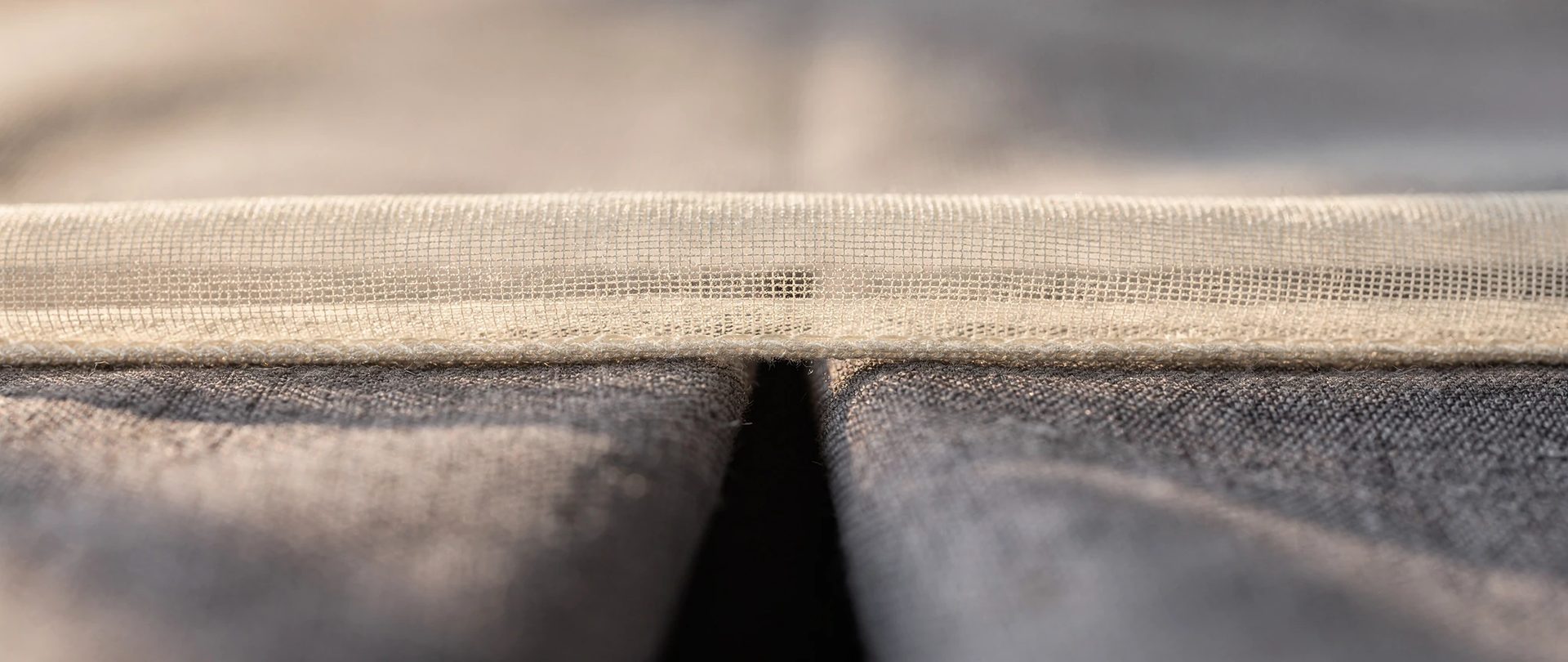
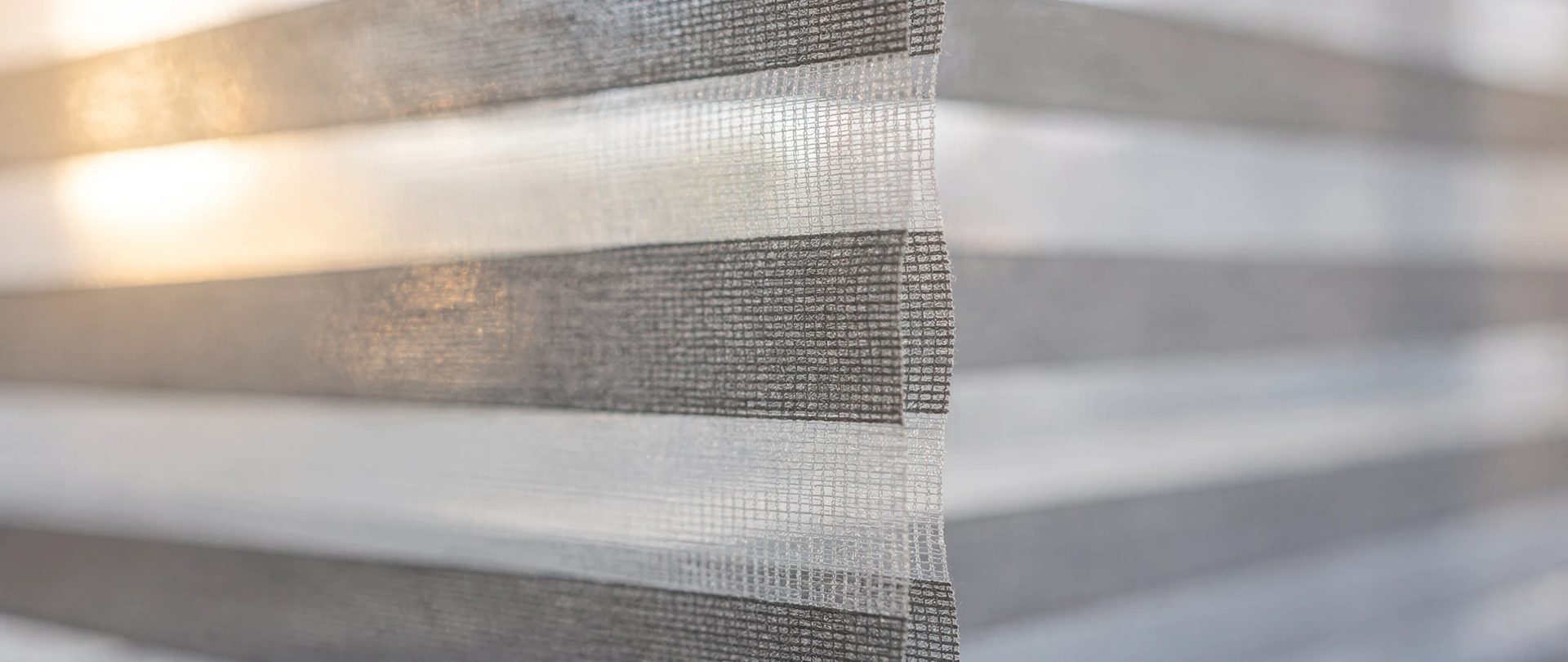
Triple-weave fabric is woven in three distinct layers, with a black centre layer that mechanically blocks light: no chemical coating involved. This is my reference choice for projects where true darkness is the requirement. It's dense, durable, and its blocking performance doesn't degrade with washing the way some coatings can.
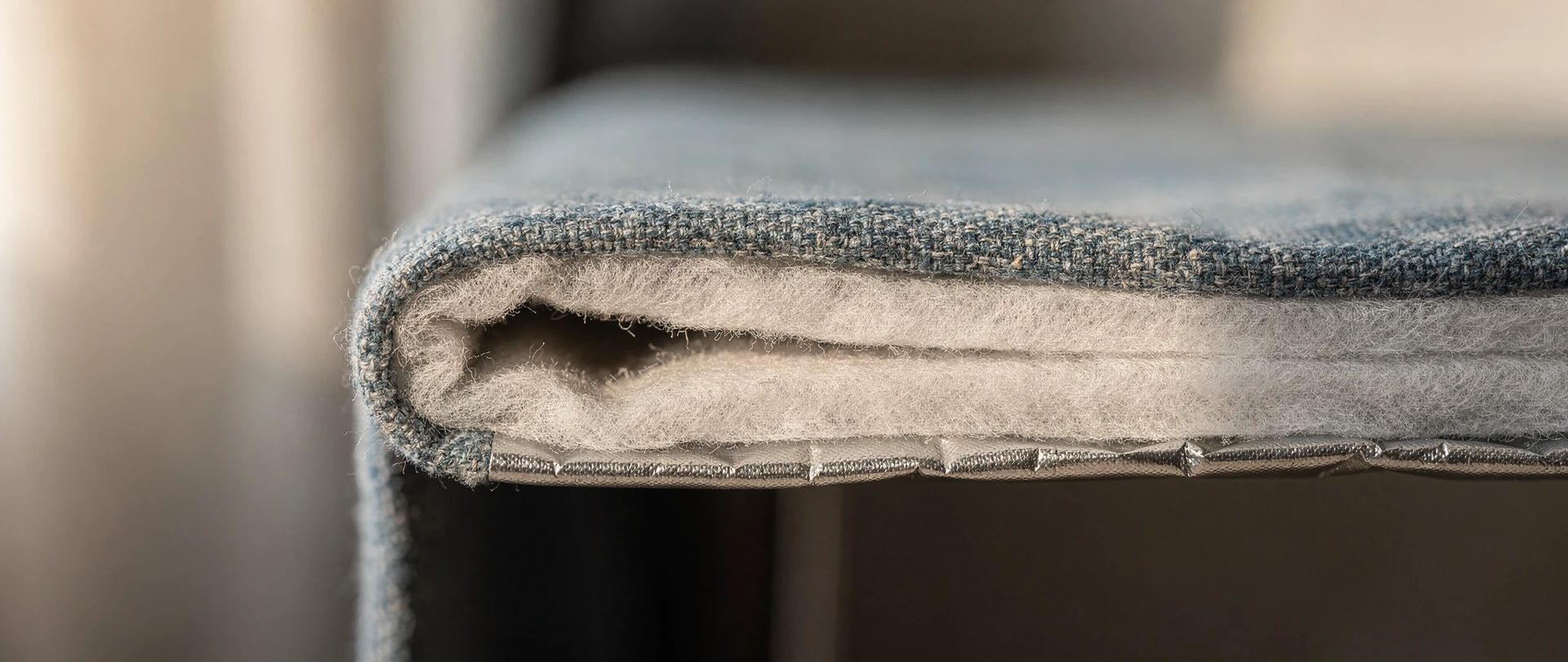
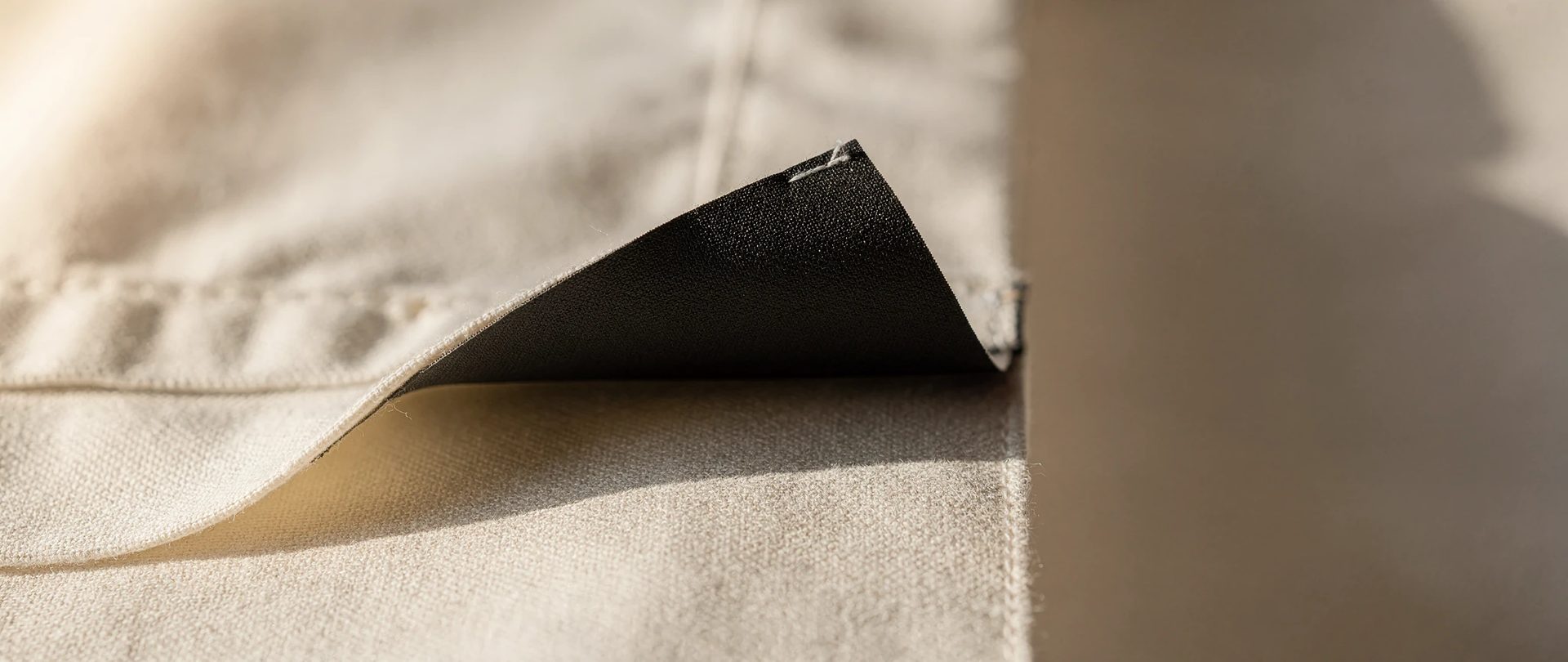
Blackout lining is a different approach: you choose a decorative face fabric you love aesthetically, then add a technical lining, black on the back, white on the visible side, that blocks 100% of light. This gives you more freedom with your main fabric choice, but adds thickness to the panel.
What I always tell my clients is that the fabric is 50% of the work. The other 50% is how it's installed. A perfectly blackout-rated fabric with a poorly thought-out installation gives you nothing.
Why off-the-shelf blackout curtains always fail in the same place
Store-bought blackout curtains have a structural problem: they're manufactured in standard sizes, for standard windows. But windows aren't standard. And even if yours were, standard hardware almost always lets light through the sides.
Here's what you typically see:
- The rod is mounted inside the window frame. The panel can't extend past the frame, so light bleeds through both sides.
- The drop is measured from the top of the frame, not the ceiling, leaving 10 to 20 cm of exposed wall above where light pours in.
- Panel width barely covers the frame, with no overlap on the sides.
The classic result: a visible halo of light on three sides of the closed curtain, even when the fabric itself is rated at 100% opacity.
For a bedroom where you genuinely need to sleep in total darkness, these compromises don't work.
What custom solves, concretely
When I take measurements for a blackout project, I'm not measuring the window. I'm measuring the space that needs to be covered to eliminate all light entry.
Ceiling mount or high wall mount. By positioning the rod 10 to 15 cm from the ceiling, or directly on the ceiling when possible, the panel covers the entire wall surface from ceiling to floor. That band of light above the curtain rod disappears entirely.
Generous width overlap. I consistently plan for 15 to 25 cm of overlap past the window frame on each side. A closed panel creates a shadow zone along both sides, and lateral light has no path in.
Floor-length drop. For complete darkness, the panel needs to reach the floor. A 1 to 2 cm surplus that rests lightly on the floor guarantees no light line at the base.
Wall-return track systems. For projects demanding total blackout, I use track hardware with a wall return: the panel, instead of hanging in a straight line, folds back toward the wall 5 to 10 cm on each side. Side light is blocked physically, not just visually.
The Quebec light context: darkness in January, light at 4:50 a.m. in June
There's something particular about living in Sherbrooke from a light perspective. In December, the sun sets before 4 p.m. Short days affect mood, and people try to make the most of every hour of natural light during the day.
Then June arrives. Sunrise at 5:10 a.m. By 9 p.m., there's still enough light to read outside without a lamp. For a bedroom facing east or south, this is a genuine challenge: light starts filtering in before 5 a.m., and store-bought blackout curtains often can't hold against that level of intensity.
This is frequently the exact reason clients reach out to me. Not because they're looking for aesthetics first, but because they've stopped sleeping properly past mid-May. Custom window treatments solve this problem definitively: once the panels are properly installed, the June 4:50 a.m. sunrise stops coming through.
What I recommend by room type
For adult bedrooms where total darkness is the goal, I recommend triple-weave fabric with a wall-return track, mounted at or near the ceiling. It's the most effective combination and doesn't require a separate blackout lining.
For nurseries and young children's rooms, the priority is zero light during naps. I often add a thermal lining alongside the blackout layer: children's rooms tend to overheat in summer and cool down quickly in winter, and the combined treatment handles both.
For home theater rooms, a dark charcoal or black blackout fabric is ideal. It eliminates the ambient light that degrades image contrast and absorbs stray reflections better than lighter colours.
If you have windows that are genuinely hard to darken, or if you've already tried off-the-shelf blackout curtains without satisfying results, I'd be glad to assess the situation with you. Request a quote for a custom project in Sherbrooke and across Estrie.