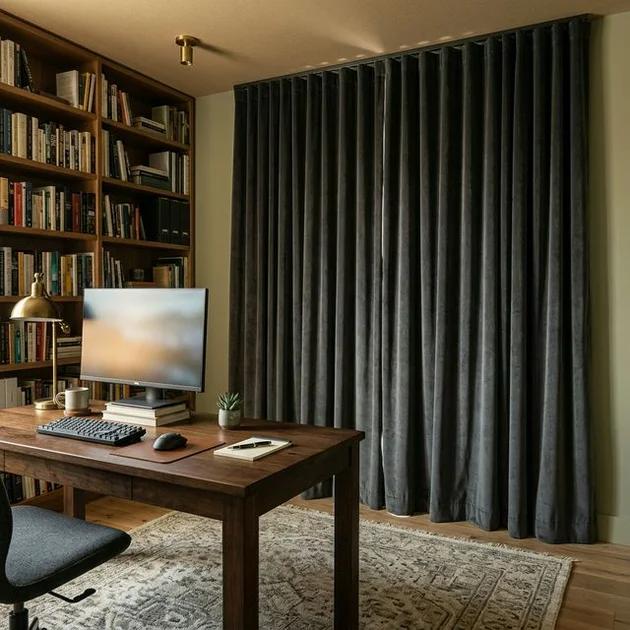
Listening Room and Home Theatre: What Curtains Actually Fix
Early reflections, flutter echo, room modes: what a gathered curtain corrects in a listening room or home theatre, and where it stops.
By Tim Chaikhraziev, RF Specialist | Telos Machina inc.
"You could place the best sound system in the world in a bathroom and it will still sound horrible." I'm barely exaggerating. The room is the other half of the system, and it's the only half no spec sheet describes.
You own a serious system, or you're about to buy one, for a listening room or a home theatre. You may already have set aside a room dedicated to listening. Soundstage and imaging, you talk about without hunting for words. The room around the gear, much less so.
Gathered and pulled off the wall, a curtain corrects early reflections, flutter echo and the reverberant tail that lingers in the mids and highs, but it does little below about 250 to 300 Hz and it won't stop noise from next door.
Why the room changes how your system sounds
In a listening room, music never reaches you just once. The direct sound arrives first, then its copies, bounced back by the walls, ceiling, floor and any glass. Because it arrives first, the direct sound tells your ear where what you're hearing is coming from. The whole sense of imaging rests on that first arrival.
A reflection arriving 5 to 30 ms after the direct sound isn't heard as a separate echo, even when it's louder than the direct sound itself. For music, the brain fuses arrivals up to about 40 ms. So you don't hear the reflection. You hear a timbre that has changed.
You already know the result: an empty room snaps. Picture a living room on moving day, bare walls and cleared floor, where your own voice sounds harsh and lingers after every word. Nothing about your voice changed: what you're hearing is the room.
Reverberation or echo: what's the difference?
An echo is a single reflection that arrives after the fusion window, late enough that you hear it as a distinct repeat. Reverberation, by contrast, is the buildup of every reflection in the room, still ringing after the last note stops.
RT60 measures the length of that sonic tail: how long it takes to die out once the source stops. For a home theatre, the target sits between 0.3 and 0.5 s in the mids.
Four defects you hear without knowing their names
First reflections, comb filtering, flutter echo, room modes: your ear already knows what each one sounds like.
First reflections
A first reflection is sound that bounces once off a side wall, the ceiling or a window before reaching your seat. That reflection follows the direct sound so closely that it blends right into it. You never hear it as a separate event, which is exactly what makes it the hardest defect to put a name to.
Those spots are called first-reflection points. That's where treatment matters most, on the side walls and the ceiling. Sliding a mirror along the wall from your listening seat is how you find them.
Comb filtering
Comb filtering happens when two copies of the same sound, one having taken a longer path, cancel each other out at evenly spaced frequencies. On a response curve, those cancellations carve notches lined up like the teeth of a comb. The delay decides where they fall: a 10 ms delay puts the first cancellation at 50 Hz, with another every 100 Hz after that.
By ear, people just say it "sounds hollow." A bare window or a hard wall near the speakers or your chair is enough to colour the tone, even though that bounce never registers as an echo.
Flutter echo
Flutter echo is sound bouncing back and forth between two hard, bare, parallel surfaces, most often two facing walls. The result sounds like a fast, metallic buzz, something like a zipper pulled shut in one quick motion.
Try it now. Stand in the middle of the room, clap once, and listen: if a quick, ringing repeat follows the clap, the room has a flutter echo.
Room modes
Room modes are resonances that belong to the room itself, set by its dimensions. When a half wavelength fits exactly between two parallel surfaces, that frequency feeds itself. The strongest modes form between a single pair of surfaces, like two facing walls.
At the listening seat, certain bass notes boom louder than others, and that boom shifts from one chair to the next. A standing wave's pressure peaks against the walls, piles up in the corners, and stays weaker everywhere else. A curtain does almost nothing against this one.
The other three defects mostly start on bare walls and windows, and that's exactly where a curtain gets real traction.
What a curtain fixes well, and what it doesn't
A curtain fixes the room well in the mids and highs, poorly in the bass, and it won't isolate you from your neighbour.
What a fabric absorbs in a room is expressed in NRC: the closer that number sits to 1, the more the fabric absorbs. Its metric equivalent is written αw.
Hung flat against the wall, a heavy curtain measures an NRC of around 0.35, roughly half of what the same fabric gives once gathered. The same weight of curtain gathered to 200% fullness reaches about 0.60, the same figure that C. M. Harris's reference table gives for heavy velour. Gathered and hung 15 cm off the wall, a curtain fabric reaches an αw of 1.00, the top absorption class.
In acoustic treatment, meaning the correction of sound within the room, how you hang a curtain counts for at least as much as which fabric you pick.
What it fixes well
On the side walls, a gathered curtain tackles first reflections, as long as it covers the points a mirror reveals.
A bare window near the speakers or the chair colours the tone through comb filtering. The curtain covers it during listening sessions, then opens back up to give you the window back.
Flutter echo needs two bare, parallel surfaces. Cover one of the two, and the back-and-forth breaks.
That leaves the sonic tail. As air passes through a porous fabric, the sound's energy turns into heat, which cuts down echo and reverberation in the room. RT60 drops toward the target cited above, though fabric alone doesn't guarantee you'll reach it.
What it fixes poorly
A curtain corrects the bass poorly. Below roughly 250 to 300 Hz, it does very little, even heavy and well gathered, and that's exactly where room modes boom. Better-controlled bass won't come from the fabric.
That register gets handled with other tools: porous bass traps a few tens of centimetres thick, ideally in the corners; membrane absorbers, a flexible panel that vibrates over a sealed air gap and turns pressure into heat; Helmholtz resonators, cavities connected to the room through a narrow neck and tuned to a specific frequency band.
One more limit: sound leaving the room, or entering it. Soundproofing means stopping sound from passing from one room to another; that takes mass and airtightness. A curtain, by contrast, damps sound inside the room where it hangs.
Gathered curtain, flat curtain or panel: the comparison
A gathered curtain pulled off the wall absorbs far more than the same curtain flat. It holds its own against a felt panel in the mids and highs. Like that panel, it stays weak in the bass. The measurements, band by band:
| Treatment | 125 Hz (bass) | 500 Hz (mids) | 2 kHz (highs) | Opens |
|---|---|---|---|---|
| Heavy curtain hung flat against the wall | 0.05 | 0.35 | 0.38 | Yes |
| Same weight of curtain gathered to 200% | 0.14 | 0.53 | 0.70 | Yes |
| Gathered curtain fabric, 15 cm off the wall | 0.15 | 0.98 | 1.10 | Yes |
| Wool felt panel | 0.08 | 0.45 | 0.80 | No |
A value above 1 comes from the lab method: no fabric absorbs more sound than it receives.
Between the first two rows, only the gathering changes, and it counts for more than the weight does: gathering a mid-weight fabric gains you more than moving up to a heavy fabric does. Deep folds also scatter part of the mid and high reflections instead of sending them back as one flat bounce.
The third row leaves 15 cm of air behind the fabric. A porous fabric absorbs best where the air moves the most, at roughly a quarter wavelength from the wall; right against the wall, the air barely moves at all. At 50 Hz, that quarter wavelength measures about 1.7 m, far more than the few tens of centimetres a curtain leaves at best. Hence the low bass column staying weak on every row.
Too much absorber hurts too. A room that swallows the highs and leaves the bass untouched sounds dead. Treat part of the room rather than every surface, and combine absorption with diffusion.
Fixed to the wall, a panel absorbs permanently. A curtain opens: if the room goes too dull, you pull it aside, and the bare wall bounces sound again.
Basement home theatre: floor to ceiling
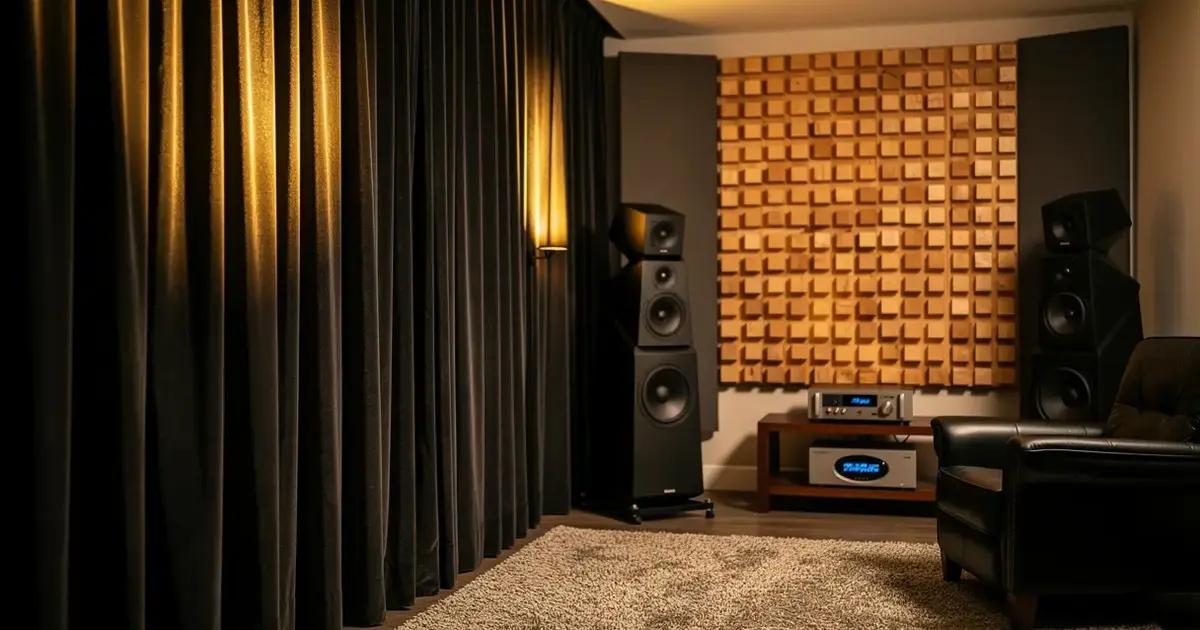
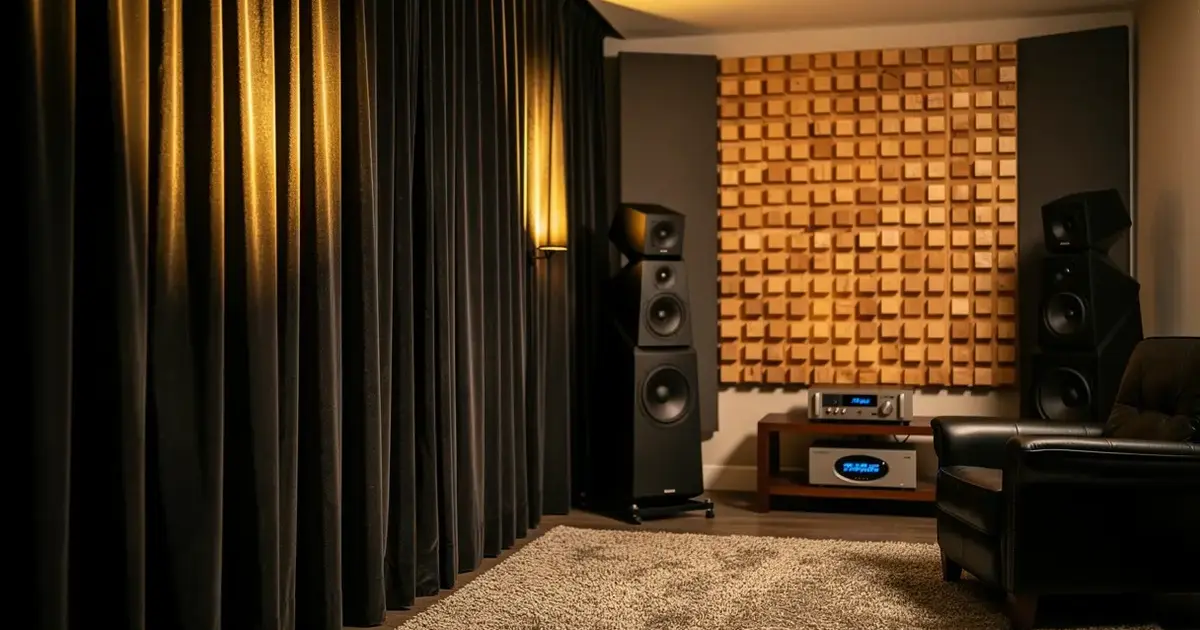
A basement home theatre is treated with dark, gathered velvet, floor to ceiling, on the walls that need it. In Quebec, the basement is in fact where a stereo and theatre system usually ends up.
That velvet does two jobs. It stops light from the screen bouncing off the surrounding walls. Gathered, the same velvet also absorbs the mids and highs, as the measurements above showed.
In a home theatre, three walls get fabric, each for its own reason. Around the screen, the dark fabric works mainly for the picture. On the side walls, the fabric covers the first-reflection points, the ones the mirror reveals from your seat. At the back, a rear wall left bare faces the screen wall: two parallel surfaces, exactly what it takes to produce a flutter echo.
Dressing these three walls doesn't mean covering them edge to edge. Leave part of each one bare, so the room stays alive rather than dead.
The panels hang from a ceiling track, which you or your installer mounts. Nalia sews each panel to the exact drop between that track and the floor, and to the fixing you have planned.
Two construction details matter. The return to the wall folds the edge of each panel back to the wall, so light doesn't leak out the sides. Fullness, meaning how much gathered fabric covers the width, runs around 200%, the same fullness measured above for the gathered curtain.
Watching movies in broad daylight? Panels covering a basement window then get a blackout lining behind the velvet, to block daylight.
None of this calms the subwoofer down. If a bass note booms louder at your seat than at the one next to it, that's a room mode: it calls for bass traps and the other bass tools described above, not fabric.
Where to place the curtains: the mirror method
Curtains go on the first-reflection points of the side walls, and a mirror is all it takes to find them. Have some painter's tape ready, and a second pair of hands.
- Sit in your listening seat, as if for a movie or a record.
- Have your helper slide a small mirror flat along the side wall, at ear height.
- Every time you see a speaker in the mirror, that spot on the wall is a first-reflection point. Have them mark it with a piece of tape.
- Repeat for each speaker, then on the other side wall.
The ceiling has its own first-reflection points too. Up there, a curtain can't do anything. It hangs in front of a wall; it doesn't cover a ceiling.
Your marks then decide how much fabric you need. On each side wall, the curtain has to span all of them, which means starting at the front wall and stopping a bit behind your seat.
Leave air behind the folds, as in the table row where the gathered fabric hangs 15 cm off the wall. That gap gets set when the track goes up, since it's the track that holds the fabric off the wall.
Before you order, take two measurements: the drop, from the planned track down to the floor, and the width of the zone you marked with tape. It isn't the windows that decide an acoustic curtain's dimensions; it's your marks.
Fabrics, linings, care: the short version
Ask for a heavy, well-gathered fabric, with or without felt and lining, and plan on dry cleaning, never the washing machine. Another article covers acoustic curtain fabrics and construction in more detail.
Heavy gathered velvet. The reference heavy velour weighs 610 g/m² and gathers to about 200% fullness: its absorption is the figure given above for a heavy gathered curtain. Weight isn't everything. Lightly gathered but pulled about 13 cm off the wall, a 500 g/m² cotton curtain reaches an NRC of about 0.55, comparable to velvet's. Care: dry clean only for velvet; washed, a curtain shrinks 5 to 10%.
Felt interlining. Behind the face fabric, the thicker the felt, the more it absorbs. A cotton acoustic felt interlining measures an NRC of 0.45 at 10 mm, 0.75 at 20 mm and 0.95 at 40 mm. Care: dry clean with the curtain assembled, never taken apart.
Fabric, felt and lining together. No lab measurement of these layers assembled together turned up, so I won't give you an NRC for that combination. Taken separately, though, the measured effects all point toward more absorption: gathering the fabric with air behind it, and a thicker felt. Care: dry clean only, as with any interlined curtain.
Frequently asked questions
Does a curtain replace acoustic panels?
Yes, for the mids and highs. A heavy curtain gathered to 200% shows an NRC of about 0.60, close to a wool felt panel's 0.55. Neither one reaches far into the bass. As a bonus, the curtain dresses a window and opens.
How much wall should I cover?
There's no percentage to aim for: coverage gets decided room by room. Start with the first-reflection points the mirror method reveals. Then clap your hands; if the clap repeats in a quick burst, dress one of the two parallel walls responsible. Stop before you deaden the room.
Does an acoustic curtain block noise from next door?
No. Even a heavy curtain weighs 5 to 10 times less than the window glass it covers: it doesn't stop what the glass lets through. Its edges aren't sealed either, so sound passes around it. This fabric calms the room it hangs in, not the one next door.
Is a blackout curtain acoustic?
Not just by being blackout: that word is about light. To absorb sound, a curtain needs both weight and fullness. Flat against the wall, that same curtain absorbs less than it would with air behind it.
Can you over-treat a room?
Yes. When absorber piles up and pulls out the highs far more than the bass, the room sounds lifeless. So keep some surfaces bare. On an evening when the sound feels flat, pull the curtain back: no screwed-down panel gives you that option.
The room, the other half of the system
Your system sounds only as good as its room lets it, and that room can be worked on without changing a single piece of gear. Start with what fabric fixes well: first reflections, flutter echo between bare walls, and the reverberant tail in the mids and highs. For the bass, other tools take over, starting with bass traps.
Nalia starts from measurements of your room and sews, in her Sherbrooke workshop, panels that run from ceiling to floor, each one cut to the exact drop under the track you or your installer mounts.
For a listening room or a home theatre, see Nalia's custom acoustic curtains. Your tape marks are in place and your two measurements are taken? All that's left is to request a quote.