Custom Acoustic Curtains: Reducing Noise With Style
Custom acoustic curtains in Sherbrooke: how fullness changes what they absorb, a materials comparison and care advice, by Nalia.
The older homes in Sherbrooke's Plateau Saint-Joseph have a lot of character: plaster walls, wide-plank floors, century-old windows that let the street breathe right into the living room. That's part of their charm. It's also why sound travels so freely through them, and why a busy street can feel like it's just on the other side of your curtains. Over the past few years, I've had a steady increase in requests for custom acoustic curtains in home offices, nurseries, bedrooms near busy streets, and open-plan commercial spaces. I want to explain how these actually work, and what you can realistically expect.
How acoustic curtains actually work
An ordinary curtain reflects sound waves. An acoustic curtain absorbs them. The difference comes down to fabric density and construction.
Sound travels through vibration. When a sound wave hits a lightweight, smooth surface (a sheer panel or a thin roller blind), it bounces back and keeps going. When it hits something dense, heavy, and textured, part of its energy is dissipated as heat within the fibres. The sound doesn't disappear, but it is damped.
This is why cinemas, recording studios, and conference rooms are lined with thick, soft materials. Custom noise reducing curtains apply the same principle, adapted for residential and commercial interiors.
Understanding NRC ratings
Acoustic materials are rated with a coefficient called NRC, for Noise Reduction Coefficient. It runs from 0 (total reflection) to 1 (total absorption). Even a well-constructed heavy triple-layer velvet panel has no single number of its own, because the result depends on how it hangs. On Acoustic Supplies' absorption coefficient chart, medium to heavy drapery hung flat against the wall measures only about 0.20 to 0.35. Gathered to about twice its width, it reaches about 0.60. In a test published on Acoustic Index, a curtain gathered with an air gap behind it goes up to about 1.0. Put plainly: fullness and the air gap make the difference.
What does that mean in practice? An NRC of 0.60 means the fabric absorbs about 60% of the sound energy that strikes it and reflects about 40% back into the room. Across a full-height window or partition, that's a meaningful contribution.
Plenty of people search for "soundproof curtains", so what I always tell my clients is this: acoustic curtains reduce echo and dampen ambient sound; they don't eliminate it. A room doesn't become an anechoic chamber. But the perceived difference is real, and often more significant than people expect.
Setting expectations honestly matters here. A curtain damps sound inside the room; it doesn't shut sound out. Acoustic curtains make a genuine difference for internal reverberation and for the way background noise, like traffic or distant conversations, builds up in a room. They don't block impact noise, such as a hammer or a dropped object, and they won't fully isolate a room from a neighbour's music or an outdoor heat pump.
Fabrics and construction: what makes the difference
For curtains to be genuinely acoustic, they need to be dense, heavy, and multi-layered. Here's what I work with for these projects.
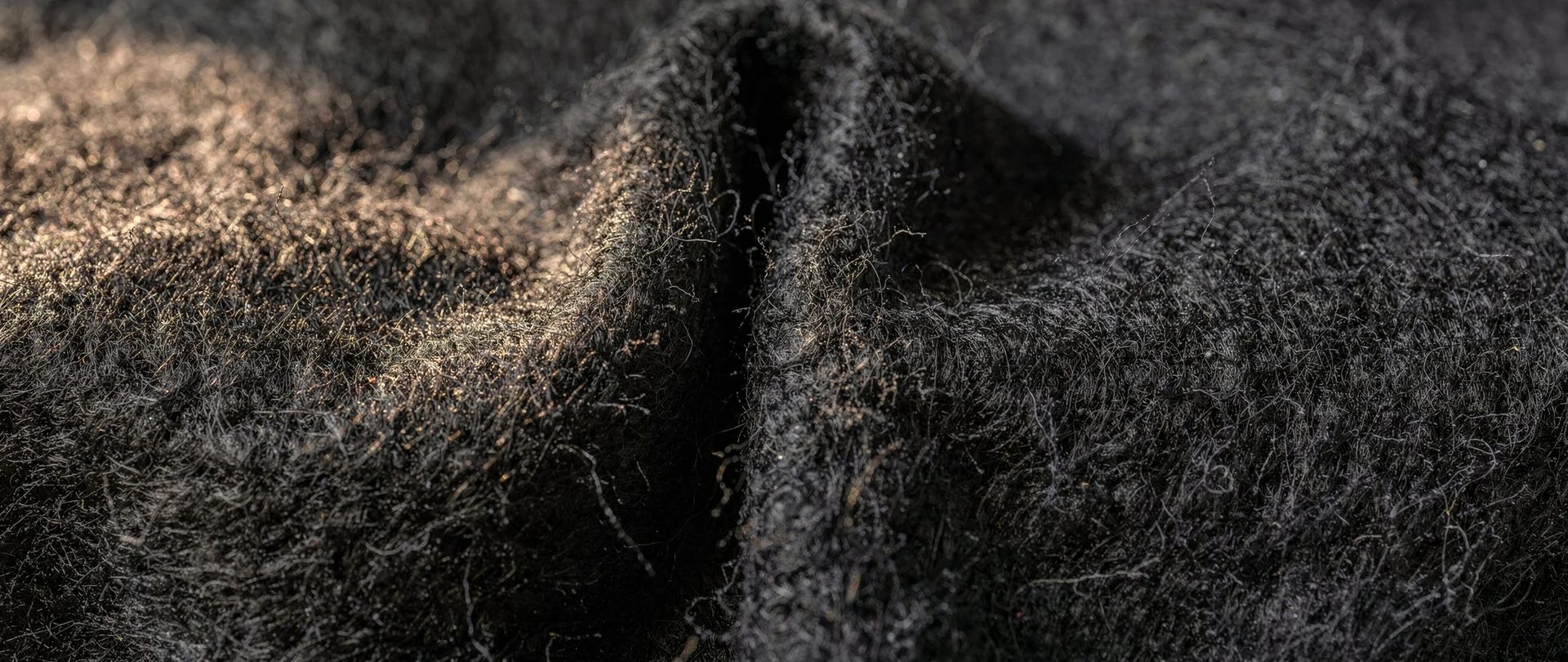
Dense cotton velvet, or a dense polyester, is my primary reference fabric. The band that works runs from 250 to 500 g/m². For a concrete reference point: 350 g/m² is about the thickness of a good hoodie, and 500 g/m² is heavier still. In that band the fabric carries the mass it needs to absorb mid and high frequencies, its dense surface keeps vibrations from bouncing freely, and a room dressed in it rings noticeably less. A 250 g/m² fabric worked properly does an excellent job: how it is gathered and hung decides the result, not weight alone.
What I do not sew. There are very thick industrial fabrics, made for machine rooms, weighing 5 to 10 kg per square metre, far past what my machines will take. Those are the ones that reach a high NRC even hung flat, and they are not curtains. I work in the band that sews cleanly and still dresses a window, and within it I always take the heaviest, thickest fabric the project allows.
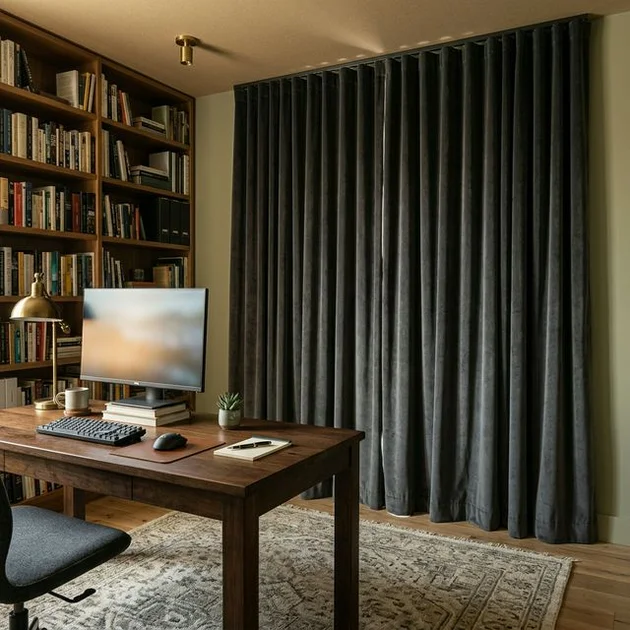
Configuration matters more than the fabric. This is the point I repeat most. Where the curtain sits, how far it stands off the wall, and above all how full it is gathered weigh more in the result than the fabric name on the invoice. Three conditions make the difference: the curtain is gathered into deep lobes and never hung flat, it stands at least 15 cm off the wall, and it covers the surface completely from ceiling to floor. A mid-weight velvet hung that way beats a heavier fabric hung flat, and the gap is often a factor of two. Lobes do not only absorb: they scatter, which breaks up reflections instead of sending them straight back.
What I aim for. Published measurements for a gathered heavy velvet sit around NRC 0.60. In a deep-lobe installation, at least 15 cm off the wall and covering the full surface, I aim higher: 0.75 to 0.80. That is a design target, not a guaranteed figure, and laboratory measurement is covered below.
My default choice: a blackout-lined velvet. It absorbs better than standard synthetics, it blacks out, and it cleans without drama. A dense multi-layer polyester is the alternative when colour or availability calls for it.
Large dimensions are not an obstacle. I sew long, wide curtains for big window walls, full walls and high ceilings. What falls outside my atelier is weight, not size: stage curtains and heavy industrial canvas need different equipment than mine.
Density before thickness. Between two fabrics of the same weight, the tighter one works better. A dense cotton at 400 g/m², gathered to full fullness, beats a soft heavier fabric hung flat.
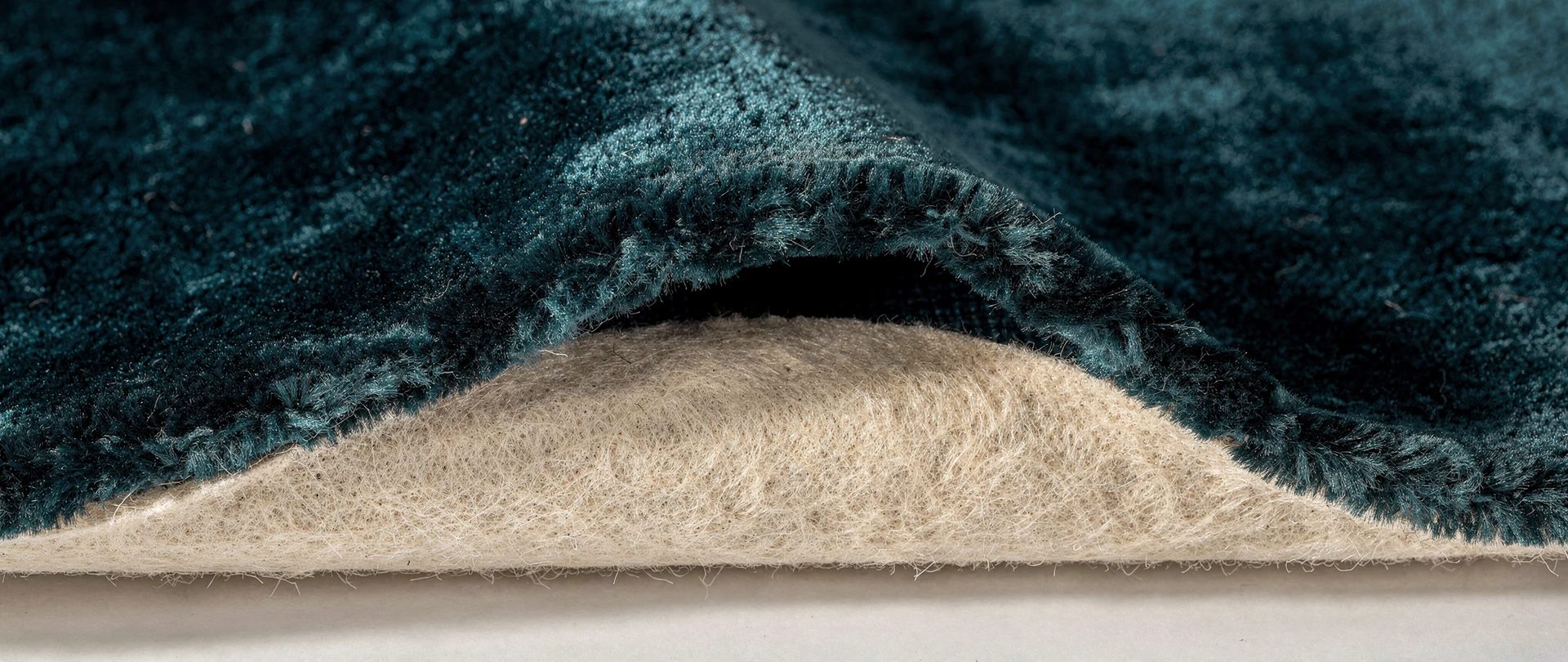
Triple-layer construction puts an absorbing layer behind a good fabric. Three elements are assembled together: the face fabric (velvet, heavy jacquard, treated linen), an interliner of acoustic felt or dense quilted cotton, and a backing fabric.
Mass-loaded vinyl is sometimes added to that sandwich. On its own, a fabric curtain adds only about 2 to 5 points of STC, the rating for sound stopped between rooms. A vinyl layer makes a heavier curtain, not a wall that stops sound, because sound goes around a curtain: through the ceiling, the floor and the gaps. Only industrial curtains built around a heavy vinyl core and sealed at the edges reach STC 27 to 33, and that is not a decorative drape.
Total weight matters as much as composition. Weight helps, but fullness counts for more.
Comparing materials
Of the fabrics I sew, only gathered heavy velvet has a test published on Acoustic Index as a hanging drape, at NRC about 0.60. Here is how they compare.
| Material | Weight | Lining | What it absorbs | Care | Who it suits |
|---|---|---|---|---|---|
| Dense cotton velvet (what I sew) | 250 to 500 g/m² | None needed | Mids and highs; NRC about 0.60 when gathered | Dry clean | Bedrooms, home offices |
| Very heavy cotton velvet | 610 g/m² tested | None needed | Mids and highs; NRC about 0.60 when gathered | Dry clean | Large rooms, subject to availability |
| Industrial machine-room fabric | 5 to 10 kg/m² | Not applicable | High NRC even hung flat | Industrial | Past my atelier; my machines will not sew it |
| Flame-resistant polyester velour | not measured | None needed | not measured | Ask whether the flame resistance is in the fibre | Commercial rooms |
| Wool or acoustic felt | 815 to 1,550 g/m² | Is the interlining | NRC 0.31 to 0.55 on its own | Dry clean | Backing a face fabric |
| Molleton or bump | not measured | Is the interlining | not measured | Dry clean | Adding body |
| Lined linen or heavy weave | not measured | Sateen or blackout | not measured | Dry clean | A lighter look |
| Industrial vinyl-core curtain | Vinyl core 4.9 to 9.8 kg/m² | Quilted fibreglass | NRC 0.70 to 0.85, STC 27 to 33 | not measured | Factories, not homes |
| Triple layer: face, felt, lining | not measured | Felt and lining | not measured | Dry clean | Rooms full of echo |
Not measured means I found no published test, including for a finished triple-layer curtain, so I won't put a number on mine. The velvet figure also holds only when the fabric is gathered.
Questions about acoustic curtains
Acoustic curtains and noise-blocking curtains are the same product, and yes, they work against echo.
Acoustic curtains or noise-blocking curtains: what is the difference? In practice, none. Both names, and the one quoted above, are used for the same product. What matters is what the curtain does: it absorbs sound inside the room, and does little against sound travelling between rooms.
Do acoustic curtains work? Yes, against echo. If voices bounce around your home office, a heavy curtain with real fullness makes a difference you can hear. Against sound coming through a wall, it only takes the edge off, and I'd rather say so before we start.
Residential uses: where it applies
In homes, the requests I receive most often come from home offices, bedrooms near busy streets, nurseries and open-plan living spaces.
Home offices have become the most common case since hybrid work became the norm. An untreated room generates a lot of echo, which is fatiguing during extended video calls and makes it harder to concentrate. Acoustic curtains running full height on a window wall or partition make a clear difference in perceived sound quality.
Bedrooms near busy streets are a real issue in Sherbrooke's older neighbourhoods. Some stretches of King Street, Wellington, and parts of the Plateau stay active late into the evening. Curtains won't replace a double-glazed window. Even the heaviest residential curtain is 5 to 10 times lighter than the glass behind it. Combined with a decent window, they take the edge off the street noise that still filters through, but the window does most of the blocking.
Nurseries and children's bedrooms benefit from reduced internal echo. Infants are sensitive to sharp sounds. A room with lower reverberation is more soothing, with less bounce from voices and footsteps.
Open-plan living spaces are another interesting case. Renovations that removed walls to create open layouts often created acoustic problems in doing so: kitchen noise travels to the living room, conversations overlap. Acoustic curtains on a track (yours or your installer's; I sew to its exact drop) help create functionally distinct areas without a permanent partition.
For a listening room or a home theatre, see the guide to curtains for listening rooms and home theatres.
Commercial applications: offices, restaurants, studios
In commercial spaces, curtains reduce echo in open-plan offices, restaurants, meeting rooms and studios. The acoustic stakes are often higher and the solutions more straightforward to justify.
Open-plan offices suffer from chronic reverberation that affects both productivity and conversational privacy. In noise, people raise their voices without noticing: the Lombard effect, first documented in 1911. Custom acoustic curtains hung as zone dividers, along conference room walls, or on glass partitions are less invasive than permanent construction. They adapt as spaces evolve. Drywall doesn't.
Restaurants and cafés with hard surfaces (concrete, wood, exposed metal) are often uncomfortably loud. Conversation noise stacks until it becomes hard to hear the person across the table. The ceiling and walls come first. Heavy curtains on the windows and in alcoves then add absorption without changing the look of the room. There is more on dining rooms in the article on curtains for restaurants.
Meeting rooms and recording studios are the highest-demand applications. For these projects, I sew heavy triple-layer panels to the exact drop of the ceiling track the client or their installer puts up, so they can be drawn to adjust the absorbent surface. A home podcast or recording studio can be treated well this way above about 300 Hz; below that, a curtain leaves the bass largely untouched.
If you have a commercial project and want to explore options, I'd encourage you to get in touch so we can assess what's possible together.
The custom advantage for acoustics
For a noise reducing curtain to work, it has to cover the surface completely. Every gap, every centimetre of fabric that falls short of the wall, every inch between the panel and the floor, is a path for sound to travel through.
Off-the-shelf acoustic curtains always involve compromise: the width is never quite enough, the height stops short of the floor, the sides don't extend past the window frame. Sound slips through those openings.
When I take measurements for an acoustic project, I measure the space to be covered, not the window. The track, yours or your installer's, ideally sits at or near ceiling height, and I sew to its exact drop. On each side, the width extends 20 to 25 cm past the frame. The length reaches the floor with a small surplus. The result is unbroken coverage with no acoustic bypass.
It's the same logic as with blackout curtains: the fabric's performance accounts for a lot, but the way it hangs does the other half.
Can you guarantee a measured NRC? I can give you the published references for the fabric and configuration chosen, and aim high by working the fullness and the standoff from the wall. An actual measurement is a laboratory test under ASTM C423 or ISO 354, and that service costs more than making the curtain. Not every fabric on the market has been tested in a chamber, so I work from existing references and from installation best practice.
Care: what each fabric needs
Velvet, wool and interlined drapes go to the dry cleaner, never the washing machine. The table covers the rest.
| Fabric or situation | What to do |
|---|---|
| Velvet, wool, interlined drapes | Dry clean, never the washing machine. |
| Any drapery in the wash | It can shrink 5 to 10%, and one wash strips a flame treatment. |
| Flame-resistant fabric | Resistance built into the fibre lasts; a topical treatment washes out and must be renewed. |
| Restaurant drapes | Clean about once a year; they trap grease and smoke. |
Cleaning and pressing drapes is part of what I do, so when yours are due, ask me.
If you're dealing with noise issues in your home or workspace in Sherbrooke, it's worth talking through. Custom acoustic curtains aren't a miracle solution. But they're often practical: effective when properly made, aesthetically appropriate, and completely reversible. Book a consultation and we'll look at what can be done.