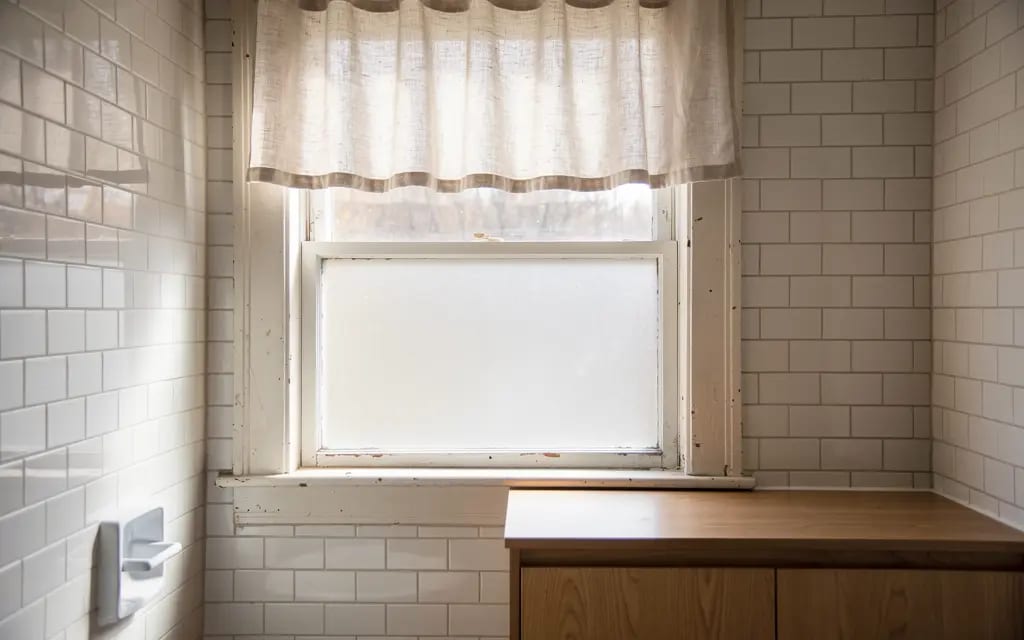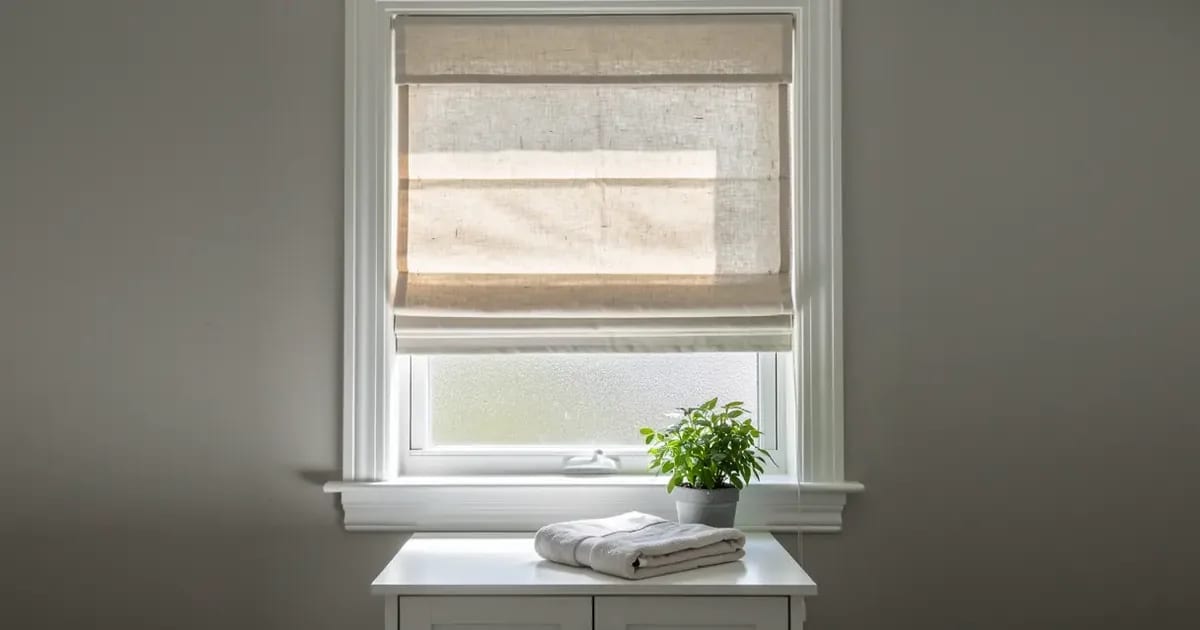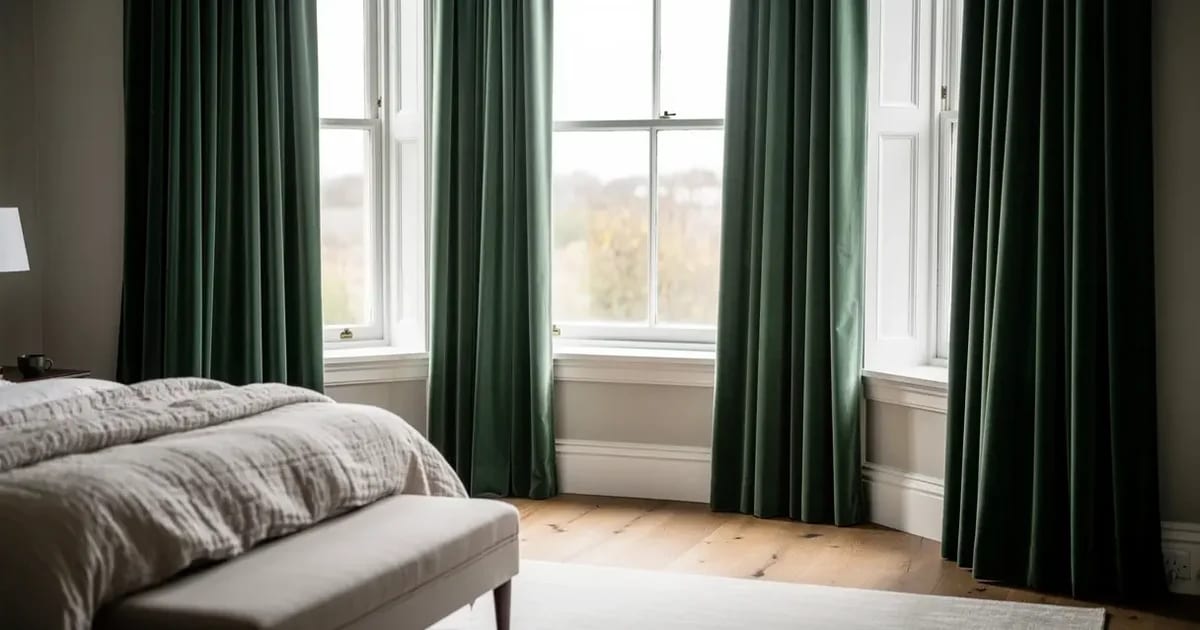
A big window behind a freestanding tub is what many people dream of in a main bathroom. It is also the hardest window in the house to dress. It takes steam, it lets in a lot of daylight, and after dark it turns into a screen where you can be seen from the street or the yard.
My posts on condensation and on privacy were mostly about small windows. This one is about the big one, the one you want to look good.
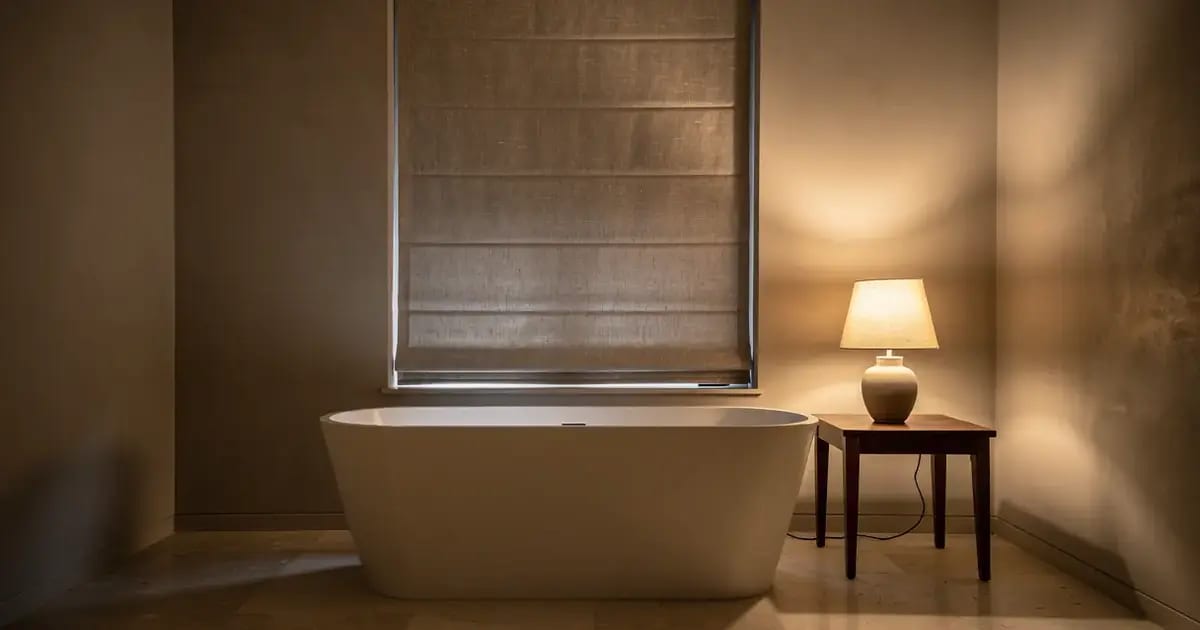
What this window asks of a fabric
Four things, and they pull against each other a little.
Cope with steam. After a hot bath the air in the room is saturated. The fabric has to dry between baths, which matters more than its fibre.
Let daylight in. If the window is big, it is for the light. A treatment that blocks it all day misses the point.
Hide you at night. By day, people see poorly from the street into the room. In the evening, with the lights on, it is the other way round, and a tub in front of the glass is exactly what you do not want on show.
Look good. A window this size is the first thing you see on walking in. The fabric hangs in full view, and its folds matter as much as its job.
Three answers, and what each one settles
| Your window | What I would make |
|---|---|
| Wide and tall, with room on each side | Floor-to-ceiling linen drapes with a light lining |
| Wide, but no wall space at the sides, or a view you want to keep by day | A Roman shade, or two or three side by side |
| A view to keep, day and night | A sheer for the day, a heavier panel for the evening |
Lined drapes
This is the most generous answer, and the quickest route to a spa look. Washed linen that falls straight, deep folds, a hem that just clears the floor.
Here I have to qualify what I write elsewhere. In my post on condensation, I sew the panels for a small window unlined, because a lining holds moisture. I still stand by that. On the large window of a main bathroom, though, a lining does real work: without it, a light linen shows your silhouette at night with the lights on.
So this is how I make it. A light lining that breathes, never coated or bonded. Hung with some play behind the face fabric rather than sewn flat across the whole surface, so the two layers move and dry on their own terms. And if the glass runs with water all winter despite the fan, I go back to a single unlined panel, as on a small window. The lining is decided with the window, not before.
The Roman shade
Raised, it clears almost the whole glass. Lowered in the evening, it hides everything, as long as it is sewn in a cloth tight enough to stop a silhouette.
A shade is made up to 5 feet wide. A large window is therefore split into two or three shades side by side, which barely shows once they are all down, and lets you lower just one for a bath. I order the lifting mechanism for each shade, so you have nothing to buy. The details are in my post on Roman shades.
In a bathroom, the shade is mounted on the wall above the frame, so air moves between the fabric and the glass. Same rule as for a curtain panel.
The sheer and the heavier panel
Many of my clients in the Eastern Townships layer a sheer for the day and a heavy curtain for the evening. In a bathroom, it works very well.
A linen sheer softens the light, keeps the view of the garden and dries fast, because it is a single layer. But in the evening it turns almost transparent. A heavier panel then closes the window. It is the same tight cloth as for a shade, or a linen with a light lining as above.
A custom sheer is sold on its own or with a curtain: both are made.
Fabrics that hold up
The same as in my other bathroom posts, because steam does not change.
Washed linen and cotton go through the machine, dry fast and stand up to repeated washing. Washed linen has already finished shrinking, which makes it steadier in your home. Linen has its habits in a Quebec climate: it moves a little with the seasons.
Treated polyester blends resist mould and keep their shape. A solid choice if the room lives in humidity all year.
What I rule out: velvet, silk, any heat-bonded lining, and anything that needs professional cleaning. A bathroom gets washed more often than a living room.
Away from the tub, away from the glass
Two distances matter more than the fabric.
Away from the tub. A panel hanging within reach of splashes will take one some day. Keep the hem of the curtain clear of the tub, and never let fabric fall into the bath. If the shower sits inside the tub, or the spray reaches the window, that is the splash zone I describe in my post on bathroom window treatments: a vinyl blind or a composite shutter does better than fabric, and I do not make those.
Away from the glass. As with any bathroom window in Quebec, the panel stays clear of the cold glass, with air behind it. Health Canada notes, in its guide to moisture and mould, that thick curtains kept closed can hold cold and moisture against the glass. Open them by day. An exhaust fan that runs for a good while after the bath settles much of the rest, and it is the first thing I look at in a bathroom.
What gives the spa look
It is not the price of the cloth. It is height, width and length.
Height. On a large window, the rod or track goes up near the ceiling, 2 or 4 in (5 or 10 cm) below it, and you or your installer put it up. In my workroom, I sew the panel to reach the floor. The room looks taller and the window larger.
Width. Panels wider than the frame, overlapping it by 6 to 10 in (15 to 25 cm) on each side, stack on the wall when open and clear the whole glass. The tub stays facing the light.
Length. In a bathroom, I end the hem about 3/8 in (1 cm) above the floor rather than letting it drag. It does not drink the water off the floor, and the vacuum fits underneath.
This is high-end drapery work: a cloth with some weight, even folds, a well-finished heading. It is no more complicated, but sewing does not forgive shortcuts.
Frequently asked questions
Can you hang long drapes around a freestanding tub?
Yes, if the hem stays clear of the tub and out of reach of the water. A hem that touches neither the bath nor a wet floor dries fast.
What fabric for a large bathroom window?
A washed linen or cotton, or a treated polyester blend, for the face. For the evening, a light lining that breathes, or a tight cloth. I rule out velvet and silk.
Does a Roman shade stand up to bathroom humidity?
Yes, in a washable cloth, mounted above the frame so air passes behind it. I would not recommend one inside the shower or the tub alcove.
Where to start
Look at the window in the evening, lights on, from the yard or the street. What you see from outside tells you whether a sheer is enough or whether you need a cloth that hides.
Then call me at 873 200-4056. Tell me the width of the window, whether there is room on each side, and where the tub sits relative to the glass. That tells me almost everything. The rest of my work for this room is on my bathroom window treatments page.