When you get ready to host for the holidays, you think about the table, the dishes and the tablecloth. The kitchen chairs, the breakfast nook banquette and the bench by the door get less attention, yet that is where your guests spend the evening. A cushion that slides off, a flattened pad or a stained cover is the first thing people notice. I have been sewing for more than thirty years, and in my Sherbrooke workroom, seat cushions land on my cutting table often.
The holidays make a good deadline, but these cushions work all year. Here is how I make them stay put, keep their shape and go through the wash. For decorative cushions on the sofa, see my guide to custom throw pillow covers instead.
How to measure a chair or a banquette
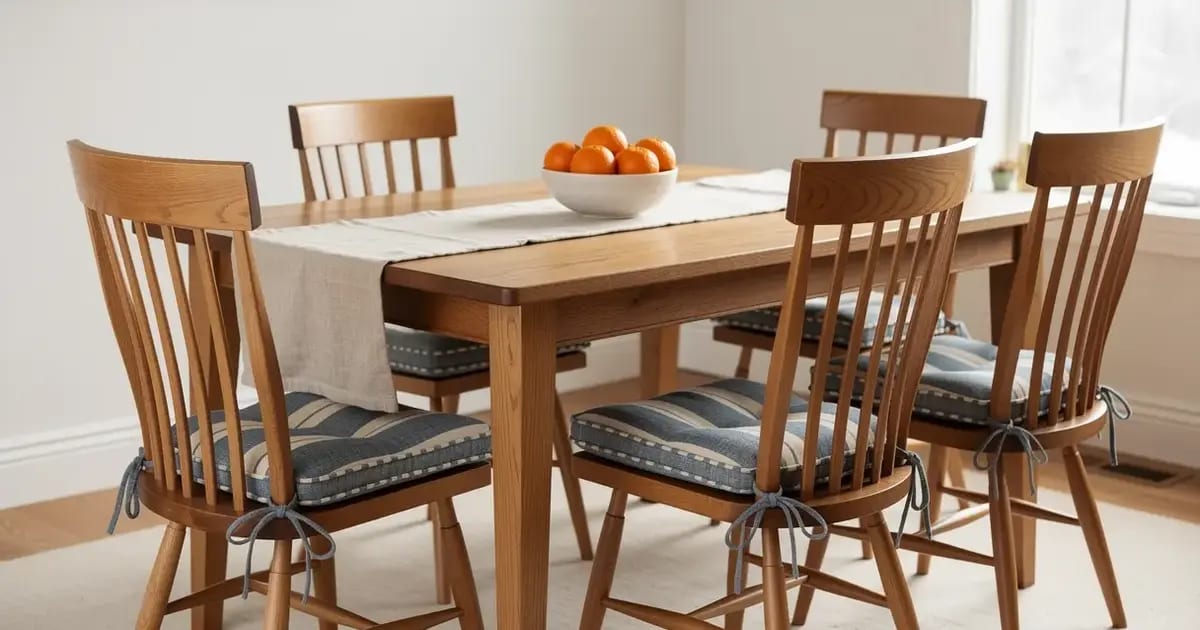
For a chair, I work from a paper template. Lay a sheet of brown paper on the seat and trace around the edge with a pencil. Cut notches around the back posts and write "front" on the right side. Mark where the posts sit, because that is where I sew the ties. If your chairs all match, one template is enough.
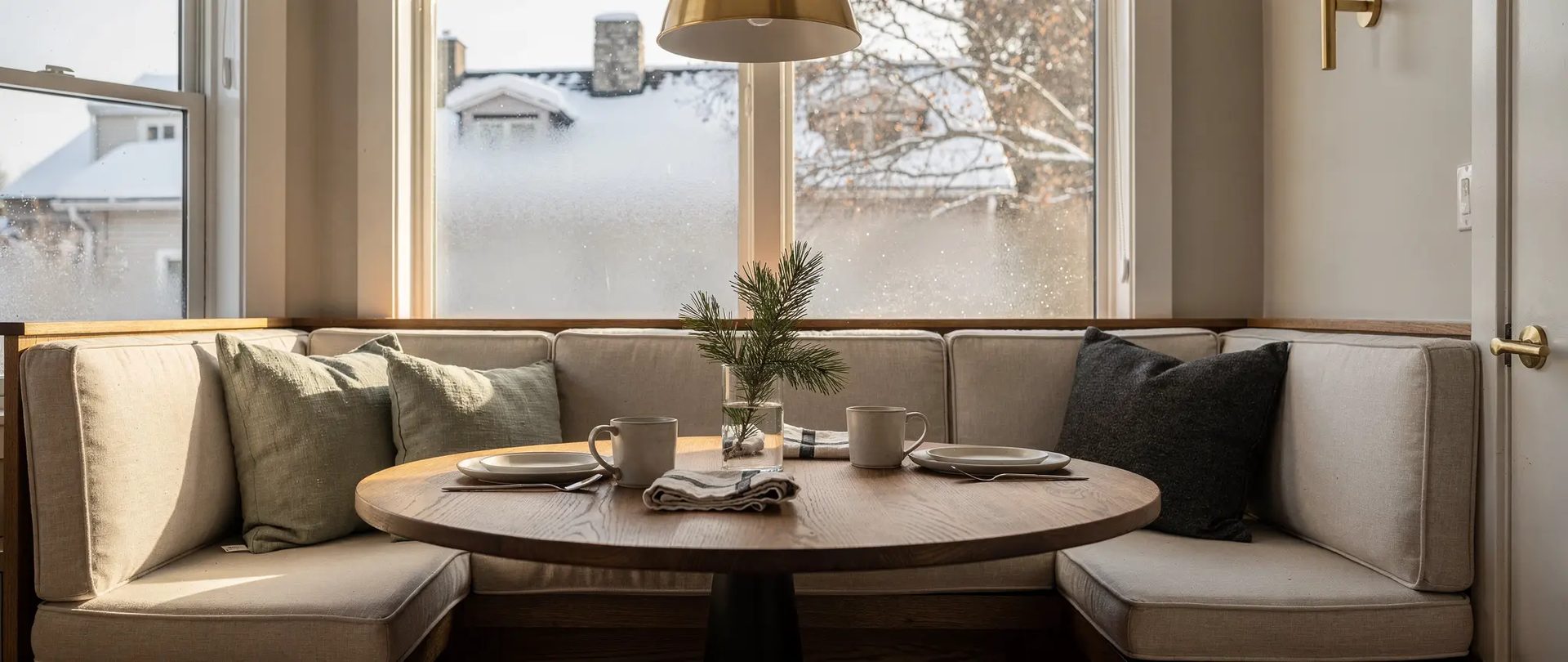
For a banquette, I need three numbers: the length, the seat depth and the height of the back. Measure the length at the back and at the front, since walls are not always square. An L-shaped banquette is measured as two pieces, and I will ask which end meets the wall. A bench only needs length and depth.
A rocking chair takes more care. The seat is often scooped and the back is tall, so the paper template matters even more. We can also plan a back cushion tied to the top rail.
Which foam to choose
Denser foam lasts longer, and firmness is a comfort choice you make separately. The Polyurethane Foam Association explains that density is measured in pounds per cubic foot or kilograms per cubic metre, and that it affects durability and support. Firmness is measured on its own scale, called IFD. The association points out that a high-density foam can be soft and a low-density foam can be firm, so ask for both numbers.
For thickness, I think about the height of the table. On a kitchen chair, a 2-inch (5 cm) pad is often enough; any thicker and you sit too high. A banquette can take 3 or 4 inches (7.5 or 10 cm). I wrap the foam in a thin layer of polyester batting, which softens the edges and fills the cover nicely.
If you already have foam, or old cushions with good insides, bring them along. If not, we talk about it at the consultation.
Box cushion or flat pad
A box cushion has straight sides and crisp corners; a flat pad is thinner and softer. I sew a box cushion with a side band and piping along the top and bottom seams. It holds its shape and suits a banquette or a bench. A flat pad, two faces sewn together, works better on a wooden chair or a rocking chair. A few tufting buttons stop the filling from shifting.
A removable cover with a zip
Yes, I put a zip in every cover so you can take it off and wash it. In a kitchen, that is what makes a cushion last. On a box cushion, the zip hides in the side band at the back. On a flat pad, it runs along the back seam. I cut the cover snug to the foam so it stays taut and does not wrinkle. Wash it in cold water and dry it flat, or follow the fabric label.
Which fabrics work in a kitchen
A tightly woven, washable fabric, ideally with a stain-resistant finish, stands up to meals. Cotton canvas, cotton twill and solution-dyed acrylic outdoor fabrics handle washing and spills well. Keep light linen and long-pile velvet for the living room.
The Association for Contract Textiles publishes guidelines for commercial upholstery fabrics. As of November 2026, its abrasion guideline pairs 15,000 Wyzenbeek double rubs with light-traffic use and 30,000 with high-traffic use. It also notes that a fabric rated for twice as many rubs does not last twice as long. So I look at the weave and the colour as well. If you want the windows to match, see my practical guide to kitchen curtains.
How to stop a cushion from sliding
Ties at the back posts and a non-slip underside keep a cushion in place. I sew two cords or ribbons into the back seam where the template is marked, and you knot them around the posts. Under the pad, a non-slip fabric keeps it from creeping forward. On a banquette, well-fitted box cushions hold each other in place. For a few festive throw cushions on the banquette, see my custom Christmas cushions.
Frequently asked questions
Can you make just the covers if I already have cushions?
Yes. Bring the cushions, I measure the foam and sew a new cover with a zip.
Do I need to bring the chair to the workroom?
A paper template is usually enough. For a rocking chair or a deeply scooped seat, bring the chair if you can.
Can the banquette cushions match my curtains?
Yes. I can sew the cushions and the curtains from the same fabric, or pick a solid that picks up a colour from the pattern.
Where to start
If you want your chairs, banquette or rocking chair ready before you host, call me at 873 200-4056. We talk about your seats, your measurements and the fabric you have in mind. You can also book a consultation.