Most of the Christmas cushions I sew are really covers. You keep the cushions already on your sofa, and I make them a second set of clothes for the holidays: on in early December, washed and put away in January, with the same inserts doing the work all year.
The year-round rules for a good cover are in my guide to custom throw pillow covers. This post is the seasonal version: the closure that makes swapping easy, fabrics that feel like Christmas without tipping into kitsch, and how to tie the cushions to the rest of the room.

Keep the insert, change the cover
The simplest route to Christmas cushions is a second cover for each cushion you own. The feather or fibre insert stays put. Only the outer layer changes, and it folds flat into a drawer for the other eleven months.
What I need from you is the real size of each insert, measured flat from seam to seam without squashing it. Labels are often off by about 1/2 in (a centimetre or two). I then cut the cover slightly smaller than the insert, so the corners stay full, the same way I would for any cover in the house.
Envelope back or zip: it depends on who leans on it
For a Christmas pillow cover you take off once a year, an envelope back is often the right call. Two panels overlap at the back and the insert slides in within seconds, with no zip to line up. On a cushion that is mostly there to be looked at, it works perfectly.
On the cushion someone leans against every evening of the holidays, I put a concealed zip along the bottom edge instead. An envelope back gapes once people sit against it. A zip keeps the cover taut, and it opens in one move when the cover needs a wash.
Fabrics that say Christmas without shouting
A good Christmas fabric gets its effect from texture and colour far more than from its print.
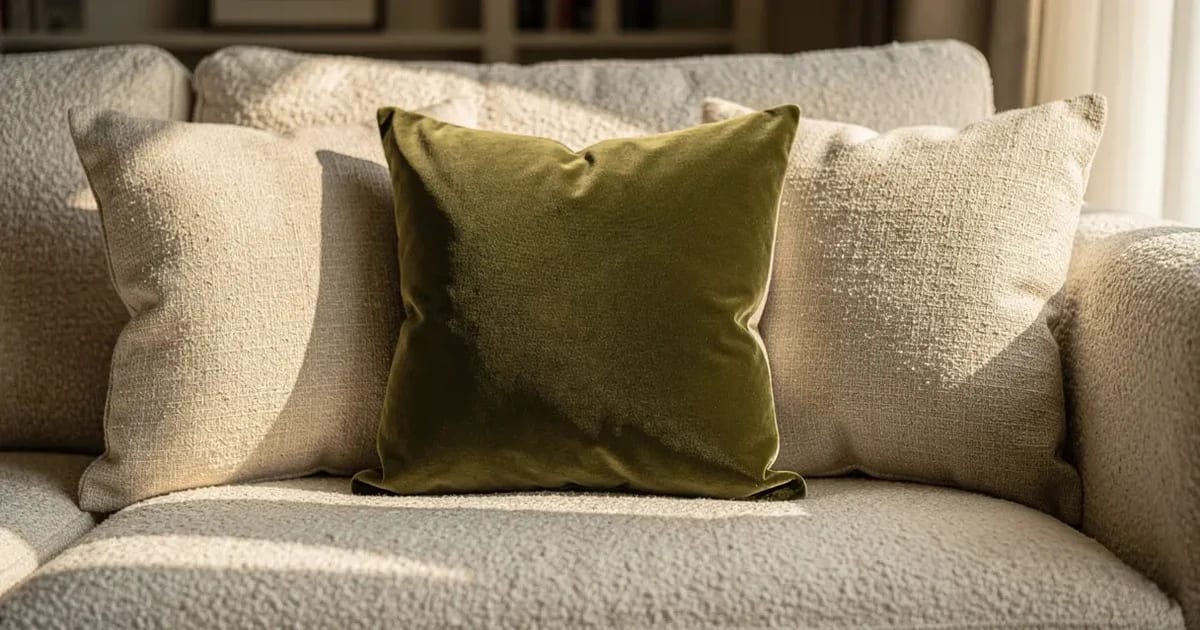
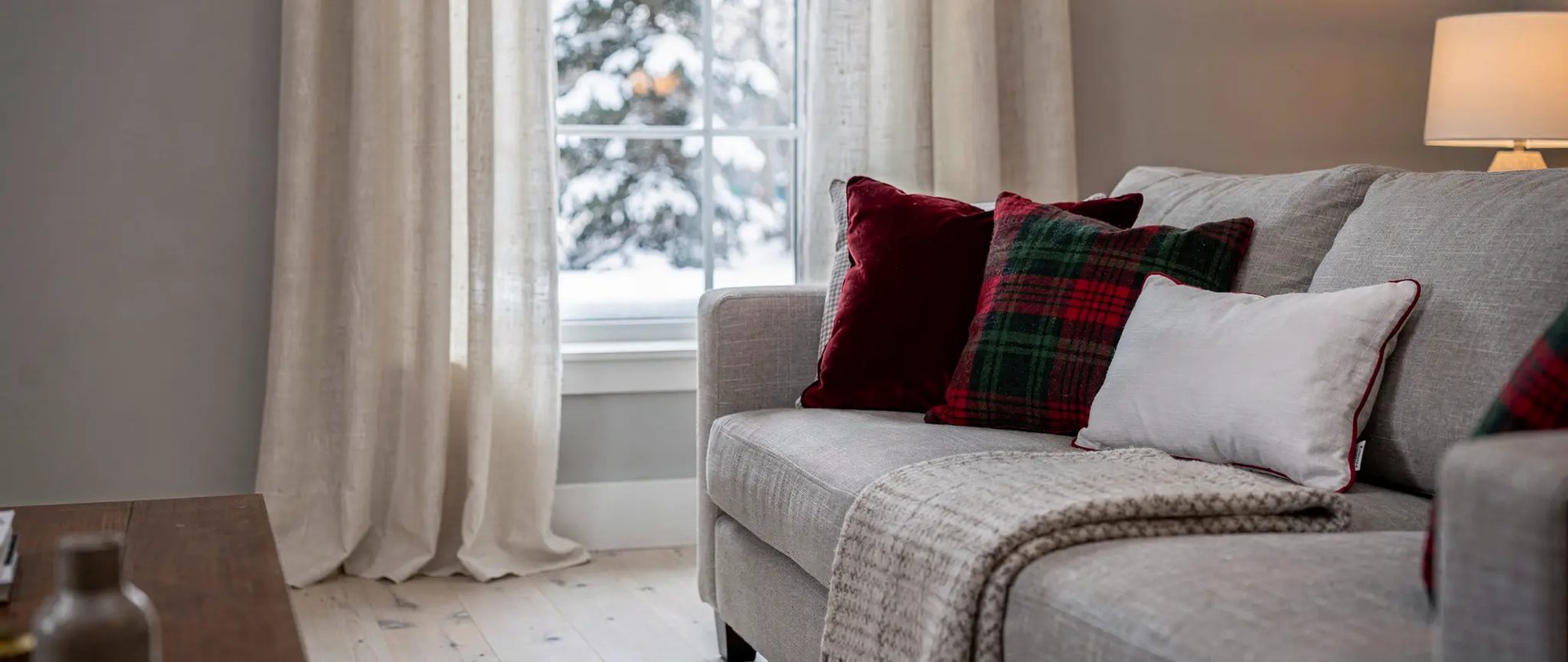
Short, dense cotton velvet in red is my first choice. It catches lamplight in the evening, and a deep red leaning toward burgundy wears better year after year than a bright one. Long-pile velvet crushes where people lean, so I keep it for cushions nobody sits against. More on velvet in my January post on velvet and texture.
Tartan wool reads as cottage and Christmas at once. A check has to be matched, so I centre the pattern on the face of the cushion, which takes a little more fabric than a solid.
White linen with red piping is the quietest of the lot. Piping is a cord wrapped in a strip of bias-cut fabric and sewn into the edge seam, so it outlines the cushion in a thin red line. That one can stay out well into winter.
Cotton prints need restraint: a small repeat such as stylised trees or snowflakes on a plain ground, and only one printed cushion among the solids. Leave one or two of your everyday cushions in the mix and the room still feels like yours.
Matching cushions to curtains, a tablecloth or a tree skirt
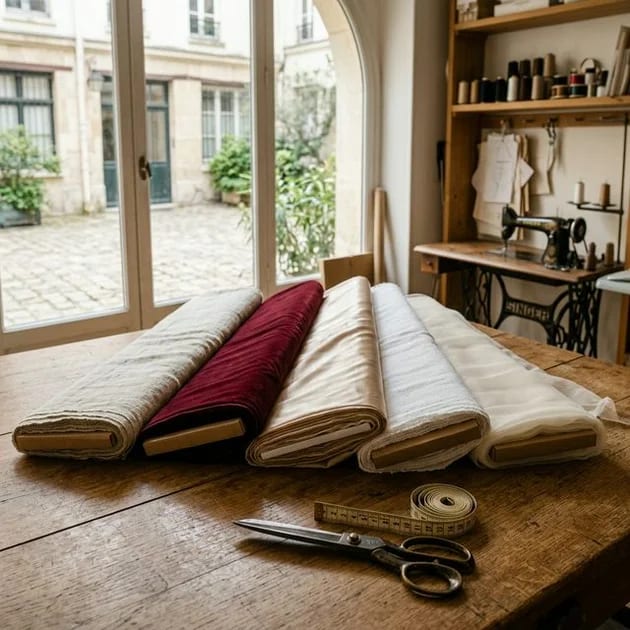
The surest way to make Christmas cushions look planned is to repeat a fabric already in the room. Leftover fabric from a curtain order often covers one or two cushions; the fibres themselves are covered in my fabric guide.
I also sew tablecloths, table runners and tree skirts (see my post on the Christmas tablecloth, table runner and tree skirt). A red velvet tree skirt and two cushions in the same velvet tie the tree corner to the sofa. A white linen runner edged in the same red as the cushion piping does the same between the dining table and the living room.
To match a cover to curtains you already have, bring an offcut. Reds shift a lot with the light in a room.
Washing and storing the covers in January
Wash each cover before you put it away, following its care label. As of November 2026, the Government of Canada's Guide to Apparel and Textile Care Symbols sets out five basic symbols, for washing, bleaching, drying, ironing and professional cleaning. It recommends a high iron, up to 200 °C, for cotton and linen, and a medium iron, up to 150 °C, for wool and silk. So your tartan wool cover gets a cooler iron than the white linen one.
Velvet should never be pressed flat: steam it from a distance, on the back. Store the covers clean and fully dry in a drawer or a cotton bag, never a sealed plastic bag, which traps moisture. Roll velvet rather than folding it.
When to order Christmas cushion covers
Call me early in November. A velvet or tartan cover gets cut once the fabric is chosen and the inserts are measured, and the weeks go fast before the holidays. On the phone we can sort out what is doable before Christmas for the fabric you have in mind.
Frequently asked questions
Can you make a Christmas cover for a store-bought cushion?
Yes. Bring the cushion, or its size measured flat. I sew the cover to its real dimensions, and the same insert goes back into its everyday cover in January.
Which fabric works for a Christmas cushion people actually sit against?
A short-pile cotton velvet, a tightly woven tartan wool or a mid-weight linen. They stand up to a whole holiday season of leaning. Keep silk and long-pile velvet for the cushions that are just for looking.
Can you make the tree skirt in the same fabric as the cushions?
Yes, I sew tree skirts, tablecloths and table runners too. Tell me when you order so I can plan the fabric for the whole set.
Where to start
If you would like Christmas cushions this year, call me at 873 200-4056. We talk about your cushions, your curtains and the colours in the room. You can also book a consultation.