Canopy Bed Curtains: The Fabric Is the Easy Part
The frame carries the weight and the room decides whether it is pleasant. Panels are seen from underneath and lit from behind, which changes the cloth entirely.
Canopy beds are back, and the sewing is the straightforward half of the job.
What decides whether a canopy works is almost entirely outside the fabric: whether the frame can carry the weight, whether the panels are meant to close or only to frame, and whether the room stays pleasant with them drawn. That last one is a Quebec question, and it is the one nobody writing from a warmer place has to answer.
Why canopies came back
The version returning in 2026 is not the heavy draped four-poster of a period drama.
It is lighter and much more open: two panels rather than four, unlined or barely lined, in linen or a loose cotton, often on a slim metal frame rather than a carved wooden one. Several are not really curtains at all but lengths of cloth arranged over a frame.
The appeal is that a bedroom is the one room where nobody has to justify comfort, and a canopy is the fastest way to give a large room a smaller room inside it. In an older Townships house with a high ceiling and a big bedroom, it does something real: it brings the ceiling down to human height over the bed without touching the ceiling.
The frame carries the weight, not the fabric
This is the first thing I ask about and the thing most people have not considered.
Bed curtain panels are long. A full-height panel on a four-poster can be well over two metres, and four of them in a mid-weight cloth is a serious load hanging off the top rails of a frame that was often designed to look good rather than to carry anything.
Wooden four-posters with proper joinery are usually fine. Slim modern metal frames are the ones to check, because the top rails can flex visibly under weight, and a rail that bows makes every panel hang crooked no matter how well it was cut. Frames assembled with bolts through thin tube are the ones I ask about twice.
The frame is hardware, so it is not mine, and I will tell you honestly when I think a frame will not carry what you are asking it to. It is much cheaper to hear that before I cut two metres of linen four times over.
A canopy fails at the top rail far more often than it fails at the seam. The sewing is the part everyone worries about and the part least likely to be the problem.
Panels seen from underneath and lit from behind
Here is the thing no styling article mentions, and it changes the fabric choice completely.
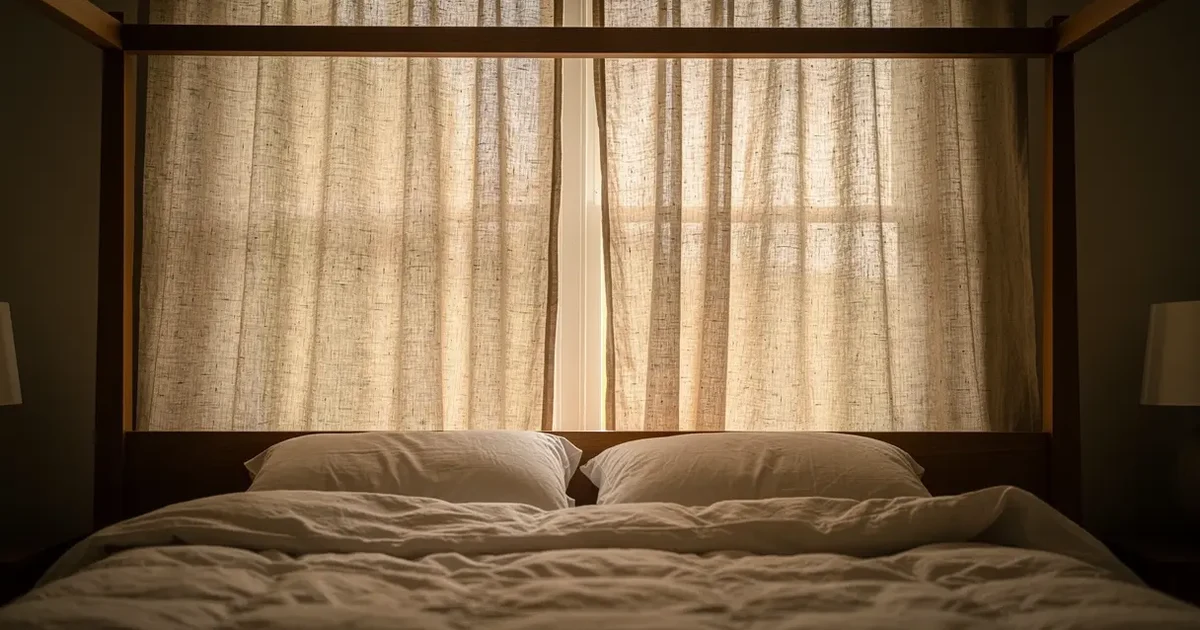
Almost every photograph of a canopy bed is taken from across the room, at standing height. That is the one view you will essentially never have. You will see these panels lying down, looking up, with a window behind them.
Backlit and seen from below, a fabric behaves differently. The weave becomes visible in a way it never is on a window, because your eye is close to it. Every seam shows as a line. Slubs and irregularities that read as texture in a curtain read as detail here, which can be lovely or can be distracting. And any fabric with a printed pattern shows the print as a shadow in reverse.
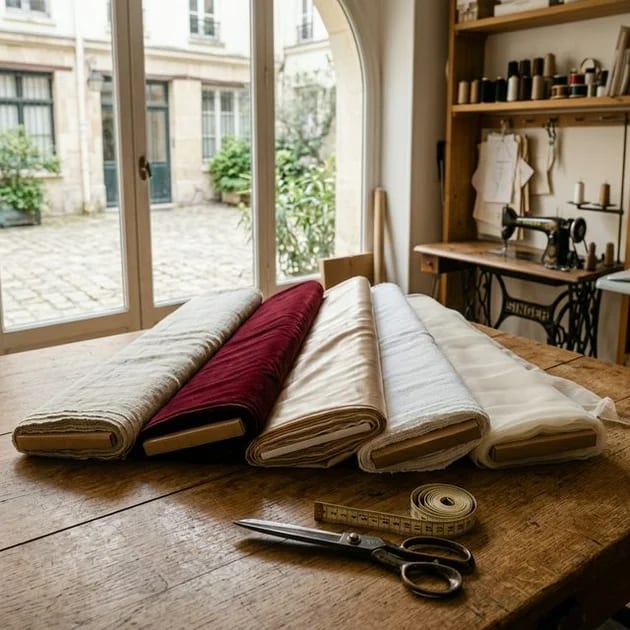
So I choose these panels for how they look lit through, not for how they look against a wall. Loose plain weaves in linen and cotton are wonderful this way. Anything with a coated back is dead, and it looks dead specifically from underneath.
The inside face matters as much as the outside. On a canopy, the side facing the bed is the side you actually live with, which is the reverse of a curtain. If the panels are lined, the lining is the face you will see for years, and it deserves to be chosen rather than defaulted.
January and July are two different rooms
This is where I would push back on almost any magazine.
A closed canopy is a small enclosed volume. In a Sherbrooke February that is genuinely lovely: it holds warmth around the bed in a room that runs cold, and on a cold night it is the most comfortable thing in the house.
In July the same enclosure is stifling. Fabric that traps heat in winter traps it in summer too, and a bedroom in an older house without air conditioning is already the warmest room by evening.
Which is why I steer most people toward panels that are unlined and light, and toward a canopy that is meant to be tied back for half the year. A heavy lined canopy that is genuinely enclosing is a wonderful thing for a specific room, and that room needs to be one you can keep cool, or one you accept using differently in summer.
To close, or only to frame
Answer this before choosing anything else, because it changes the fabric, the fullness and the count.
Panels meant to close need enough width to actually meet, which means real fullness, at least double the span they cover. They need to be openable and closable without effort, which means a light cloth and a clean top edge. They will be handled every day, so they need to survive handling and washing.
Panels meant to frame are the more common request even when people describe them as the first kind. They stay where they are put. They can be narrower, they can be a more delicate cloth, and they mostly exist to soften the vertical lines of the frame and to give the bed a top edge.
Framing panels are cheaper, easier to live with, and what most people actually wanted. Closing panels are worth it when the room is cold, or when there is a real reason to be enclosed.
Two panels at the head beats four all round
My honest recommendation, and it is the opposite of what the pictures suggest.
Four panels, one at each post, is the classic arrangement and it is a lot of fabric in a room. It closes the bed in on all sides, it collects dust on every surface, and it makes an average bedroom feel crowded rather than layered.
Two panels at the head end do most of the work. You get the sense of enclosure where your head actually is, you get the softening of the frame, and you keep the foot of the bed open so the room still reads as a room. It is also half the fabric, which on a two-and-a-half-metre drop is not a small difference.
I suggest starting there. Adding two more later is easy if the first two came from a fabric I can still get, which is worth asking about at the time of the order.
Before you order
Measure from the top rail of the frame down to where you want the hem, and tell me whether the panels should close or only frame. Photograph the frame at its top corner so I can see how the rails are joined.
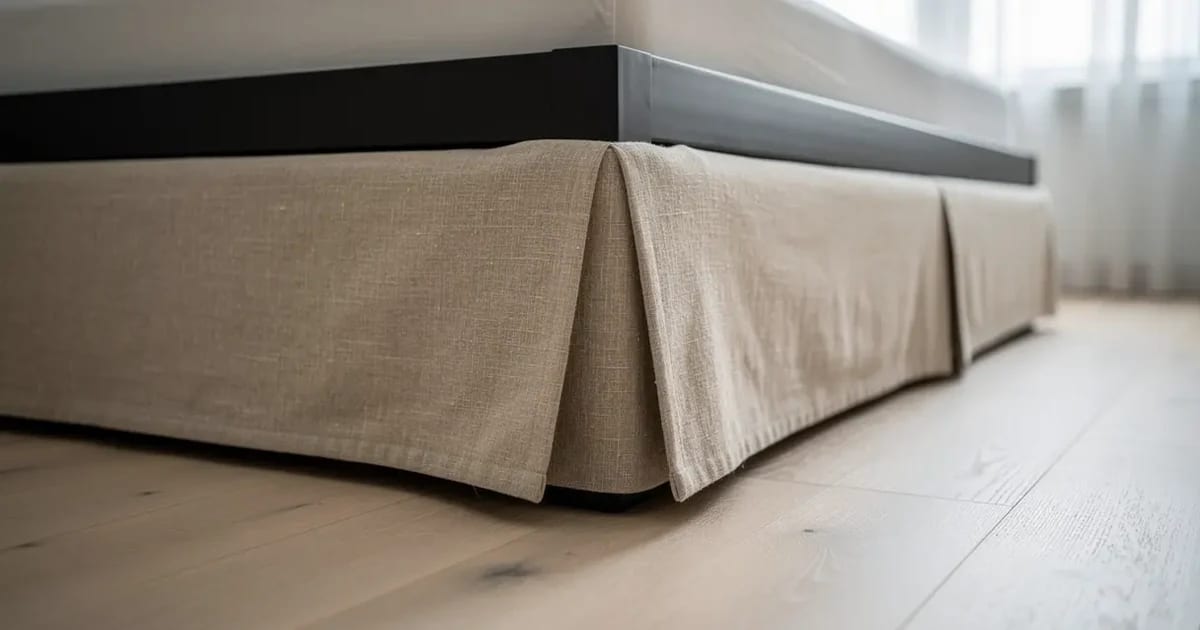
The bedroom-level thinking is on the bedroom page, and if the rest of the bed is part of the same project, the bed skirt piece covers the measurements underneath.