Your Bed Skirt Is the Wrong Length, and It Is Not Your Fault
Every store bed skirt is cut for a box spring, and almost no bed still has one. How to measure the drop that matters, and when a coverlet beats a skirt.
A client called me last spring because she had bought three bed skirts in a row and sent all three back. She assumed she was measuring wrong.
She was not. She had a storage base with drawers, and every skirt she ordered had been cut for something else entirely.
This happens constantly, and the reason is worth knowing before you buy a fourth one.
Why every store bed skirt is the same length
Bed skirts exist because box springs are not attractive. That was the whole design brief.
A box spring is a manufactured object with a standardized height, so for decades a bed skirt could be sold in one drop and fit nearly every bed in the country. That is why the tag says a length and not a range, and why nobody ever asks you to measure anything.
Then beds changed. Platform beds, storage bases with drawers, adjustable bases, low frames with a bunkie board, upholstered frames with visible legs. None of these is a box spring, and none of them sits at the box spring height. The skirt did not change with them.
So you get one of two outcomes. Either the skirt floats above the floor, which reads as a mistake rather than a style, or it pools on the floor and gets caught under the vacuum. Both are the same problem: a fixed drop meeting a bed that was never measured.
A bed skirt is not a size. It is a measurement, and it is a different measurement on nearly every bed built in the last fifteen years.
Three bases, three different drops
Before measuring, work out which one you have, because it changes more than the number.
A platform bed has a solid or slatted deck holding the mattress directly. There is no box spring, so the skirt has to hang from somewhere else, usually a fitted deck under the mattress, or clips. The drop is measured from the top of the platform, not the top of the mattress.
A storage base with drawers is the hardest case, and the one that defeats store-bought skirts entirely. The drawers have to open. A gathered skirt that covers the whole side will be dragged into the runners within a week. This bed wants a skirt that stops above the drawer line, or no skirt at all and a longer coverlet instead.
An adjustable base moves. The head lifts, the foot lifts, and a skirt fitted tight to a static shape will bind or tear the first time the bed articulates. These need a skirt attached to the base itself rather than trapped under the mattress, with enough ease at the hinge points.
Measuring the drop that actually matters
Two measurements, and neither is the one people take first.
The drop. From the surface the skirt hangs from, meaning the top of the box spring, the platform deck, or the rail of the base, straight down to the floor. Use a rigid tape, not a soft one, and take it at the head, the middle, and the foot. Old houses in the Townships are not level, and a two-centimetre difference from head to foot is common. I cut to the shortest of the three so the skirt never pools.
The deck. The length and width of the surface the skirt attaches to, which is not the same as the mattress size. On a platform bed the deck is often slightly larger than the mattress; on a base with a rail, slightly smaller.
Then subtract. I cut the finished drop about one centimetre short of the floor measurement. That gap is invisible from standing height, and it is the difference between a skirt you can vacuum around and one you fight with.
Split corners versus gathered corners
Here is the construction detail that separates a made skirt from a bought one.
A store skirt is usually gathered all the way around, including the corners, because gathering is forgiving of dimensions. It hides a multitude of measurement sins. It also bunches at every post and every visible leg, and on a modern frame that bunching is the first thing you see.
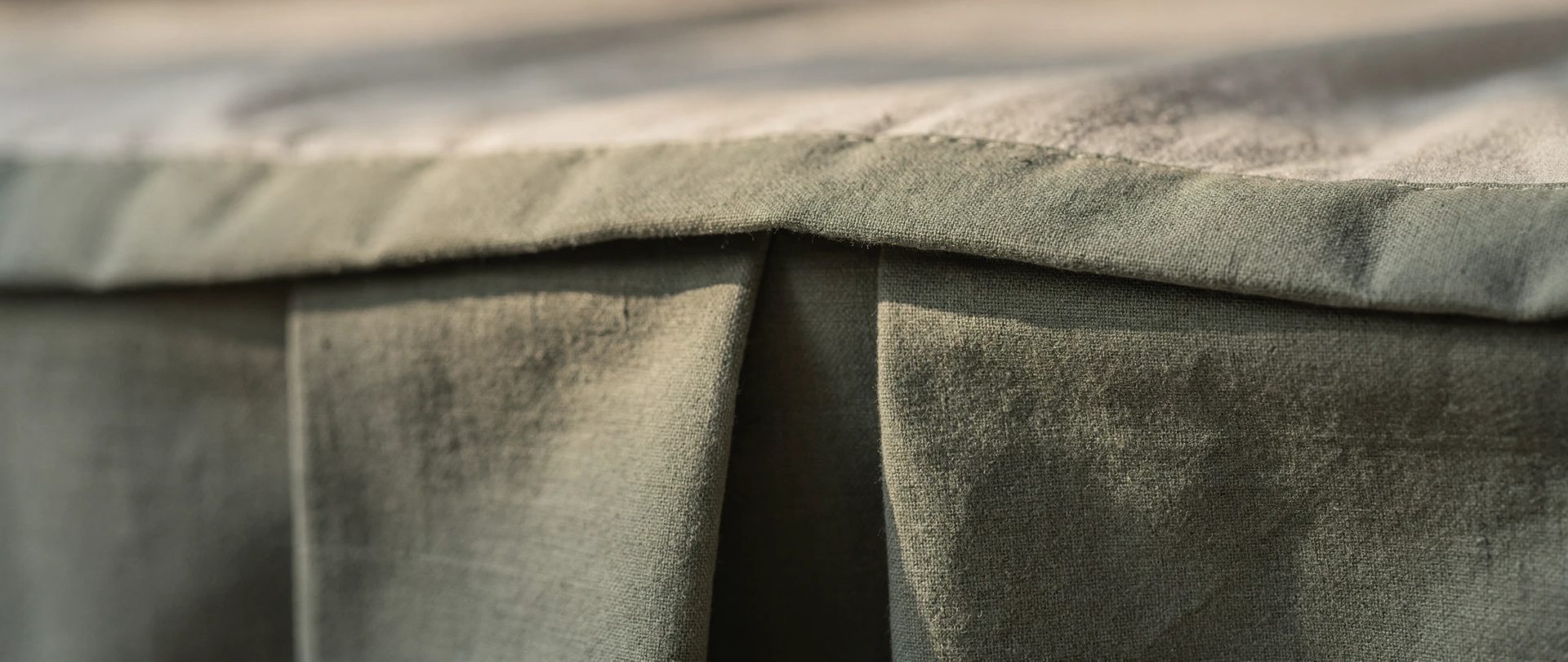
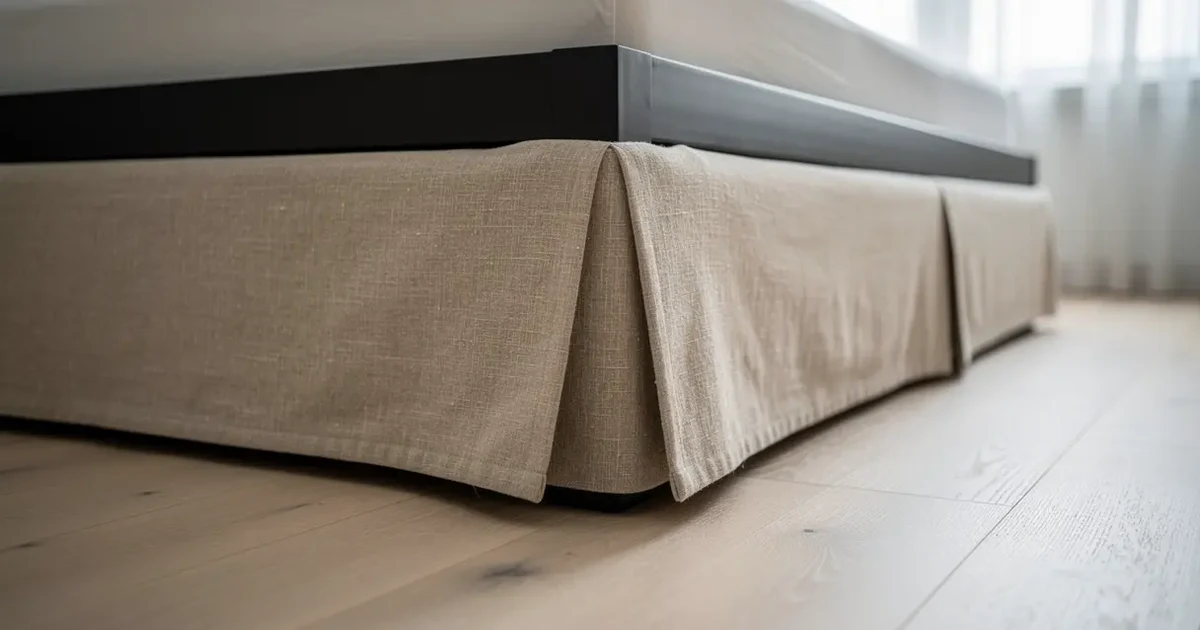
A made skirt has split corners: the panels are cut as separate sections that meet at each corner with a finished opening. On a four-post or a bed with visible legs, the panel goes around the post cleanly instead of wadding against it. On a storage base, the split lets a drawer open without dragging the whole side.
Splits also mean the skirt can be tailored rather than gathered: flat panels with a crisp fold at each corner, which is the look most people actually want when they say they want a bed skirt but do not like bed skirts.
The fitted deck, and why elastic fails
Most store skirts attach with an elasticated band that stretches around the box spring.
Elastic works on a bed that never moves. On a base you slide out to vacuum behind, on an adjustable base, or on a bed in a room where the frame gets shifted, elastic migrates. It rides up on one side, the drop goes uneven, and you straighten it every few weeks forever.
A fitted deck is a flat panel of plain fabric that sits under the mattress with the skirt sewn to its edge. The weight of the mattress holds it, so it cannot migrate. It uses more fabric, but the fabric is inexpensive lining rather than face cloth, and it is the single change that makes a skirt stay where you put it.
When a longer coverlet beats a skirt
I talk about a third of my bed skirt enquiries out of a bed skirt, so it is worth saying plainly.
If your base has drawers you use often, a skirt will lose that fight. If your frame is genuinely handsome, whether solid wood, a good upholstered rail or visible tapered legs, covering it is working against the furniture you paid for. And if the room is small, a floor-length skirt visually plants the bed on the floor and makes the space read smaller than it is.
In all three cases, a coverlet cut long enough to fall past the mattress does the job better. It hides the mattress edge, it leaves the base visible where the base deserves to be seen, and it comes off in one motion when you strip the bed.
That is a bedding decision rather than a skirt decision, and it belongs in the same conversation as the duvet cover, because the two have to agree on where the eye stops.
Before you order anything
Take the three drop measurements and note whether they match. Photograph the base from the side. That is enough for me to tell you whether you want a skirt, a coverlet, or nothing at all.
Full details of the service are on the custom bedding page. If the mattress side of the problem sounds familiar too, the sizing arithmetic behind duvet covers is the same arithmetic, and it is the reason most beds look under-dressed no matter what the fabric cost.