In December, everyone wants red on the sofa. In January, the covers go back into the basement bin with the garlands. I would rather sew a red that stays until the end of March: a deep velvet, a checked wool, a white linen picked out with a red edge. This post is about colour and fabric. For cushions that change with the holidays, see my post on custom Christmas cushions instead.

Which red cushions last all winter?
A deep red, in a winter fabric, with no seasonal motif. A dark cherry, a brick or a burgundy in velvet or wool reads as warmth. An embroidered tree or reindeer reads as December 25, and the cover gets an expiry date. Plain red, tartan and checks carry through the whole winter, so nothing tells you to pack them away in January.
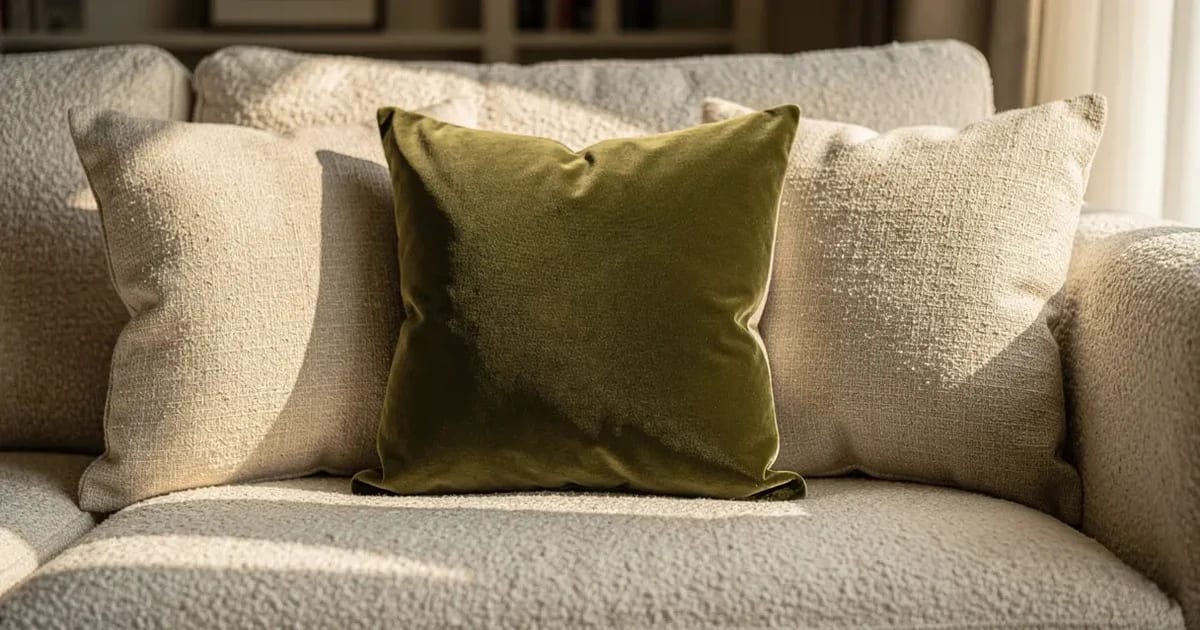
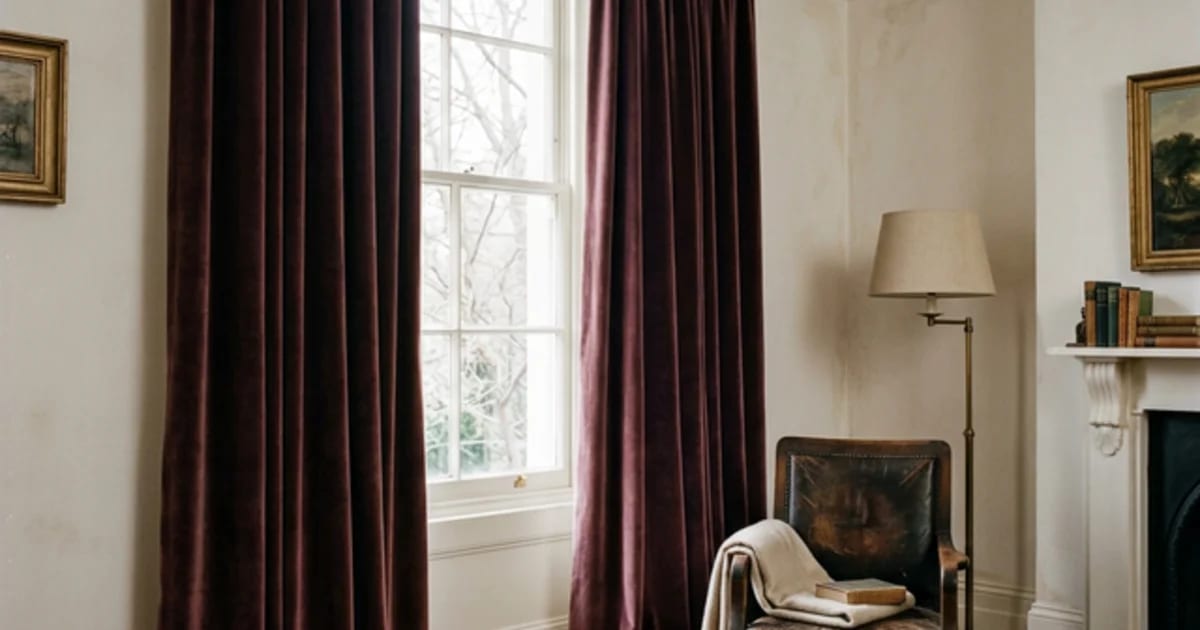
Red velvet: the pile direction changes the colour
On a velvet cushion, the direction of the pile decides which red you see. Run your hand over the cloth: with the pile it is smooth and looks lighter; against it, it feels rougher and looks darker. The sewing site SewGuide puts it plainly in its guide to sewing velvet: every piece is cut in the same direction.
In my workroom, I chalk an arrow on the back of every piece before cutting. The front and back of a velvet pillow cover run the same way, and so do the two cushions of a pair. Otherwise, side by side, they look like two different reds. For a cushion you lean on, I run the pile from top to bottom so your hand slides with it. For the darkest possible red, I turn it to run upward. That is settled before the scissors come out.
For wear, choose a short, dense cotton velvet: a long pile keeps the print of every elbow. I always press velvet from the back so the pile is never flattened.
Tartan and buffalo check: the pattern carries across the seam
A plaid cushion looks custom-made when the lines run on from one piece to the next. I centre the pattern on the front, either in the middle of a square or where two lines cross, so the cushion reads the same both ways. The horizontal lines on the front then meet those on the back at the same height on both sides of the seam. With the zipper along the bottom edge, I match the pattern across the zipper too.
Buffalo check, those big two-colour squares, is the least forgiving: a 3/8 in (1 cm) offset shows from across the living room. It is the same logic as matching a pattern on curtains, only smaller. On a cushion the extra fabric is a couple of inches (a few centimetres), and the offcuts from a plaid curtain order are often enough for two or three covers.
For tartan, pick a tightly woven wool. The thumbnail test in my throw pillow covers guide will tell you: if the threads stay pushed apart, the fabric will wear fast.
White around the red: piping and a flat flange
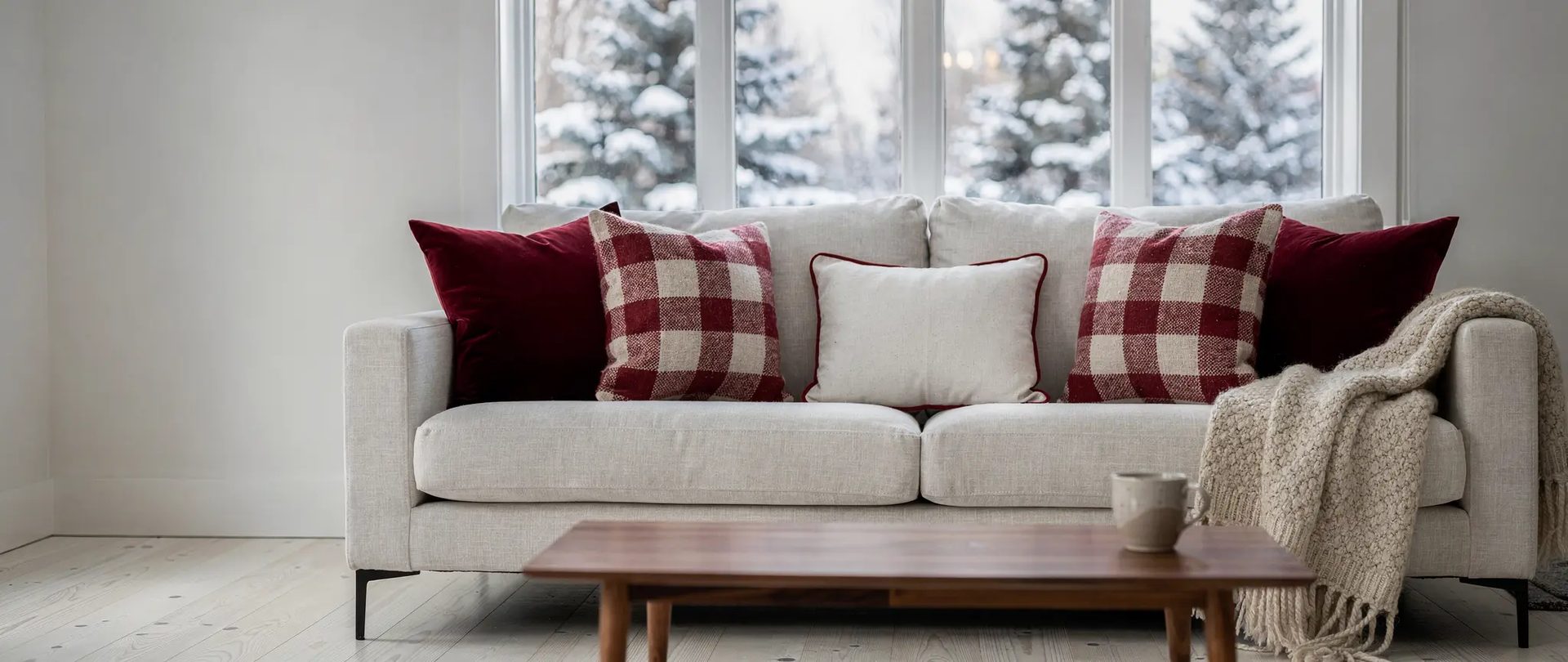
White gives red some air. On red and white pillows, a red edge ties every cushion on the sofa together. Two ways to do it:
- Piping. A cord wrapped in a strip of bias-cut fabric and sewn into the edge seam. White linen with red piping, or red velvet with white piping, draws the outline and keeps the edges straight.
- A flat flange. A band of fabric 1 1/2 to 2 in (4 to 5 cm) wide that stands out past the seam all the way around. White linen with a red flange looks softer, more country.
White linen shrinks at the first wash. I wash it before cutting, along with the piping fabric, so the two move together. The zipper then lets you wash the cover without the insert.
Mixing pattern scales on one sofa
On a sofa, I use one large pattern, one small one and some plains. For example: two buffalo checks at the ends, two plain red velvets, and a white linen with red piping in the middle. The large pattern sets the tone and the plains let it breathe. A small tartan added to the mix stays in the same family of red as the buffalo check. Two large patterns fighting each other tire the eye. The biggest cushion goes to the outside, the smallest toward the centre.
Which red goes with which walls and wood?
Not every red works everywhere. A cool red, cherry or raspberry with a touch of blue, suits white, grey or cool greige walls and pale maple or birch. A warm red, brick, tomato or rust, goes with cream, beige and oak, and is at home in a pine-panelled cottage. A dark red, burgundy or cranberry, pairs with walnut, cherry wood and dark green or navy walls.
Before you choose, I bring samples to you. Look at them in your living room around 4 p.m. in December, when the light drops: that is when red changes most. My January post on velvet and texture has more on winter colours.
Frequently asked questions
Can a red velvet pillow cover be washed?
It depends on the velvet. I read the label on the bolt before cutting, and many velvets are dry-clean only. That is why I put in a zipper: the cover goes to the cleaner and the insert stays home.
Can you make cushions from the fabric of my plaid curtains?
Often, yes. Pattern matching leaves offcuts, and they are usually enough for two or three covers. Bring them to the workroom and I will tell you what we can get out of them.
Doesn't red and white look too much like Christmas?
Not when the red is deep and the pattern has nothing seasonal about it. A burgundy velvet, a wool tartan and a white linen feel like a cottage in winter. A natural linen or greige cushion added to the sofa calms the whole set.
Where to start
If you want red cushions that last the winter, call me at 873 200-4056. We talk about your sofa, your walls and the fabrics you have your eye on. You can also book a consultation.