Custom Zebra Blinds: Guide to Alternating Shades
Zebra blinds alternate sheer and opaque bands to control light at any angle. Custom sizing eliminates band asymmetry from off-the-shelf blinds. Sherbrooke.
Of all the window covering products I install in Sherbrooke, zebra blinds, also called alternating shades or dual shades, tend to surprise clients the most the first time they see them in motion. Not because they're complicated. Because they do exactly what you ask of them, with a precision that neither a traditional curtain nor a standard roller blind can match.
How zebra blinds actually work
A zebra blind is made from a single continuous length of fabric, or technically two layers that move together, wound onto a roller mechanism. What makes it distinctive is the fabric itself: it's woven with alternating horizontal bands, one sheer, one opaque, repeating across the full height of the blind.
The light control happens when you adjust the blind. As the fabric moves, the two layers shift relative to each other. When the opaque bands align, they block light completely. When the sheer bands line up, light passes through freely. Between those two positions, there's a continuous spectrum: every degree of light filtering available to you simply by adjusting the cord.
That's the concept. Simple, elegant, functional. What makes it work in practice is the quality of the mechanism and the precision of the sizing. Both matter enormously.
Why custom sizing is non-negotiable
I hear from clients occasionally who ordered a zebra blind online at a reduced price and felt let down by the result. The most common complaint: the blind looks uneven. Bands on one side don't match the other. There's a visual irregularity they can't quite name but can't stop noticing.
That's what happens when an off-the-shelf blind meets a real window. The alternating band pattern is geometric. It repeats at a fixed interval across the fabric. When the blind width doesn't match the window precisely, those bands get cut at awkward points on the edges, creating asymmetry that reads as a manufacturing defect even when the blind is technically "working."
There are also light-gap issues. A blind that's even a few centimeters narrower than the window frame lets light leak in on the sides. In a kitchen where you're trying to reduce glare on a work surface, or a home office where screen glare is a daily irritant, that gap undermines the whole point of the blind.
Zebra blinds don't forgive approximation. The band pattern is precise geometry: if the blind wasn't cut for your specific window, it shows. Custom sizing isn't a premium option here. It's what makes the product actually work.
When I measure for a zebra blind, I account for the exact frame width, the mounting type (inside the recess or face-mounted on the wall above), and the depth of the window reveal if the blind needs to sit flush within it. Those details determine both the look and the day-to-day performance.
The rooms where zebra blinds perform best
Zebra blinds aren't the right answer for every window. Like all window coverings, they have spaces where they excel.
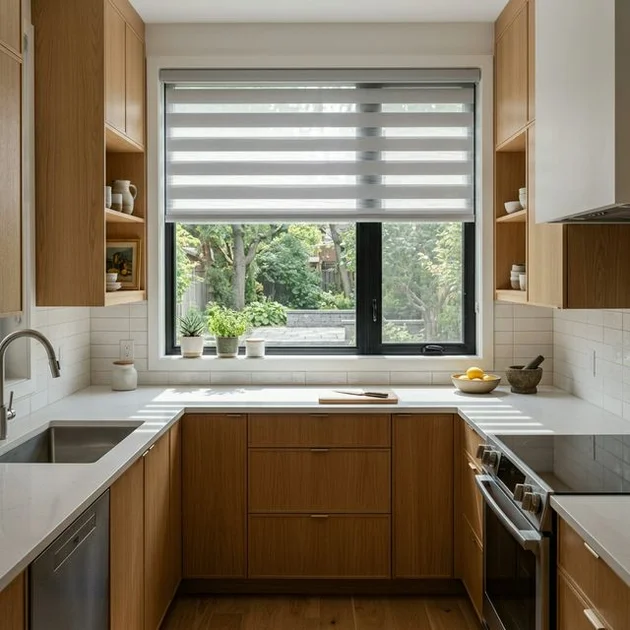
The kitchen is where I recommend them most often. Light control in a kitchen is genuinely complex: you want morning light, but not midday glare across the countertop. A zebra blind handles that transition without effort. And unlike curtains, it doesn't absorb steam, cooking odours, or grease. For a kitchen window that needs both light management and easy upkeep, it's often the cleanest solution.
The home office follows the same logic. Working at a screen with a window in your sightline is a source of constant fatigue. The ability to filter light without darkening the room entirely is exactly what the dual-shade design offers.
The living room is where zebra blinds tend to make the most visual impact. On a large window or a bay, the band pattern adds refined texture to an otherwise plain opening. During the day, the sheer bands let light in while maintaining some privacy from the street. In the evening, the opaque bands aligned give you full coverage. For a living room that gets strong natural light, it's one of the most elegant solutions I work with.
Fabric and opacity: the decisions that matter
Zebra blinds come in a wide range of fabrics and opacity levels. This is a real decision, not just an aesthetic one, because the combination you choose determines how the blind behaves in your specific space.
For the sheer bands, openness factor varies from near-transparent to semi-opaque. A highly open sheer lets in generous light but also lets silhouettes be seen from outside during daylight hours. A lower-openness sheer filters the same light while preserving privacy. The right choice depends on how exposed your window is and how much daytime privacy you need.
For the opaque bands, there's a meaningful difference between a light-filtering opacity and a true room-darkening one. A child's room where naps need to happen in summer, when Quebec daylight runs until 9 p.m., calls for maximum opacity. A home office or kitchen doesn't.
In terms of colour, current demand in Sherbrooke leans toward warm whites, soft greys, sand tones, and the muted greens and blues that are defining contemporary Quebec interiors right now. I source fabrics from suppliers who treat for UV stability: relevant for any south- or west-facing window in our climate, where sun exposure can visibly bleach untreated textiles within a few years.
How zebra blinds compare to traditional blinds and curtains
The question comes up often: why choose a zebra blind instead of a roller blind or a curtain?
Standard roller blinds offer far less flexibility. They're positioned at one level or another, and that's your light management. Some come in filtering or blackout versions, but there's no real-time gradation: you're choosing a fixed opacity, not controlling a spectrum. Zebra blinds are fundamentally more versatile.
Curtains have their own irreplaceable quality. They bring volume, warmth, soft movement. But they don't offer the same precision of light control, and they claim lateral wall space when open. In a compact kitchen window or a narrow home office, the zebra blind's minimal footprint is a practical advantage.
There's also a style dimension. Curtains read as traditional or transitional. Zebra blinds are contemporary: they work with clean-lined interiors, modern kitchens, open-plan spaces where a softer window treatment might feel mismatched. That's not better or worse. It depends entirely on the aesthetic you're building.
The two approaches can also coexist. In living rooms, I'll sometimes pair a zebra blind for light management with light linen side panels hung just for softness and visual weight. The layering works very well, each product doing what it does best.
What I do differently at my atelier
I work exclusively with professional-grade mechanisms. The difference between a quality roller mechanism and a budget one isn't always visible at installation. You feel it in the smoothness of the pull. You hear it in the quietness of the movement. And you notice it three or four years later, when the budget mechanism starts catching or losing its tension alignment while the quality one is still rolling clean.
For fabrics, I source from suppliers who guarantee band consistency, a technical detail that matters more than it sounds. The alternating bands need to register perfectly across the full width of the blind. A fabric woven with slight irregularities will show misaligned bands in direct light, especially on larger windows where there's more width to expose inconsistencies.
Each blind is cut and assembled in my atelier in the Plateau St-Joseph neighbourhood of Sherbrooke. It's not a product I receive pre-made from a wholesaler. It's something I build to the exact dimensions of your window, with the fabric and opacity combination we've chosen together.
If you're considering zebra blinds for a window in your home, get in touch for a quote. We can start with a conversation about your light needs, your space, and what look you're trying to achieve. I'll bring samples, and we'll find the configuration that actually suits your windows, not a theoretical average of windows in general.