Thermal Curtains Sherbrooke: Beat -25 Winters
Thermal curtains cut window heat loss by 25 to 40%. Lining, interlining and floor-length coverage with side overlap do the work. Winter guide by Nalia, Sherbrooke.
In Sherbrooke, winter doesn't negotiate. When it drops to -25 and the wind comes straight off Mont-Bellevue, what you have hanging at your windows genuinely matters, not for how the room looks, but for how much heat actually stays in it.
The question I get is usually not "which fabric." It's "will curtains actually help, or am I spending money while I should be saving for new windows." The honest answer depends on exactly what's happening at your window, and there's a quick way to check before you call anyone, including me.

The tell: condensation, frost, and cold air pooling at the floor
Before I talk fabric, I look at the window itself, and I ask three questions.
Is there condensation on the inside of the glass in the morning? Warm, humid indoor air meeting a surface colder than the dew point condenses, plain and simple. Almost every house in this climate sees some of that in January. What matters is where. Fog on the inside face of a single pane, worst near the bottom of the frame, is the classic sign of a cold window in a humid room, and it's exactly what a properly closed curtain helps with, by keeping warm, moist room air from hitting the cold glass directly.
Fog or frost trapped between two panes of the same sash is different: the sealed unit has failed and moisture has worked its way inside the glazing itself. No curtain fixes that. That's a window problem, not a window-treatment problem.
Do you feel cold air sliding down the wall under the window, even with it fully closed? That's air chilled by the glass, sinking and pooling at floor level. It isn't a sealing failure, it's ordinary physics in front of a cold surface, and it's exactly what a properly fitted curtain can stop, by trapping that cold air against the glass instead of letting it spread across the room.
Why curtains insulate, and why they often don't
A curtain creates an air pocket between the fabric and the glass. Stable, meaning the curtain falls to the floor and extends slightly past the frame on both sides, it acts as a thermal buffer: the trapped air warms slightly and stays put instead of circulating against the cold glass.
A curtain that's too short, too light, or poorly fitted makes that pocket unstable. Cold air slips in at the bottom and comes back out at the top or sides, which sends the draft across the room instead of keeping it trapped against the glass. The fix isn't always new windows: often, a curtain built for this is enough.
What matters more than fabric weight: a sealed edge
This is the point I repeat most often in consultations: how tightly the air pocket is sealed matters more than how thick the fabric is. A gorgeous velvet that stops 10 cm short of the floor lets in more cold air than a lighter linen that touches the floor and overlaps generously on both sides.
For serious winter performance, I aim for:
- floor length, with 1 to 2 cm of extra fabric
- width extending 15 to 20 cm past the frame on each side
Together, these two measurements change performance by 30 to 40%. They're details I check at every measurement, and they're usually what separates a curtain that actually insulates from one that just looks like it should.
One nuance I always mention: the goal is closing the space around the glass, not pressing fabric directly against it. A curtain touching the glass across its full surface traps the room's humid air against the coldest part of the window, which can make condensation worse. A few centimetres of air between fabric and glass is enough to avoid that.
Thermal lining and interlining, and when the extra layer earns its cost
Thermal lining
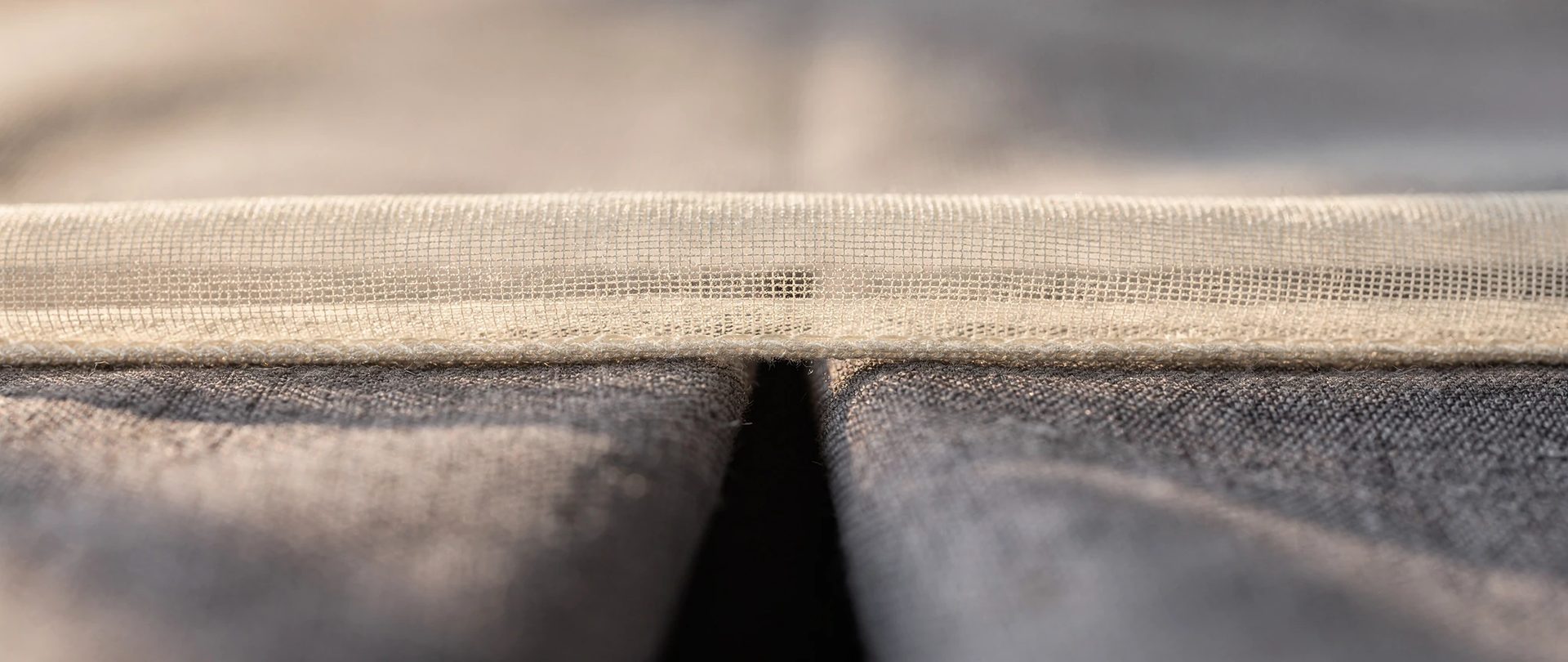
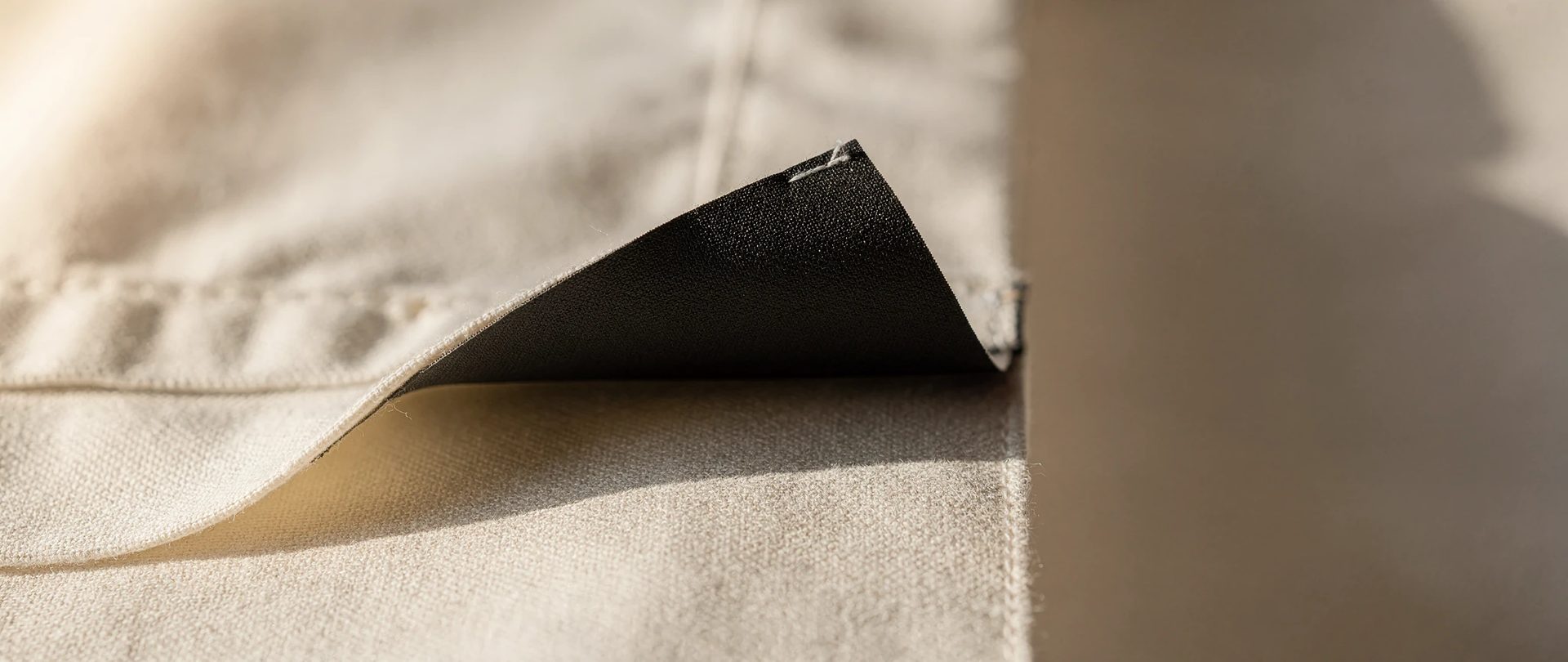
This is the single most effective upgrade. A thermal lining, fabric with an acrylic or aluminized backing, gets added to the back of the main panel. It blocks radiant cold coming off the glass and adds weight, which improves how the curtain hangs and, in turn, how well it seals.
A good thermal lining can reduce heat loss through windows by 25 to 40%. I explain this often, and it still surprises people.
Interlining
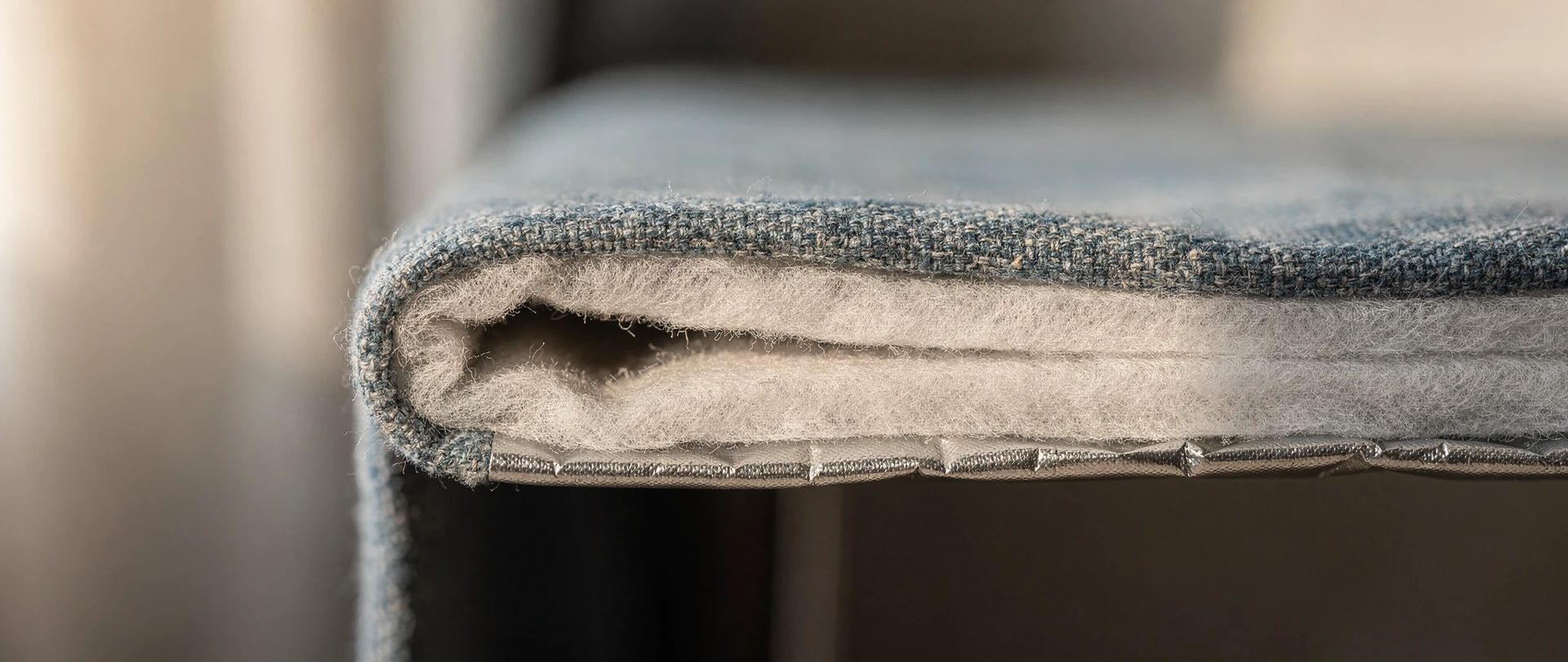
One step further: between the face fabric and the thermal lining, an interliner, a layer of flannel or quilted cotton, gets inserted. The combined effect is a true triple layer. The curtain becomes heavy, opaque, and quiet. It's what high-end hotels do, and it's what I recommend for rooms you can never quite get warm.
I don't recommend it for everything: it adds weight, cost, and bulk, which calls for a face fabric that can carry the extra layer and a sturdier rod to support it. In a room that's already comfortably heated, with a recent window, it doesn't add much over a thermal lining alone. It genuinely changes things in a north-facing bedroom, an older house with older glazing, or a room the furnace never seems to fully reach.
One practical detail I always check: if a heating vent or a baseboard heater sits directly under the window, I stop the curtain just above the sill instead of letting a heavy panel hang in front of the heat source, which would trap warmth behind the fabric instead of letting it into the room.
The two worst offenders in this climate: patio doors and bay windows
Two kinds of openings come up almost every time a client tells me about a room she can't warm up.
The patio door, first: usually the largest glazed surface in the house, often more than two metres wide, with a sliding frame that isn't always sealed as well as a fixed window. The curtain has to cover that whole surface without getting in the way, which means designing the panel so it glides smoothly on whatever track is already there and stacks cleanly to one side. My patio door curtains page goes into the specifics of how that gets built.
The bay window, second: three panes of glass, two interior corners, often several rods. Every joint is a place air can work its way in if the treatment isn't built for the exact shape of the bay, which I cover in my full guide to bay windows in Quebec.
When I tell a client to fix the window instead of ordering curtains
I don't sell curtains as a universal fix, and there are cases where I say so directly.
If you see fog or frost between the two panes of the same sash, the sealed unit has failed. Curtains change nothing about that, and waiting only lets the unit degrade further.
If you run your hand around the frame, right where the window meets the wall, and you feel air actually moving, that's not an air-pocket problem in front of the glass. That's a caulking or weatherstripping job, a much cheaper fix than any curtain.
If the wood at the sill is soft, warped, or visibly rotting, moisture has been getting into the window itself for a while. A curtain, no matter how well made, just adds warmth in front of a problem that keeps getting worse behind the fabric.
I say all three of these plainly, even when it isn't in my short-term interest. It's why clients call me back for the next project.
What fabric to choose for winter
Insulation is invisible, but fabric isn't. The trick is finding something that performs and looks good.
Cotton velvet is still my favourite material for winter living spaces. Dense, warm to the touch, it falls beautifully and absorbs sound along the way.
Heavy linen, 300 g/m² and up, with thermal lining, suits people who want a natural interior. Linen alone doesn't insulate especially well. With a good lining behind it, it performs very effectively.
Jacquard fabrics are often underrated: they have a natural density that holds heat better than flat-woven fabric, without the visual weight of velvet.
What I avoid for cold rooms: sheers, organzas, anything too lightweight on its own. They're beautiful, but they carry no thermal value by themselves. My full fabric guide for custom curtains covers where each material earns its place, and my blackout curtains guide covers the heavier lining that does double duty for both light and heat.
And what about summer?
The same construction that keeps heat in the room in January keeps heat out in July. A sealed air pocket works both directions: it stops radiant cold from the glass reaching the room in winter, and it stops solar heat absorbed by the glass from spreading into the room in summer, thanks to the same reflective lining.
For a window facing south or west, closing a lined curtain during the hottest afternoon hours makes a real difference to how the room feels, especially without air conditioning everywhere. It's a simple habit, and most people only think about their thermal curtains in winter.
There's a cost to closing everything all the time: a room stops breathing and gets stuffy fast. For south- and west-facing windows, I almost always recommend a double layer: a sheer that stays closed to filter daily light, as I describe in my layered bedroom curtains piece, and the lined curtain that closes only during the worst heat or cold.
Constant south or west sun also fades fabric faster, right along the edge that stays exposed when the curtain is open, which is worth flagging at the consultation if that exposure applies to your room.
A real project
In November, I dressed the windows of a living room on Plateau Saint-Joseph, two large bay windows, north-west facing, straight into the wind. The client had new windows and was still getting drafts. When I visited, I checked the frame by hand: nothing was moving at the joint. The problem wasn't the window failing, it was air chilled by the glass sinking down the wall, exactly the kind of draft I described earlier.
We worked with a 280 g/m² natural linen, thermal lining, and a flannel interliner. Pinch pleat, floor length with a 2 cm puddle, width extending 18 cm past the frame on each side.
The result: the perceived temperature near the windows changed noticeably. She wrote to me in early December to say she was no longer cold in her living room, without having touched the windows themselves.
Frequently asked questions
My windows are new. Does a thermal curtain still do anything? Usually, yes. A new window is still a cold surface in winter, and cold radiates regardless of glazing quality. A properly fitted curtain cuts down how much of that you feel in the room.
Can a curtain cause condensation? A curtain pressed flat against the glass can trap room humidity against the coldest part of the window and make fogging worse. That's why I always leave a small air gap between fabric and glass.
What's the difference between thermal lining and interlining? Thermal lining replaces or backs up the standard lining at the rear of the panel. Interlining is an added third layer, between the face fabric and the thermal lining, for rooms where lining alone isn't enough.
Is this worth it if my real problem is summer heat, not winter cold? Yes, it's the same construction working in both directions. If summer is your priority, I'll steer fabric and lining choices accordingly from the first consultation.
If you have windows that breathe cold air, condensation that comes back every morning, or rooms you can't seem to heat properly, it's worth a conversation before next winter. Get in touch for a home consultation in Sherbrooke and across Estrie.